Jeremy McCreary
Bought it anyway
- Region
- USA
- City
- Carlsbad, CA
Bike upgrades seem to be a way of life on EBR. Done anything interesting with the old parts?
Never got over my childhood love of spinning tops. And now that I make my own, always on the lookout for found objects to turn into working tops. LEGO's a good source for any additional parts needed.
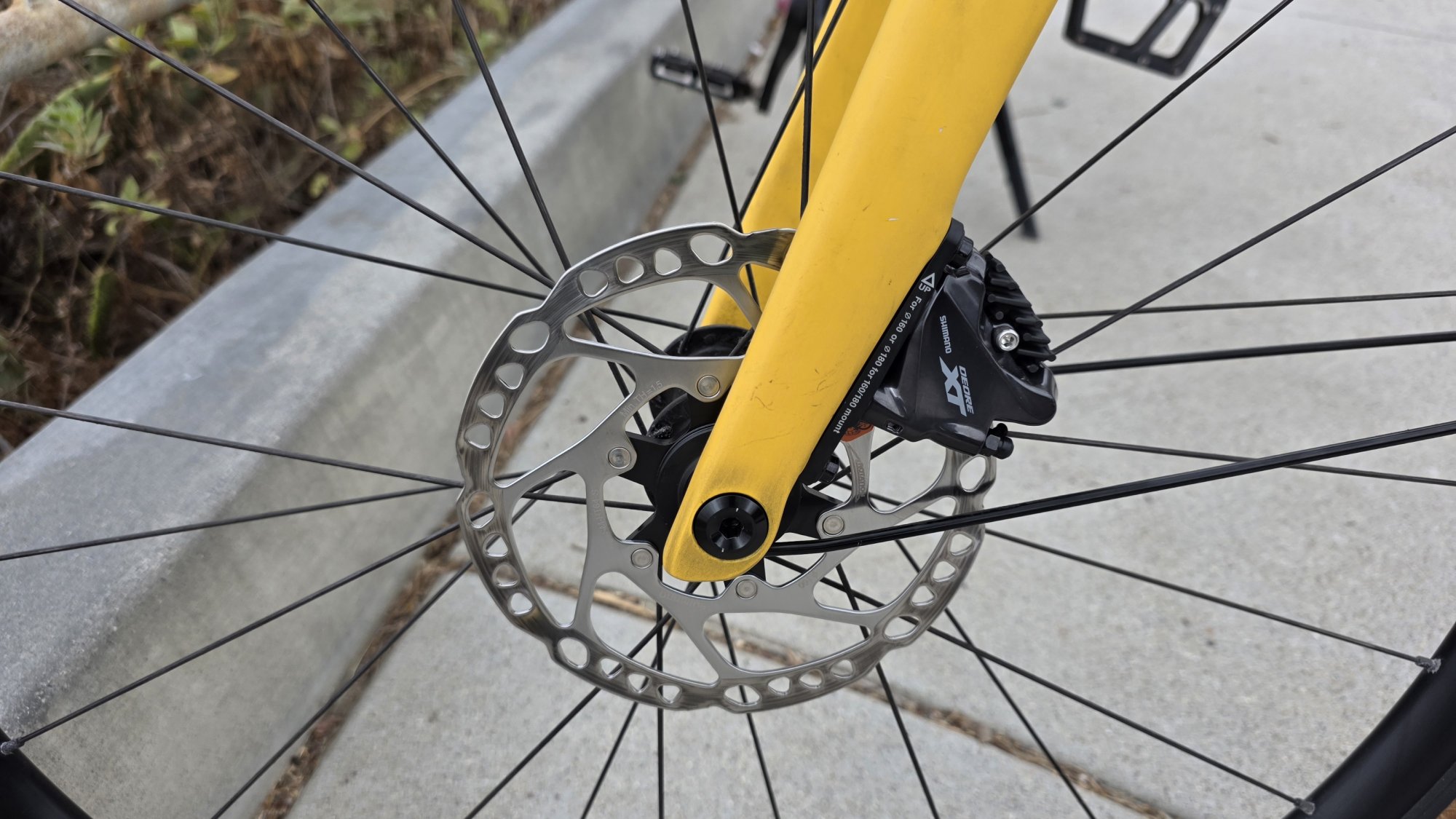
So, when I recently upgraded my Vado SL's stock Tektro disk brakes to these Shimanos, no way the old rotors weren't ending up as tops.
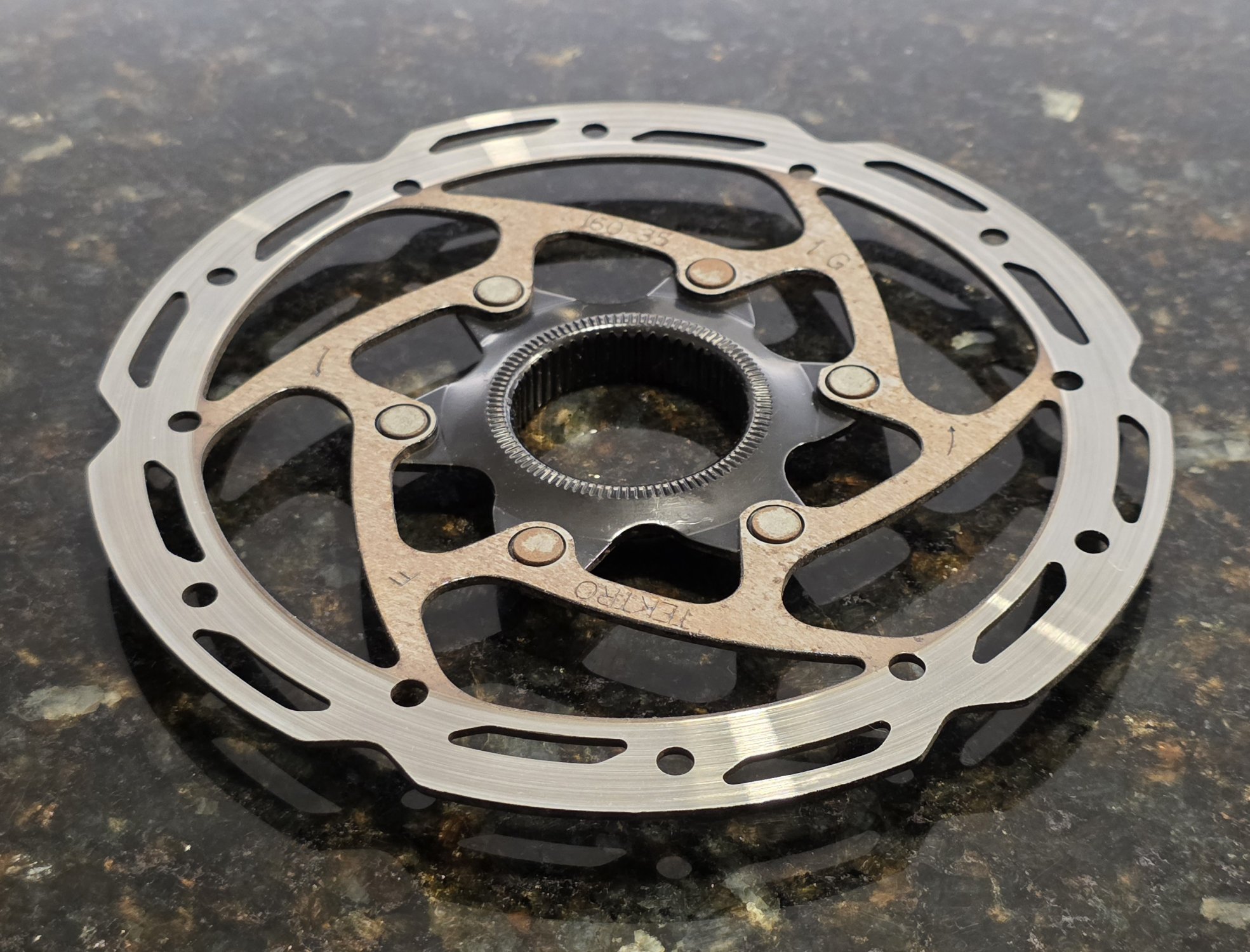
Old 160 mm all-steel rotor. The aerodynamically dirty voids and spokes take their toll on spin time. But this rotor otherwise checks all the boxes for use in a spinning top — perfect rotational symmetry, excellent dynamic balance, high rigidity, high rotational inertia for mass, a center of mass (CM) you can get very low the ground, and secure attachment points for a LEGO adapter.
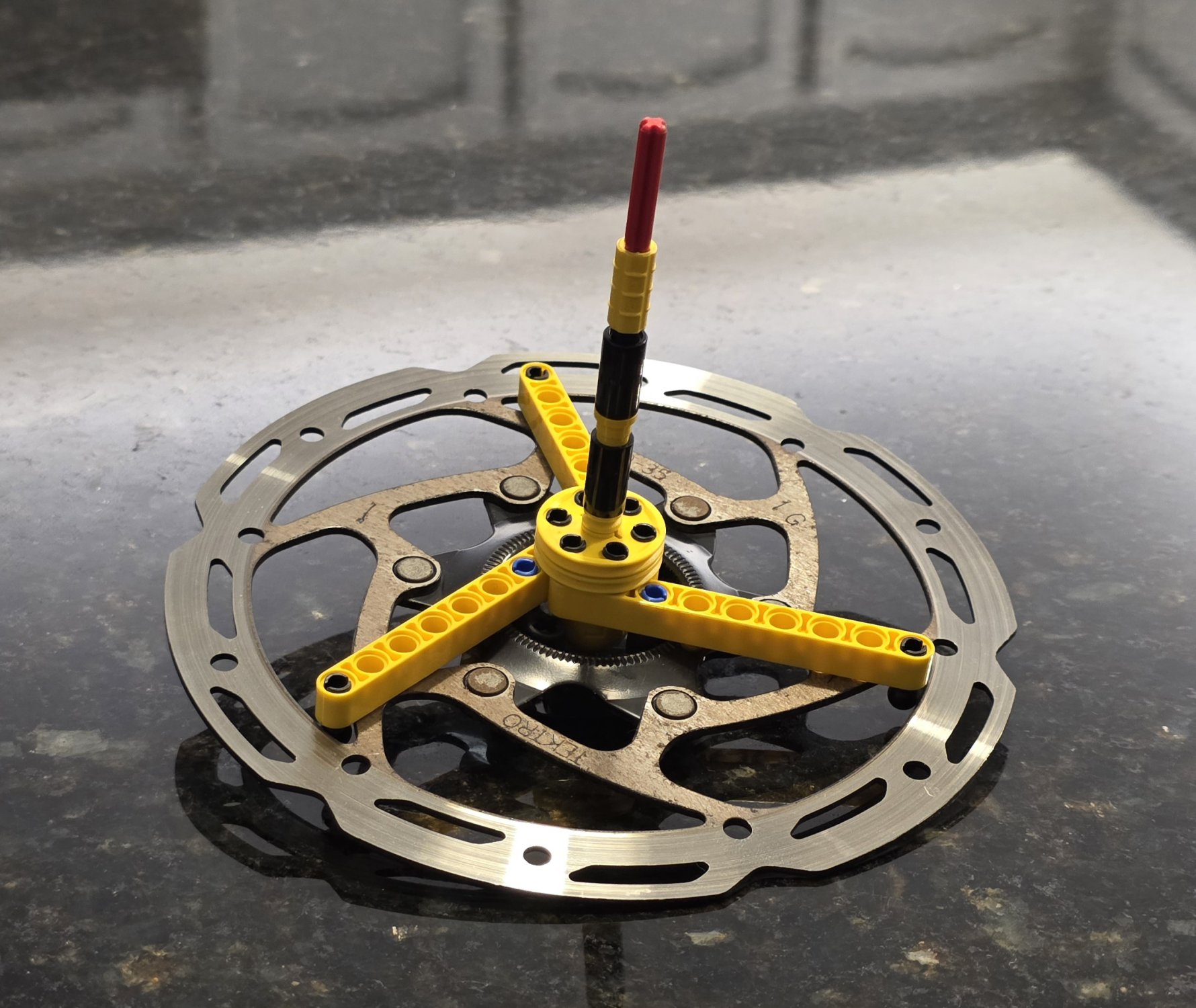
After testing several adapter designs, settled (for now) on this one, which I also made in black. Adapter details below.
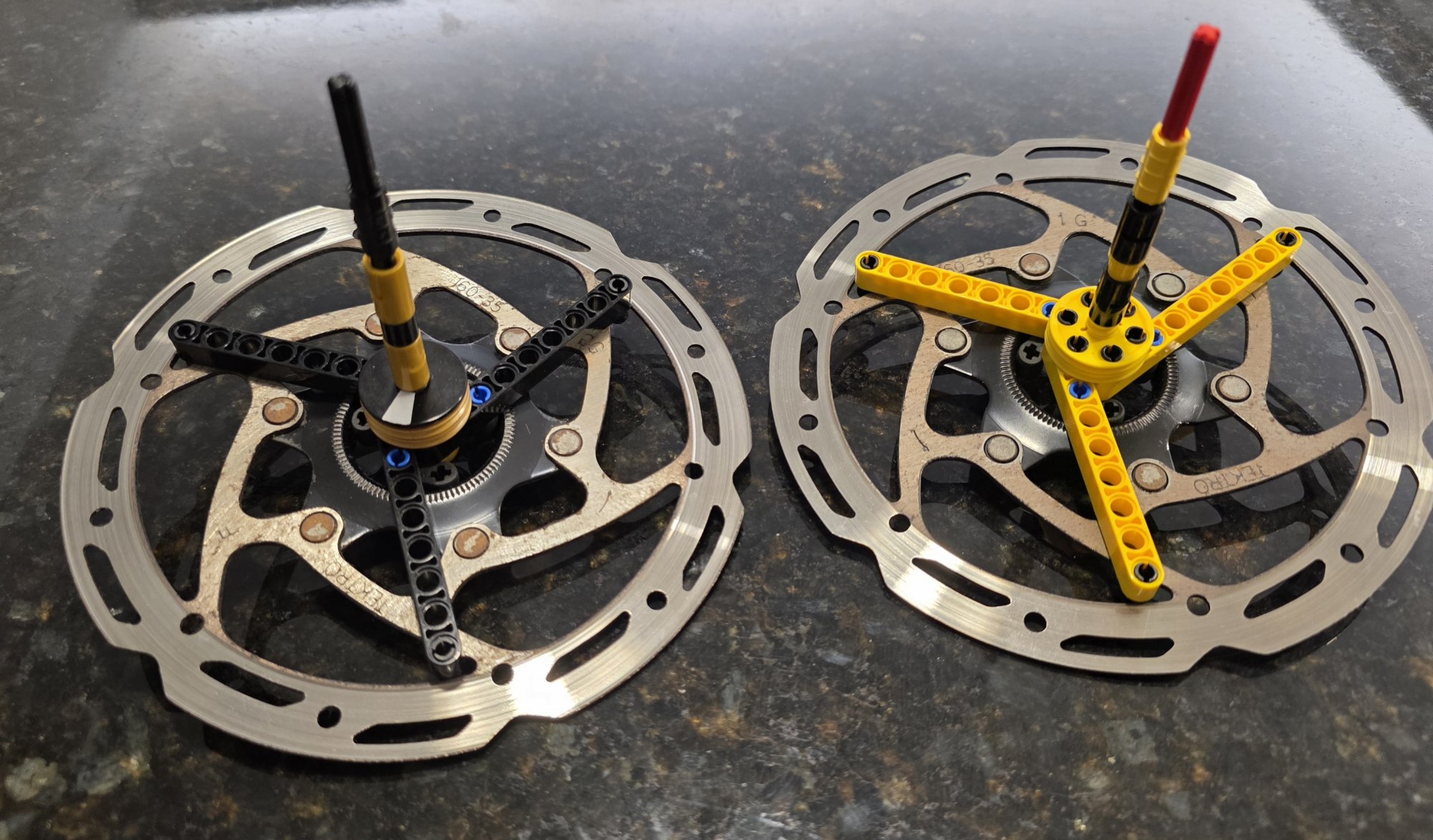
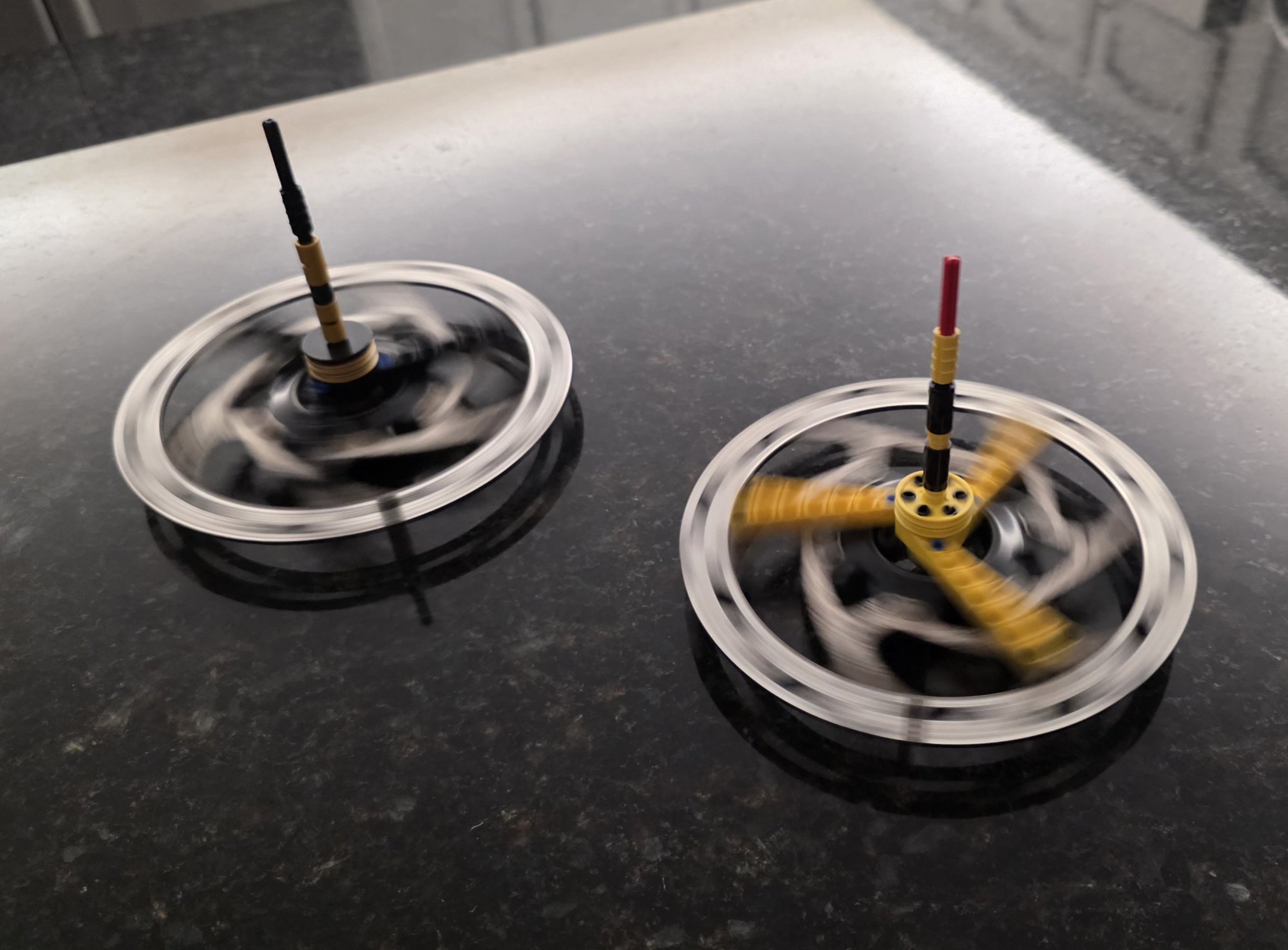
The finished products at rest and at speed. Photos at normal exposures tend to freeze the motion as seen above. In video, you see interesting frame rate and rolling shutter artifacts instead.
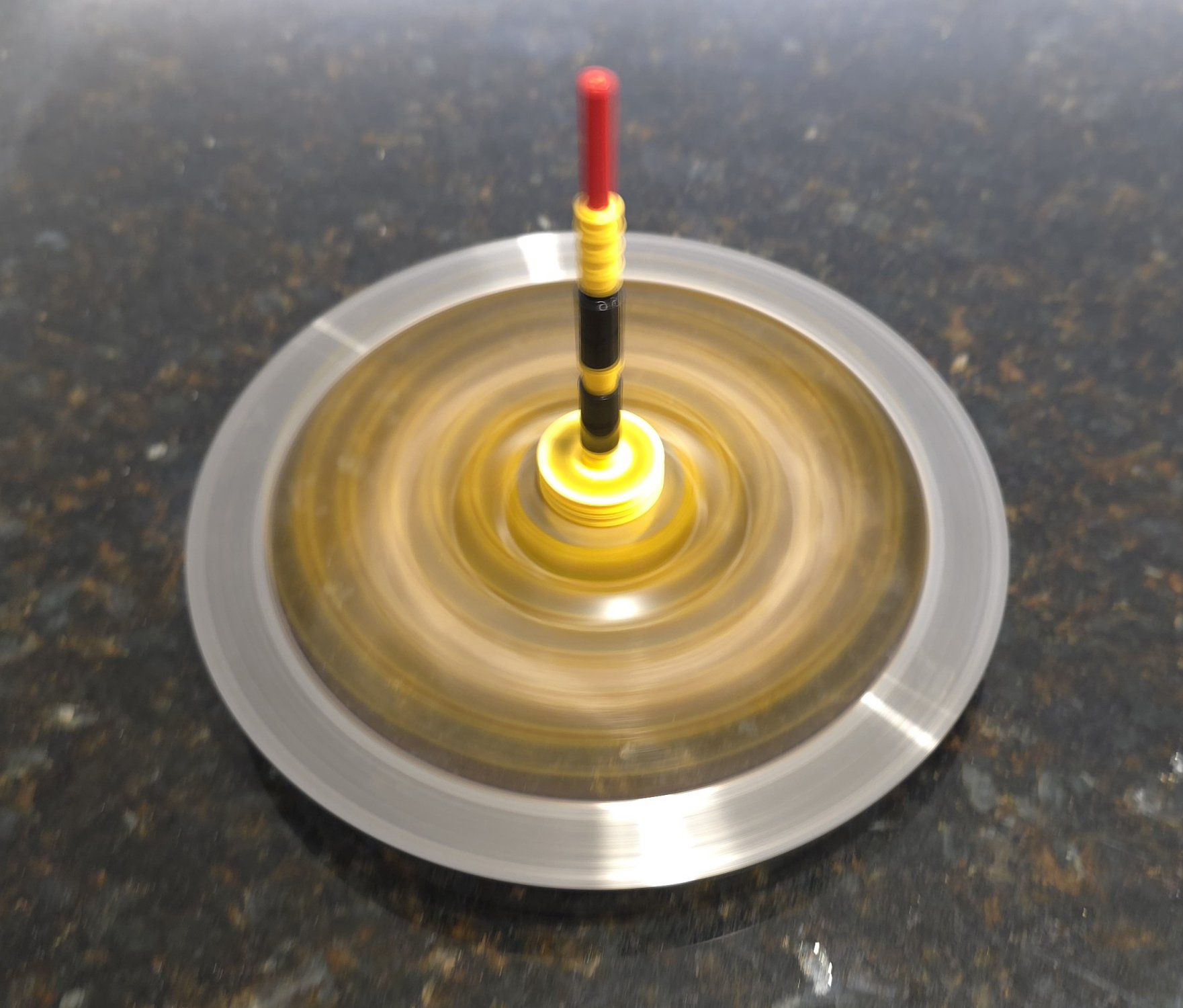
In person and in long-exposure photos like this one, the black and yellow adapters produce significantly different visual effects in motion. The black spokes effectively disappear at speed, while the yellow ones turn the silver spokes to gold. Who said alchemy doesn't work?
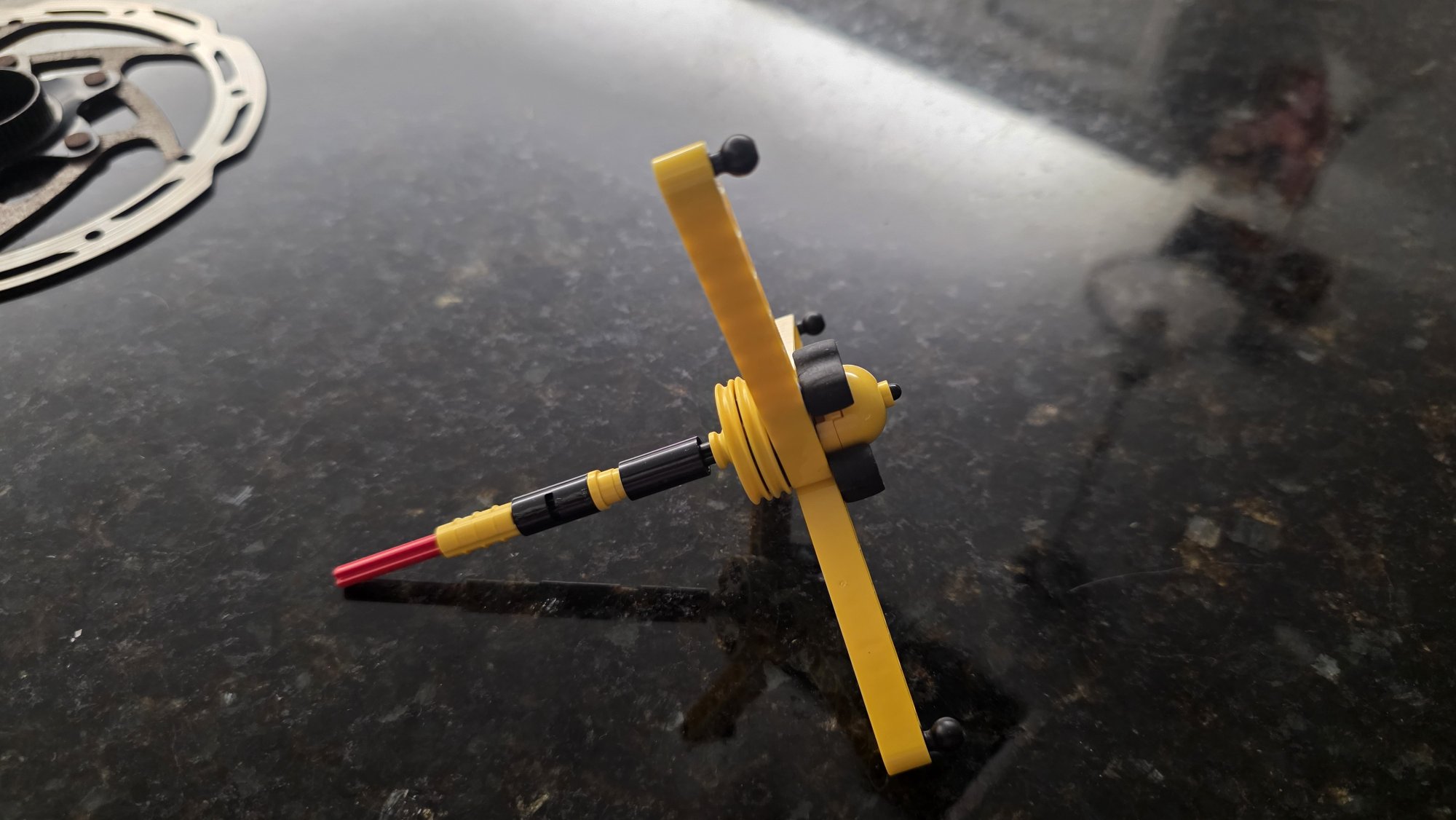
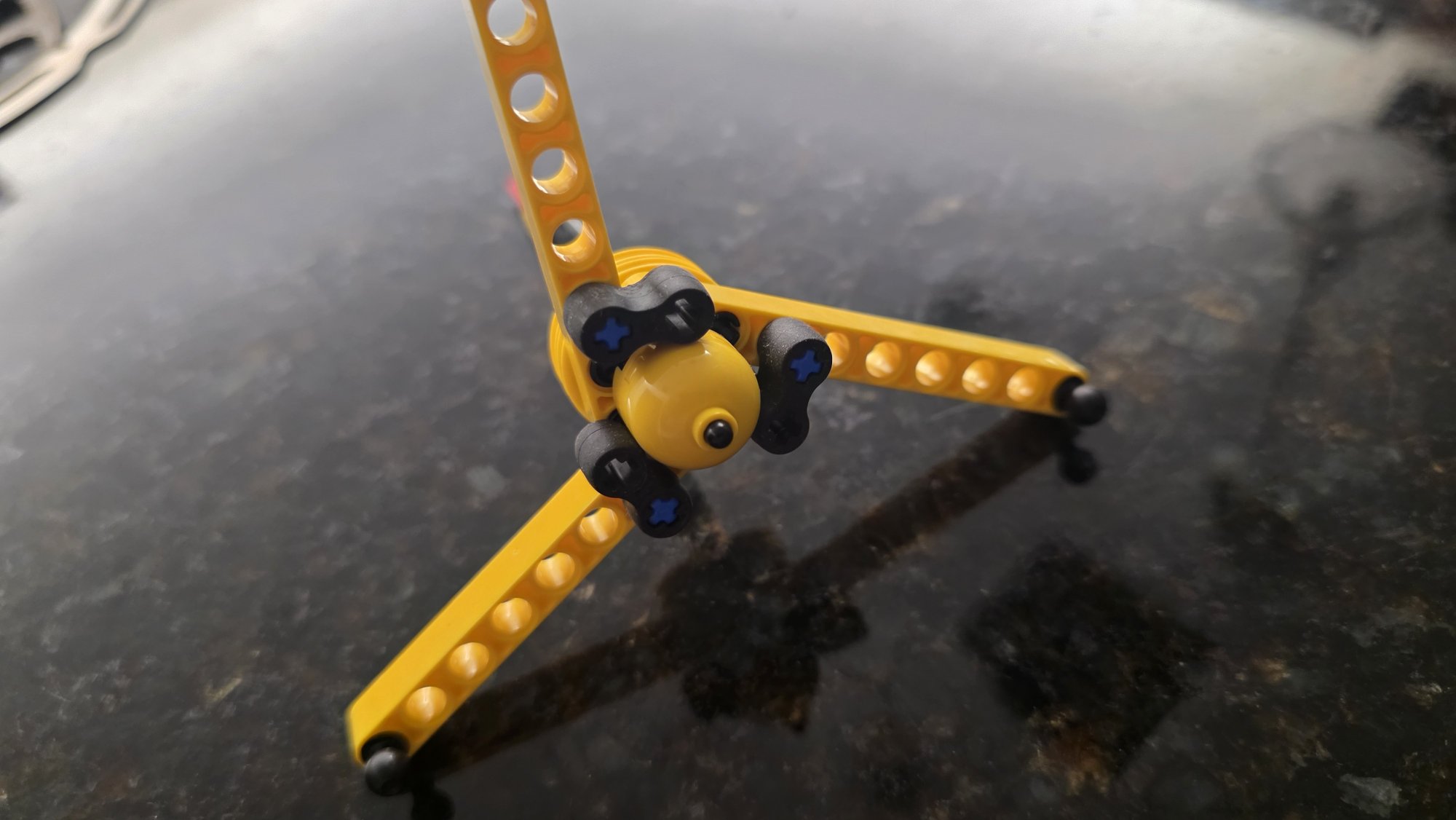
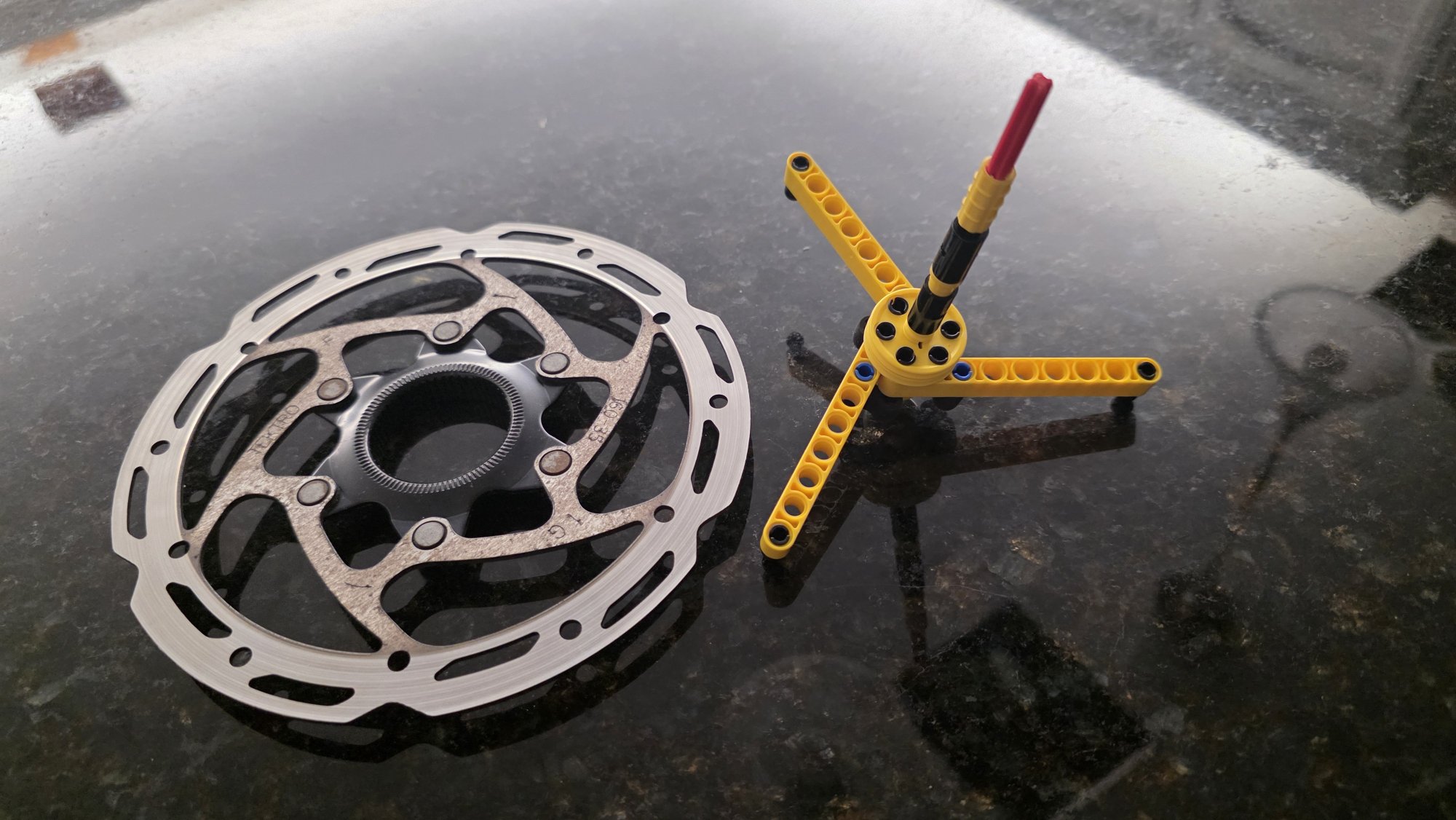
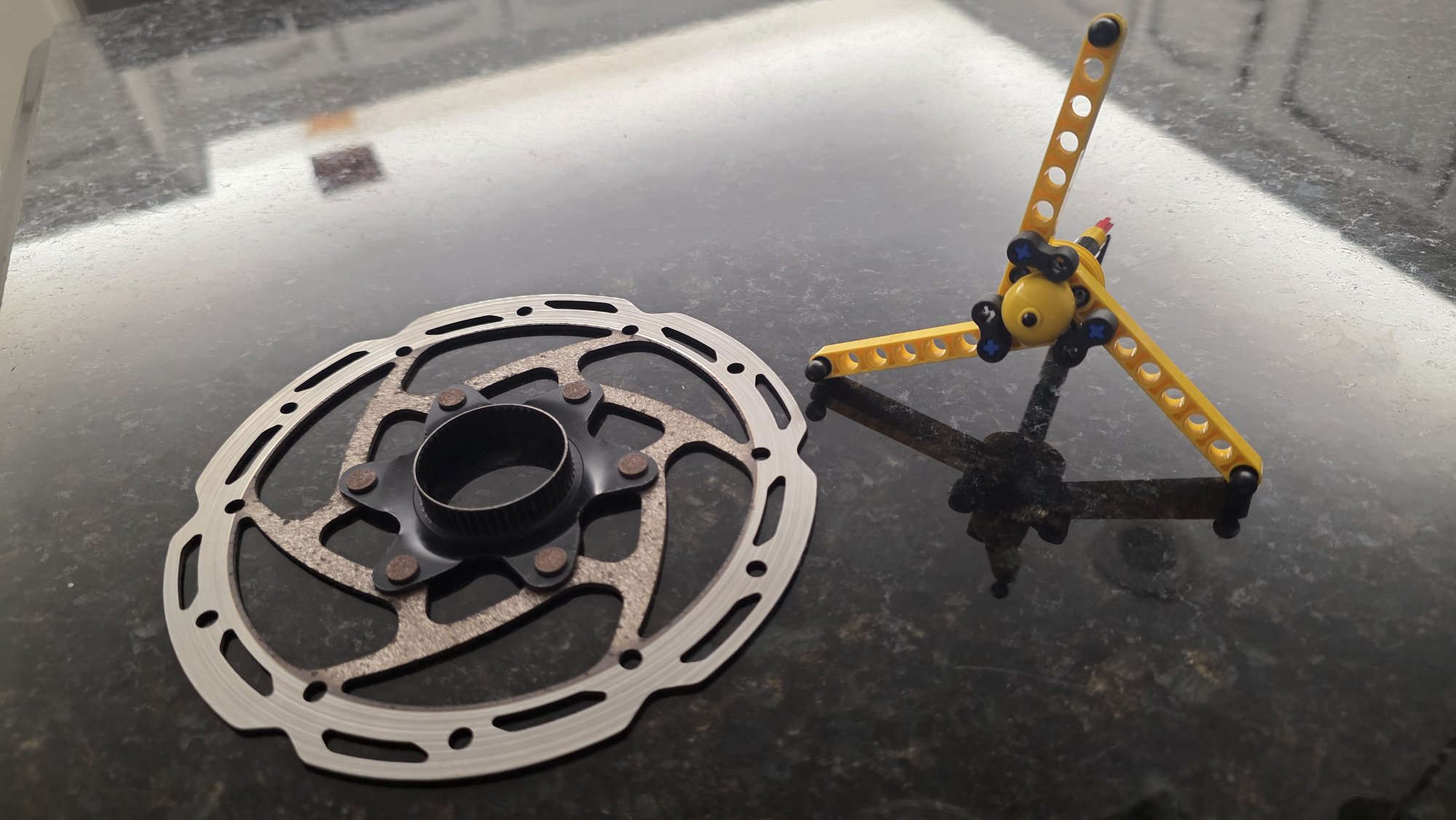
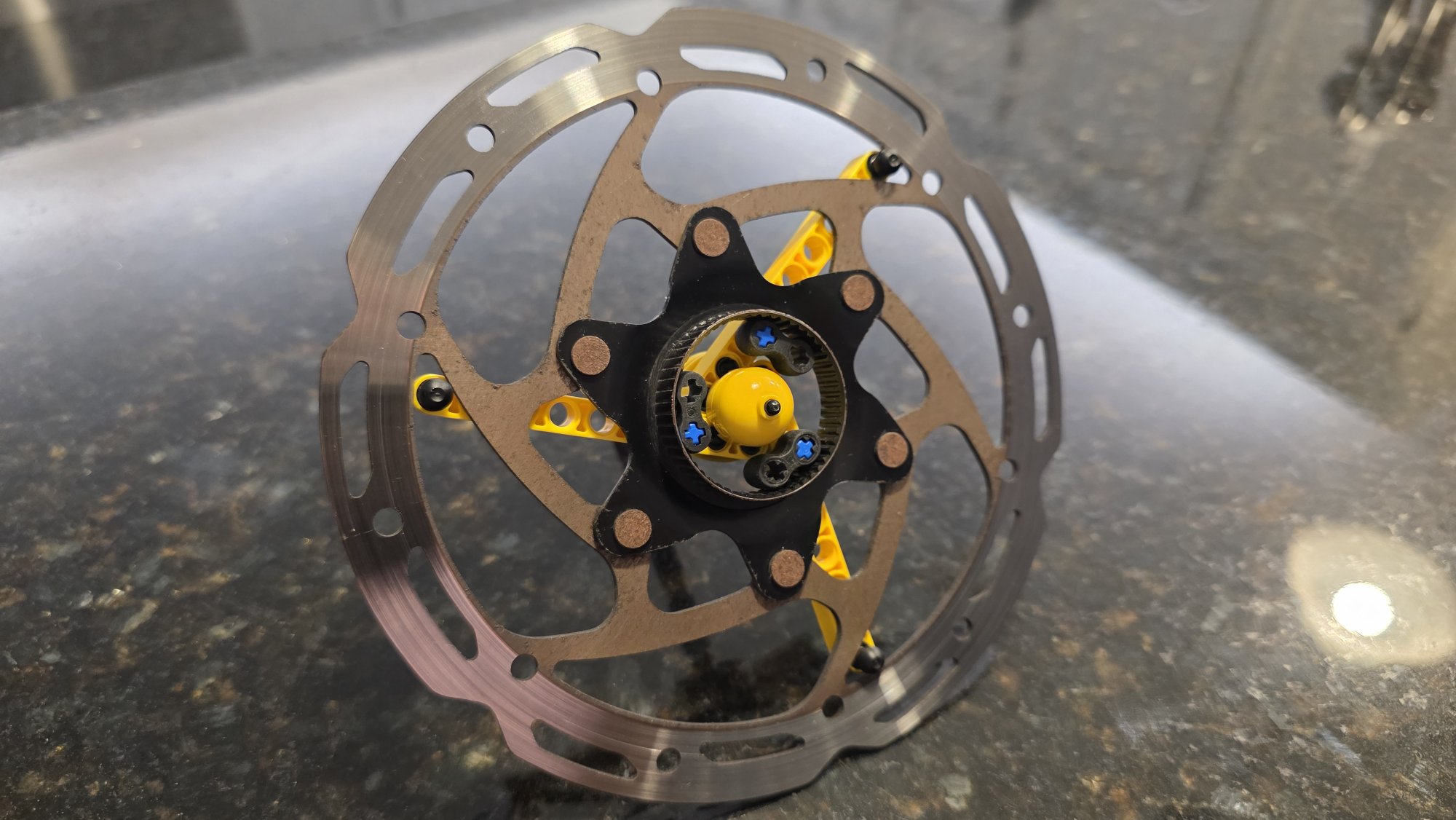
Closer look at the yellow LEGO adapter. The adapter grips the rotor at the center hole and every other spoke. The only modified LEGO part is the tiny black tip, which I cut from the rounded end of a LEGO antenna. Need a better way to keep the rotor and adapter perfectly coaxial.
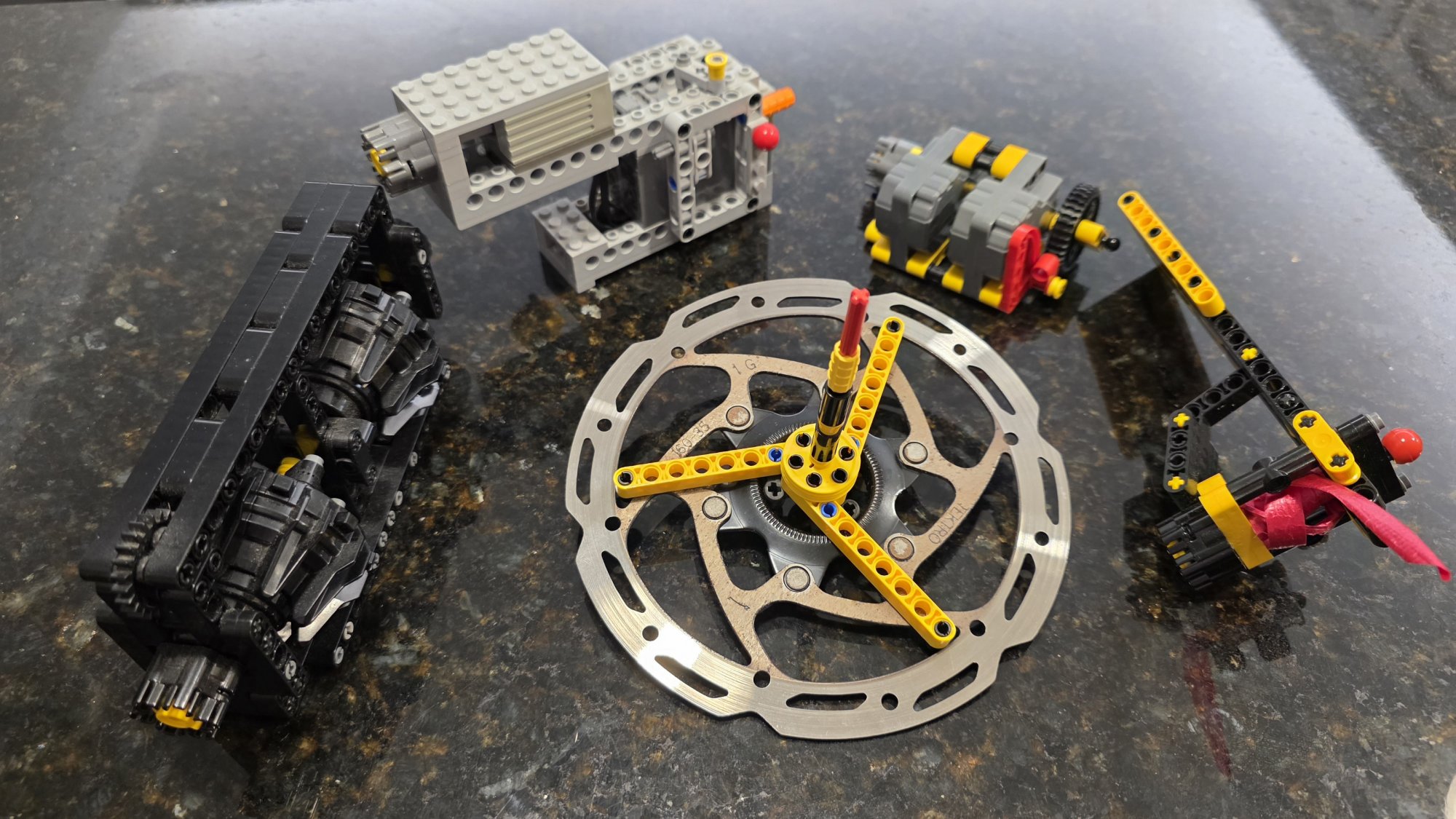
These tops work well with finger twirls, but a top this heavy and low-slung can gain a lot of play value with a suitable starter. These all-LEGO starters reduce wobble and increase spin time by delivering a smoother, higher-speed release with better tilt control.
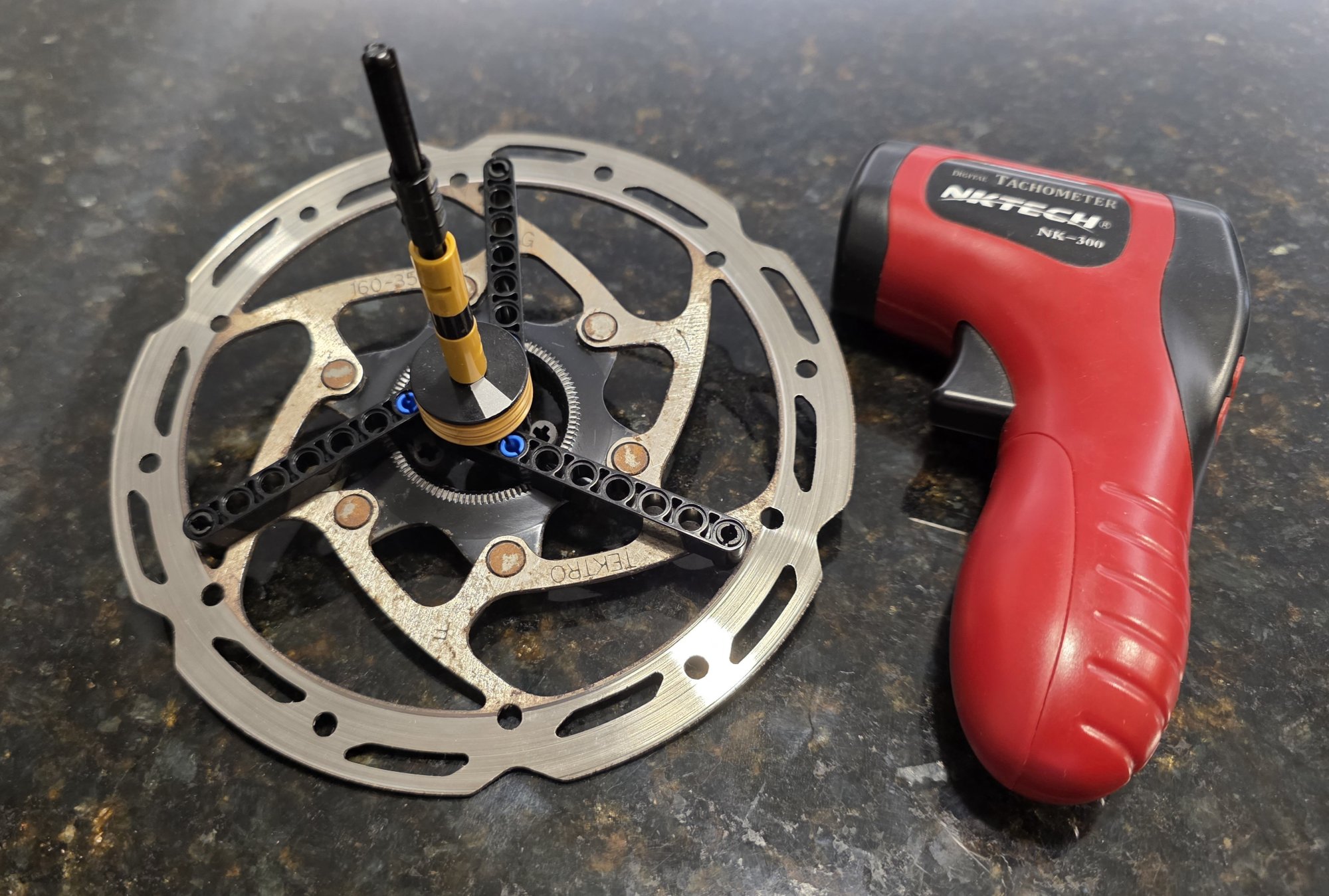
Laser tachometer and black top with timing disk at the base of the stem.
I can spin up these tops to 400 rpm and a 140 sec spin time by hand. From left to right above, the black 2-stage planetary and gray electric starters get them to 800 rpm and 150 sec. The dual-motor wind-up starter gets to 1,000 rpm and 160 sec. And the simple but powerful ribbon-pull starter to 1,200 rpm and 170 sec. Thanks to air resistance, big increases in release speed yield only small gains in spin time.
Top performance
A high-performing finger top has (a) a long spin time for its mass and release speed, and (b) no wobble with a clean release. Spin times are limited mainly by release speed, air resistance, and mass distribution. Tip resistance dominates spin decay only at the lowest speeds. Sound familiar?
The spin times reported above are quite good for a LEGO top with a found rotor. Ditto for the observed wobbles. The black top tends to wobble very slightly at lower spin rates, but some runs don't wobble at all. The yellow top wobbles a bit more.
Hoping to reduce these minor wobbles with further rotor cleaning, LEGO adapter tweaks, and if necessary, some balancing weights.
Never got over my childhood love of spinning tops. And now that I make my own, always on the lookout for found objects to turn into working tops. LEGO's a good source for any additional parts needed.
So, when I recently upgraded my Vado SL's stock Tektro disk brakes to these Shimanos, no way the old rotors weren't ending up as tops.
Old 160 mm all-steel rotor. The aerodynamically dirty voids and spokes take their toll on spin time. But this rotor otherwise checks all the boxes for use in a spinning top — perfect rotational symmetry, excellent dynamic balance, high rigidity, high rotational inertia for mass, a center of mass (CM) you can get very low the ground, and secure attachment points for a LEGO adapter.
After testing several adapter designs, settled (for now) on this one, which I also made in black. Adapter details below.
The finished products at rest and at speed. Photos at normal exposures tend to freeze the motion as seen above. In video, you see interesting frame rate and rolling shutter artifacts instead.
In person and in long-exposure photos like this one, the black and yellow adapters produce significantly different visual effects in motion. The black spokes effectively disappear at speed, while the yellow ones turn the silver spokes to gold. Who said alchemy doesn't work?
Closer look at the yellow LEGO adapter. The adapter grips the rotor at the center hole and every other spoke. The only modified LEGO part is the tiny black tip, which I cut from the rounded end of a LEGO antenna. Need a better way to keep the rotor and adapter perfectly coaxial.
These tops work well with finger twirls, but a top this heavy and low-slung can gain a lot of play value with a suitable starter. These all-LEGO starters reduce wobble and increase spin time by delivering a smoother, higher-speed release with better tilt control.
Laser tachometer and black top with timing disk at the base of the stem.
I can spin up these tops to 400 rpm and a 140 sec spin time by hand. From left to right above, the black 2-stage planetary and gray electric starters get them to 800 rpm and 150 sec. The dual-motor wind-up starter gets to 1,000 rpm and 160 sec. And the simple but powerful ribbon-pull starter to 1,200 rpm and 170 sec. Thanks to air resistance, big increases in release speed yield only small gains in spin time.
Top performance
A high-performing finger top has (a) a long spin time for its mass and release speed, and (b) no wobble with a clean release. Spin times are limited mainly by release speed, air resistance, and mass distribution. Tip resistance dominates spin decay only at the lowest speeds. Sound familiar?
The spin times reported above are quite good for a LEGO top with a found rotor. Ditto for the observed wobbles. The black top tends to wobble very slightly at lower spin rates, but some runs don't wobble at all. The yellow top wobbles a bit more.
Hoping to reduce these minor wobbles with further rotor cleaning, LEGO adapter tweaks, and if necessary, some balancing weights.
Last edited: