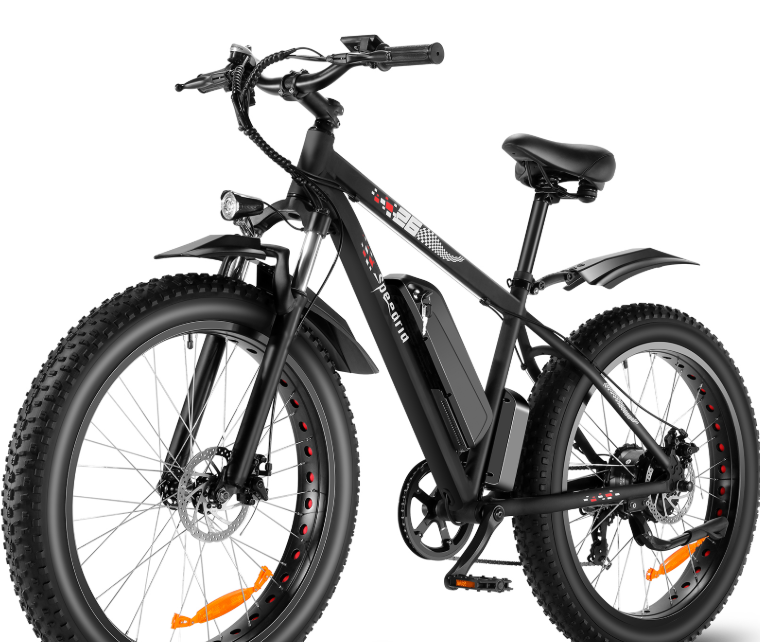
Remove Speedlimit On Ancheer Speedrid Bike

A J

New Member
Region
USA
I have a fattire 26' ebike from ancheer/speedrid and I was hoping there was a way to remove the speed limit without swapping anything. the controller compartment is filled with grey goo and it tops at 22mph when the motor SHOULD be able to do 28mph and the P options menu is missing anything related to speed
MY BIKE DOESNT HAVE THE LITTLE GREY BOX BEHIND THE BATTERY
1777409696863.png
 
Can it do 28mph unloaded (lift the wheel off the ground)? If so, the controller isn't being limited by programming or the kv rating on the motor. The bike just doesn't have enough power to go faster. You should be able to go faster if you get into an aerodynamic position on the bike as wind resistance is the biggest factor slowing you down over 20mph or so.
 
Can it do 28mph unloaded (lift the wheel off the ground)? If so, the controller isn't being limited by programming or the kv rating on the motor. The bike just doesn't have enough power to go faster. You should be able to go faster if you get into an aerodynamic position on the bike as wind resistance is the biggest factor slowing you down over 20mph or so.
No It Cannot the 28mph I mentioned is the theoretical max speed if unlimited
 
What you are claiming does not make sense. In most states, per law, class 1 and class 2 ebikes cannot provide motor assist over 20 mph. Class 3 ebikes cannot provide assist over 28 mph. In most of Europe, the maximum assist is 15.5 mph. In almost all cases, if the bike has a programmed speed limit to the assist, it will be one of those speeds. Not 22 mph. Therefore, it is something else preventing your bike from going over 22 mph. Most likely it doesn't have enough power to overcome the wind resistance after that, but it could be kv rating of the motor (rpm per volt). The power delivered to motor is determined by the controller current regulation, the battery voltage, and the battery C rating. Good luck!
 
The grey box behind the battery held the controller on earlier versions. They probably moved the controller to the battery cradle, where it's potted to prevent tampering.

If you installed a 25A controller in a grey box behind the battery, with a matching handlebar display, I expect you could get 24-25 mph. That's where my 48V hubmotor bikes go on throttle only, Upgrade to 52V for more speed. Not worth the effort and the money it would cost for the parts.
 
In 2022 I bought a Six Three Zero e-bike, advertised as Class 3, 28 mph. On some streets around here, that would be closer to the limit than Class 2. I thought that would be safer.

On a hill, I found that it put 500 watts on the wheel as advertised. However, where I regularly rode, I had to make a sharp turn between a stop sign and a utility pole while climbing 16%. Pedal assistance helps a lot in a situation like that. I discovered that Level 1 gave me 350 watts, or 70% of Level 5. That much acceleration was dangerous. I needed a password to check the controller settings. Contrary to the owner's manual, Customer Service said customers weren't allowed to know the password, and that it was a Class 2 bike, limited to 20 mph.

I intended to modify the bike to improve stability. Because it was unstable, I hadn't been over 15. I tested it. Sure enough, it topped out at 20. I hadn't asked about top speed, but Customer Service had spilled the beans. It was extremely difficult to repack it to ship back.

For many months, I kept checking the description at Amazon and at Six Three Zero's site. It kept saying 28 mph. Six Three Zero's business model was fraudulent advertising and major obstacles in the return process.

Maybe Ancheer/Speedrid has the same business model. I've cooled on Class 3. A bicycle has a short wheelbase and, if the seat is up for pedaling, a high center of mass. On the rough pavement around here, I'd surely be thrown on my face, sooner or later.
 
Just to make it clear: Class 3 is not a promise that a given e-bike would actually hit 28 mph. It is a promise the motor would not be cut off before 28 mph. These are two different things. The Original Poster can select a descent and pedal there; the e-bike will achieve 28 mph and the motor will still be working before hitting that speed. However, it appears that all resistances (especially air drag) would prevent getting at the desired speed on the flat.
 
Back