spokewrench
Well-Known Member
- Region
- USA
In the 80s I heated with wood. Filing teeth left a burr, which wore quickly. Sharpening was imprecise the chain would rock in the bar groove.
I got a Craftsman electric sharpener: a Dremel tool with a stone and guide. A Dremel typically spun at 20-35 thousand rpm. Contact before the stone was perfectly aligned meant damage to the tooth. With each sharpening, teeth became less uniform. Grinding often produced yellow sparks (1000 C) or white sparks (1200 C). Steel can lose its temper at 204 C. That explained why a fine edge quickly lost its keenness. The stone needed pressure because it was clogged with bar oil. More pressure meant higher temperatures.
The situation reminded me of my uncle’s farm in Connecticut and my grandfather’s in North Carolina. Both had bench grinders, but it was their old pedal grinders that they kept close. Before electrical power, some were made with chain drives for speed, but theirs were direct drive, which had always been more popular. At a comfortable cadence, surface speed was maybe 4 mph. What’s more, they had funnels designed to run water on the slowly moving stone. My uncle and my grandfather knew the importance of maintaining temper.
When I bought a chainsaw in 2017, diamond burrs were 4 for $10. Maybe they wouldn’t clog like stones, or they could be cleaned. That might allow me to save edge temper with a light touch. A diamond point vaporizes at 850 C, so a light touch would be important.
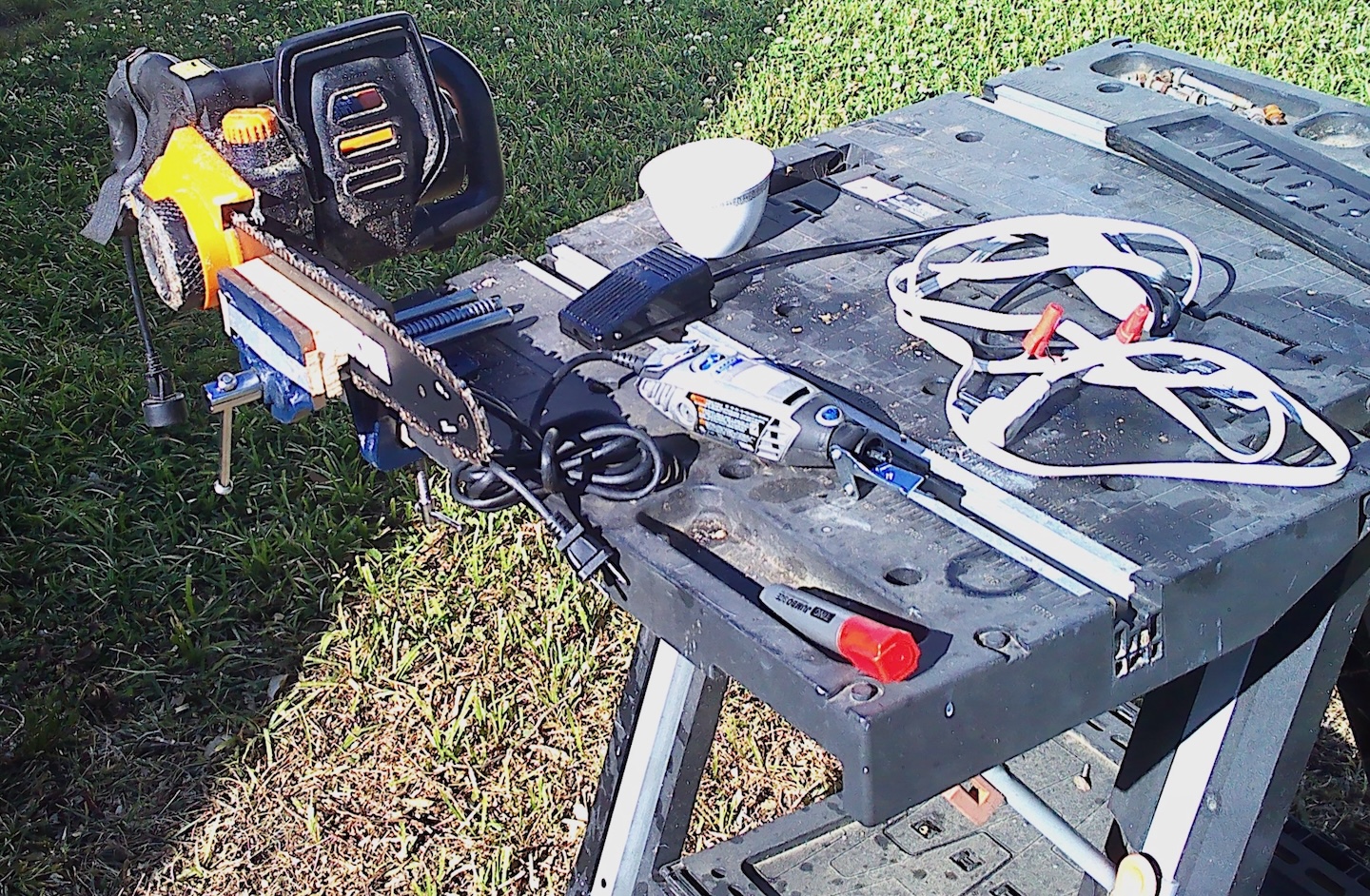
A foot switch would let me spin the burr only after it was properly positioned. I used wire nuts to splice the switch into an extension cord. I tinned the stranded conductors for stiffness, snipped them to the proper length, and screwed the wire nuts down to clamp the wires where they were insulated and not only where they were bare. Those connections have been trouble-free in 9 years of unpacking, use, and repacking. (In the photo, the red marker is to paint a top plate so I'll know when I've been around. The cup holds soapy water to dip my burr. Maybe it will keep it cleaner, and maybe it will keep a tooth a little cooler.)
Sharpened this way, the chain held its edge as well as a new chain. It might have needed only 1 or 2 touch-ups a year if I hadn’t used to to cut stumps flush with the ground. I’d remove all the soil I could with a trowel, rake, and brush, but of course the wood was gritty enough to dull a chain.
Sometimes an accidental bump would produce sparks. In 2022, I bought an adjustable-speed Dremel tool. At a slower speed, I’m sure there’s less risk of taking the temper out of an edge or burning diamonds. I began wearing a magnifying visor over my reading glasses to see precisely what I was doing.
In the past month I’ve sharpened 3 times because I’ve cut several stumps flush. The sharp teeth weren’t very aggressive. I realized that in 9 years I’d never filed the depth gauges. I guess that shows how little metal I’d needed to remove each time I sharpened.
I ordered an Oregon depth gauge tool and flat file. That’s when I realized that the tie straps on my chain are almost as high as the depth gauges. The tool wouldn’t work until I lengthened the slot with the Dremel tool. To get the required .025”, I had to take extra strokes after removing the tool, taking care not to hit the tooth. The steel of some depth gauges was much harder than others.
I never had much trouble with depth gauges in the 80s. Then I discovered that replacement chains cost only 3 for $21. I plan not to mess with depth gauges again. How about you?
I got a Craftsman electric sharpener: a Dremel tool with a stone and guide. A Dremel typically spun at 20-35 thousand rpm. Contact before the stone was perfectly aligned meant damage to the tooth. With each sharpening, teeth became less uniform. Grinding often produced yellow sparks (1000 C) or white sparks (1200 C). Steel can lose its temper at 204 C. That explained why a fine edge quickly lost its keenness. The stone needed pressure because it was clogged with bar oil. More pressure meant higher temperatures.
The situation reminded me of my uncle’s farm in Connecticut and my grandfather’s in North Carolina. Both had bench grinders, but it was their old pedal grinders that they kept close. Before electrical power, some were made with chain drives for speed, but theirs were direct drive, which had always been more popular. At a comfortable cadence, surface speed was maybe 4 mph. What’s more, they had funnels designed to run water on the slowly moving stone. My uncle and my grandfather knew the importance of maintaining temper.
When I bought a chainsaw in 2017, diamond burrs were 4 for $10. Maybe they wouldn’t clog like stones, or they could be cleaned. That might allow me to save edge temper with a light touch. A diamond point vaporizes at 850 C, so a light touch would be important.
A foot switch would let me spin the burr only after it was properly positioned. I used wire nuts to splice the switch into an extension cord. I tinned the stranded conductors for stiffness, snipped them to the proper length, and screwed the wire nuts down to clamp the wires where they were insulated and not only where they were bare. Those connections have been trouble-free in 9 years of unpacking, use, and repacking. (In the photo, the red marker is to paint a top plate so I'll know when I've been around. The cup holds soapy water to dip my burr. Maybe it will keep it cleaner, and maybe it will keep a tooth a little cooler.)
Sharpened this way, the chain held its edge as well as a new chain. It might have needed only 1 or 2 touch-ups a year if I hadn’t used to to cut stumps flush with the ground. I’d remove all the soil I could with a trowel, rake, and brush, but of course the wood was gritty enough to dull a chain.
Sometimes an accidental bump would produce sparks. In 2022, I bought an adjustable-speed Dremel tool. At a slower speed, I’m sure there’s less risk of taking the temper out of an edge or burning diamonds. I began wearing a magnifying visor over my reading glasses to see precisely what I was doing.
In the past month I’ve sharpened 3 times because I’ve cut several stumps flush. The sharp teeth weren’t very aggressive. I realized that in 9 years I’d never filed the depth gauges. I guess that shows how little metal I’d needed to remove each time I sharpened.
I ordered an Oregon depth gauge tool and flat file. That’s when I realized that the tie straps on my chain are almost as high as the depth gauges. The tool wouldn’t work until I lengthened the slot with the Dremel tool. To get the required .025”, I had to take extra strokes after removing the tool, taking care not to hit the tooth. The steel of some depth gauges was much harder than others.
I never had much trouble with depth gauges in the 80s. Then I discovered that replacement chains cost only 3 for $21. I plan not to mess with depth gauges again. How about you?