Remember Highway 61 Revisited?

spokewrench

Well-Known Member
Region
USA
1965: God said to Abraham, "Kill me a son."

Remember the siren? I just bought two! They're marketed as freezer alarms. If an electrical receptacle goes dead, a 9V battery sounds the siren.

Brewing coffee one cup at a time was a dead giveaway that I'm a snob, so I switched to instant years ago. I bought a thousand-watt digital tea kettle. It's designed to heat water to boiling, then register its temperature as it cools. Water doesn't have to boil for instant coffee, but there was no meaningful temperature reading until it boiled. It would take 40 Wh to heat water for 8oz of coffee. That's almost what my refrigerator uses per hour. If I wanted several cups during a power failure, that could mean a lot of battery drain.

An immersion heater can heat a cup of water to 145 F for 15 Wh. That's 3 minutes with a 300 W unit. They tell you to watch an immersion heater while it's in use, but that's not foolproof. I use a digital countdown switch such as I use to charge my bike battery and my smart phone.

Hot water in an open cup can cool fast through radiation, evaporation, and conduction. That's where the freezer alarm comes in. The countdown switch has two outlets. One is for the alarm, stuck to a board behind the counter. I put 8oz of water in a ceramic mug, put the heater in, switch on the alarm so I know it works, and shut it off by 3 presses on the minute switch on the timer. That siren was so loud that I taped over the "speaker." It's still loud. I know immediately when the water is ready. I switch off the alarm, stow the heater in a ceramic mug at the back of the counter, and make hot coffee.

I wanted to be able to make coffee efficiently in a power failure, but look at the counter space I've saved, and now I know as soon as my water is hot.


Last edited:

1780309382854.png

Not sure what you guys use in America but this is what we commonly use in Europe. The electric kettle shows the current temperature of water from the current state to the final set temperature degree by degree (the set temperature can be 40 or 70 or 80 or 90 or 100 C: (The top button is for any of the four settings, the bottom one is for 100 C). The kettle can also keep the set temperature (except 100 C) for 30 minutes.

You boil as much or as little water as you need...
 
My Keurig K-2550 commercial coffee maker is plumbed into filtered water and brews 16 Oz right into my travel mug. My wife likes a darker roast and a ceramic cup. She makes several smaller cups throughout the day.
 
Can yours stop at 60C? Heating only as much as I need saves nearly 2/3. That's what I was after, in the event of a power failure.

This is what I've been using for 3 years.

Heat distribution is so slow that if I want approximately 150 F, I watch intently and shut it off when it reads 100. It's not a good system, and it takes up a lot of counter space. My hardware lets me program the heat rise I want and alerts me when it's ready.
 
Unless I can get my wife to stop using the electric space heater, running the coffee maker for a few minutes isn't going to make much difference in my electric bill.
 
Mr Coffee. Make 4 cups every morning, Some days, I forget to drink any.

How about Dylan's Motor Psycho Nightnare

"Well, he threw a Reader's Digest
At my head and I did run,
I did a somersault
As I seen him get his gun
And crashed through the window
At a hundred miles an hour,
And landed fully blast
In his garden flowers
".
 
Last edited:
Unless I can get my wife to stop using the electric space heater, running the coffee maker for a few minutes isn't going to make much difference in my electric bill.
The energy difference per cup would be a fraction of a penny on a power bill, but it would make a difference on emergency power.

Ice storms can cause power failures. At those temperatures, my gas furnace would need to provide 12,000 btu per hour, on a 15% duty cycle. With space heaters, that would be 3500 W. My generator would burn 14 gallons of gas a day to produce that. My gas furnace needs 600 W, mostly for the blower. Before winter, I want to change the service shutoff from a light switch to a receptacle and plug. Then, in the event of a power failure, I can power the furnace from a LiFePO4 power station 1/40th of the electricity space heaters would use.
 
The energy difference per cup would be a fraction of a penny on a power bill, but it would make a difference on emergency power.

Ice storms can cause power failures. At those temperatures, my gas furnace would need to provide 12,000 btu per hour, on a 15% duty cycle. With space heaters, that would be 3500 W. My generator would burn 14 gallons of gas a day to produce that. My gas furnace needs 600 W, mostly for the blower. Before winter, I want to change the service shutoff from a light switch to a receptacle and plug. Then, in the event of a power failure, I can power the furnace from a LiFePO4 power station 1/40th of the electricity space heaters would use.
My gas heater heats the house just fine and does it a lot cheaper than the space heater. My wife isn't one to consider that logic though. I have a home standby generator, which runs on natural gas. The autoswitch takes about 45 seconds to fire up the generator and switch over. I have UPSes on all electronics I care about that will power the equipment for about 30 minutes, but the coffee maker just has a surge protector. The UPSes just have old fashioned SLA batteries that costs me around $100 each to replace every four years or so. Maybe I will upgrade them to LifePO4 someday, but I have other higher priority projects around the house right now.
 
Abe said, "Man, you must be putting me on!"

When the power goes out I just use my gas stove, which requires no power. Before that, when we had an electric stove, I'd just pull out one of my camping stoves. And a pourover Melitta cone filter, I won't stoop to instant coffee, tastes like crap.

No central furnace, our house is heated with direct vent LP heaters which also need no power.
 
Last edited:
With space heaters, that would be 3500 W. My generator would burn 14 gallons of gas a day to produce that. My gas furnace needs 600 W, mostly for the blower.
When the power goes out I just use my gas stove, which requires no power.

@spokewrench
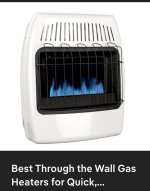
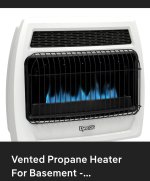
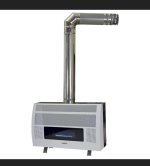
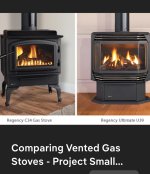
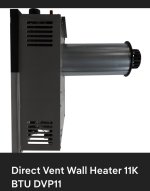
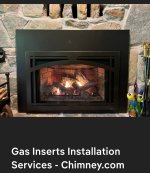
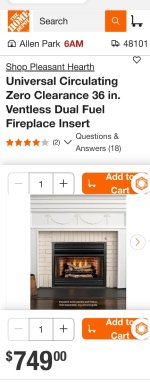
Get yourself a through the wall direct vent gas wall heater.

No electricity. (except maybe a battery to run the thermostat)

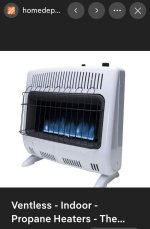
They also have propane versions including a small ventless version. (like a catalytic camping heater)
 

Attachments

  • Screenshot_20260601_164420_DuckDuckGo.jpg
    Screenshot_20260601_164420_DuckDuckGo.jpg
    137.7 KB · Views: 1
  • Screenshot_20260601_162455_DuckDuckGo.jpg
    Screenshot_20260601_162455_DuckDuckGo.jpg
    203.6 KB · Views: 1
  • Screenshot_20260601_162238_DuckDuckGo.jpg
    Screenshot_20260601_162238_DuckDuckGo.jpg
    124 KB · Views: 1
  • Screenshot_20260601_162205_DuckDuckGo.jpg
    Screenshot_20260601_162205_DuckDuckGo.jpg
    207.7 KB · Views: 1
  • Screenshot_20260601_163943_DuckDuckGo.jpg
    Screenshot_20260601_163943_DuckDuckGo.jpg
    162.3 KB · Views: 1
  • Screenshot_20260601_162018_DuckDuckGo.jpg
    Screenshot_20260601_162018_DuckDuckGo.jpg
    107.2 KB · Views: 1
Last edited:
Get yourself a through the wall direct vent gas wall heater.

No electricity. (except maybe a battery to run the thermostat)

They also have propane versions including a small ventless version. (like a catalytic camping heater)
My direct vent heaters are propane (LP). I would not install a ventless heater in my house (fumes and moisture).
 
Back