Failed cadence sensor

This is my C1 setting on my KT display.
It goes from 0-7


There's no reason why a KT V12 cadence sensor won't work with a KT controller.
(unless it's some kind of proprietary controller using KT programming and it's locked or something?)
By "missed shifts," I mean when I pushed the button to change PAS power, sometimes the controller and display wouldn't change. I used PAS and continued to use it with the KT. However, for the last 30 months, it has been my spare bike, ridden a few times a year to be sure it was in working order. In the last week or so, when it became my go-to bike, I noticed the problem immediately. One of the magnets is dead. It's supposed to take a high temperature to kill a magnet like that, but the polyethylene holder is undamaged.

The generic replacement works fine, but because I don't have a gearshift, it's dead if my speed falls below 8 mph.

I can get a hundred magnets that look right for $5, but I figured first I should pry the dead one out to measure with a caliper. I pried with a 1mm flat blade screwdriver, but it wouldn't budge.

The P14L was made for cruisers. That explains it. Cruiser e-bikes are often single speed, and a single-speed cruiser may need power at a low cadence.


The Magnum Low Rider has gears but came with the P14L. My dream bike! Look how far back the seat is! Look at the trail! I estimate 15 cm. Users who have owned others love this one because it can be repaired with generic parts.Then I read that the seat can't be raised above 29". From the ground?

Wait a minute. In the photo, the saddle seems to be 8" higher than the 26" tire. That's 34". Is this my dream bike?

I tried to buy a P14L for $6 from discountbikeshop.com, but I think they're out of business. Magnum wants $50. I might get it for $30 plus shipping on ebay, but maybe I don't need PAS below 8 mph. Maybe I don't need it at all.

I did change the throttle setting, C5, on the KT. I had it on 10, full power. Now that I've been away from the bike, too much torque at a stop seems dangerous. I changed to 2, one level slow start, then full power.
 
Last edited:

I'm just guessing, but what about removing half the magnets from your V12 cadence sensor?

You won't be able to get seven semetrically spaced magnets, but maybe 6 will work?

Or remove just one magnet from your V12 and put it in your original cadence sensor?

You've already got the V12 sensor anyway.

You might also be able to remagnetise the dead magnet, but I think you'll need a flux capacitor to do that?😁

(I still can't wrap my head around why a seven magnet sensor works, and the twelve magnet doesn't?
I'da thought 12 magnets would trick the controller into thinking that you're pedaling faster and allow you to go slower using PAS?)
 
Last edited:
You're probably not using enough silicone grease 🙃
Or maybe your valve core is loose 🙃🙃
Fun fact: You know I put silicone grease on my valve cores to keep the tire sealant from fouling them...
dance1.gif


ckPS5z.gif
 
Last edited:
I assume the pulses must pass through a capacitor in the controller. The capacitor would pass each rising and each falling pulse edge as a spike, a positive spike for rising and a negative one for falling. The voltage of a spike will depend on the steepness of the rise or fall. If the magnets are passing the transistor faster, it will produce pulses with steeper rises and falls. When the speed passes a threshold, the spikes will have the magnitude to turn on PAS power.

A higher transistor gain will also produce steeper rises and falls. I think that's why at only 10 RPM the P14L will produce the steep rises and falls that make spikes strong enough to get PAS help.

I can't fix the P14L unless I am able to pry the dead magnet out. The new sensor looks harder to take apart, but I should be able to buy a box of suitable magnets.

What I really should buy is that Lo Rider 2.0. It has a gearshift, so who will need PAS below 33 rpm? I'll swap sensors!
 
Fun fact: You know I put silicone grease on my valve cores to keep the tire sealant from fouling them...View attachment 211310


I found out from @PedalUma that a valve core doesn't necessarily seal shut.
It can also get jammed open an create a slow leak.

I was aware of the issue, so when my compressor didn't want to pump any air into the tire, I knew what was wrong and had the valve core removed, cleaned and replaced in less than ten minutes, but I can't remember if I greased it??

Maybe I'll grease it now just to be sure?
Maybe Slickoleum would work even better?
Or maybe Anti-seize?

Maybe a bit of each, to get the best of all three worlds. 😁


PS,.. the best way to test for a leaky valve is to put a little Gob of spit over the top of the valve.
It works better than soapy water, and is always readily available. 😁
 
Last edited:
I found out from @PedalUma that a valve core doesn't necessarily seal shut.
It can also get jammed open an create a slow leak.

I was aware of the issue, so when my compressor didn't want to pump any air into the tire, I knew what was wrong and had the valve core removed, cleaned and replaced in less than ten minutes, but I can't remember if I greased it??

Maybe I'll grease now just to be sure?
Maybe Slickoleum would work even better?
Or maybe Anti-seize?

Maybe a bit of each, to get the best of all three worlds. 😁


PS,.. the best way to test for a leaky valve is to put a little Gob of spit over the top of the valve.
It works better than soapy water, and is always readily available. 😁
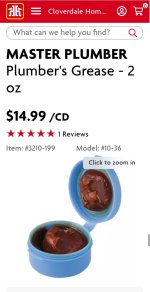
Plumber's O-ring silicone. It lasts in kitchen faucets for ten-years. Nothing sticks to it. See the chicks with
1781230950319.png
videos promoting women moving into management from doing things such as assembling bikes.
 
The voltage of a spike will depend on the steepness of the rise or fall. If the magnets are passing the transistor faster, it will produce pulses with steeper rises and falls.

I'm almost positive that a KT controller is only looking for the pulse.

The waveform shown in the manual is a square wave.

The amplitude of the pulse only has to be enough to be noticed by the sensor.


The faster cadence speed getting the weak magnet to activate makes sense to me, but I'm pretty sure that controller is just counting the pulses, not measuring rise time.
 
I'm almost positive that a KT controller is only looking for the pulse.

The waveform shown in the manual is a square wave.

The amplitude of the pulse only has to be enough to be noticed by the sensor.


The faster cadence speed getting the weak magnet to activate makes sense to me, but I'm pretty sure that controller is just counting the pulses, not measuring rise time.
Yes, the sensor sends pulses to the controller connector. But if the sensor happened to have a magnet close to the transistor when the controller was turned on, the bike would immediately take off with no pedal movement. I think the controller must pass the signal through a capacitor, to convert pulses to spikes with amplitudes corresponding to the speed of rotation.
 
Plumber's O-ring silicone. It lasts in kitchen faucets for ten-years. Nothing sticks to it.

Yeah that s*it's expensive.
You don't need much but still.

I just use silicone dielectric grease.

Interestingly silicone grease can dissolve silicone in the same way that petroleum based lubricants can dissolve petroleum based rubber.

The best rubber to use is urethane. You can lube it with anything slippery. 😁
 

Attachments

  • Screenshot_20260611_225051_DuckDuckGo.jpg
    Screenshot_20260611_225051_DuckDuckGo.jpg
    105.2 KB · Views: 1
But if the sensor happened to have a magnet close to the transistor when the controller was turned on, the bike would immediately take off with no pedal movement.


That's just wrong.
I've had my throttle engaged at startup, and it registered a throttle fault.

Was that happening with your 7 magnet cadence sensor connected to your KT controller?
Did that always happen, or only after it started to misbehave and Not activate when PAS was supposed to?
 
I found out from @PedalUma that a valve core doesn't necessarily seal shut.
It can also get jammed open an create a slow leak.
My tube had been punctured by a hair-thin wire. The hole was so tiny that it wouldn't leak when I inflated the tube and held it under water, section by section. On the bike, it could hold pressure for a week of daily use, then go flat overnight.

I knew Schrader valves had changed, somewhere around 1990. A keyed valve cap, even a plastic one, had once been adequate to torque a core. Then they'd started making seals of plastic, not rubber. The plastic could handle more torque. It could also loosen more easily. I'd read about automobilists plagued by mysterious air losses that were eventually stopped by torquing Schrader valves to spec.

I hadn't had any trouble and thought I never would. For 30 years I continued to tighten cores by feel. The unexplained air losses changed my mind. I spent $7.50 on a valve core torque tool. You might think that made me a snob, but I was born a snob!
 
Last edited:
That's just wrong.
I've had my throttle engaged at startup, and it registered a throttle fault.

Was that happening with your 7 magnet cadence sensor connected to your KT controller?
Did that always happen, or only after it started to misbehave and Not activate when PAS was supposed to?
If the controller worked directly from the transistor pulse, you would often see PAS faults on startup.

The KT controller used to work fine with the P14L. Six of the seven magnets still energize PAS at 10 RPM. The dead magnet explains the gap. If it had been dead before, I would have noticed the gap. Are there parasitic wasps that lay eggs in little magnets? Can the measles virus damage magnets?
 
,..Then they'd started making seals of plastic, not rubber.

The same sorta thing happened with the O-rings for the injectors on my car.

There were plenty of aftermarket O-rings to choose from that were made "exactly to spec" but they All leaked.

You had to spend the money and buy OEM O-rings.
 
Back