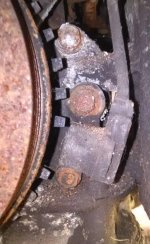
Failed cadence sensor

spokewrench

Well-Known Member
Region
USA
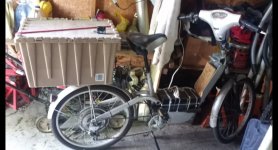
More than 3 years ago, I got an aftermarket controller for my Radmission. One advantage was that I could have the throttle available while pedaling without PAS. Today I tried PAS on a hill. It cut out for about a third of each cycle.

I pulled the left crank arm and removed the sensor. It's labeled P14 and has 7 magnets. I saw no problem except maybe dirt, which I polished away with toilet paper. That didn't fix it. This time I measured.

At 2.5 mph (cadence of 10), the transistor senses all but 2 adjacent magnets. At 7 mph (cadence of 29), it senses all but 1. At 9 mph (cadence of 38), I begin getting PAS through the pedal cycle.

One possibility is that 2 magnets have become weaker than the others. I don't know why. Another is that 2 somehow don't pass as close to the transistor as others. I didn't see anything to suggest that.

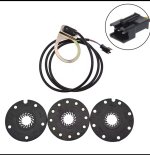
I went to Amazon. It seems that the replacements these days all have 12 magnets. I ordered one. If it works, maybe I'll start to like PAS.

I still don't know why the original sensor doesn't respond equally to all 7 magnets.
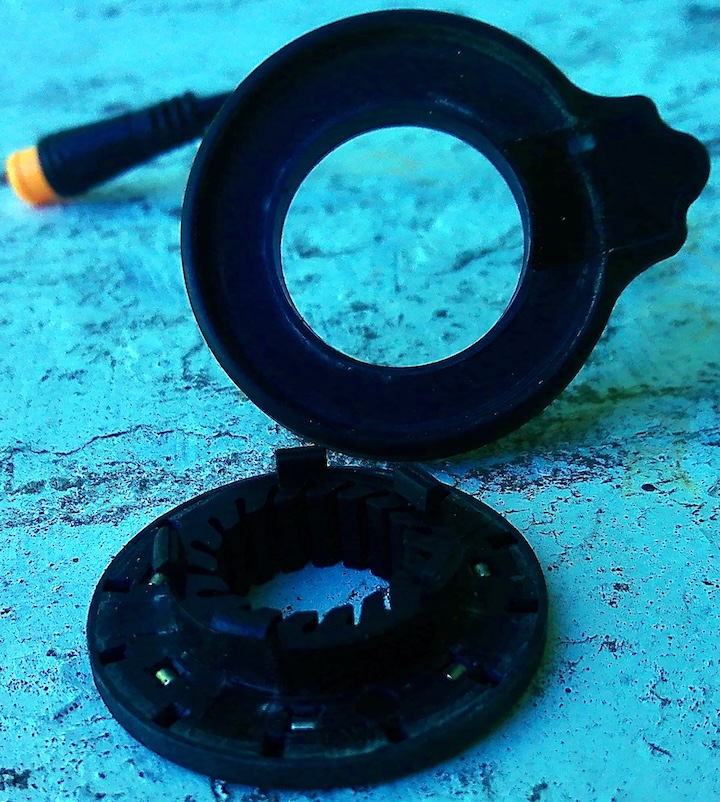
P14.jpeg
 
Last edited:
I went to Amazon. It seems that the replacements these days all have 12 magnets. I ordered one. If it works, maybe I'll start to like PAS.


I'm pretty sure that it will work, but you'll have less crank rotation (number of pulses) before the PAS engages/disengages.
Your controller should just think you're pedaling faster.


I still don't know why the original sensor doesn't respond equally to all 7 magnets.

I'm thinking it's mostly a clearance issue.
My PAS sensor was wearing inside, and the housing was separating a bit, lifting the sensor away from the magnets.

I'm pretty sure the two magnets give a stronger pulse as they move faster, so they start working at a higher cadence?
 
More than 3 years ago, I got an aftermarket controller for my Radmission. One advantage was that I could have the throttle available while pedaling without PAS. Today I tried PAS on a hill. It cut out for about a third of each cycle.

I pulled the left crank arm and removed the sensor. It's labeled P14 and has 7 magnets. I saw no problem except maybe dirt, which I polished away with toilet paper. That didn't fix it. This time I measured.

At 2.5 mph (cadence of 10), the transistor senses all but 2 adjacent magnets. At 7 mph (cadence of 29), it senses all but 1. At 9 mph (cadence of 38), I begin getting PAS through the pedal cycle.

One possibility is that 2 magnets have become weaker than the others. I don't know why. Another is that 2 somehow don't pass as close to the transistor as others. I didn't see anything to suggest that.

I went to Amazon. It seems that the replacements these days all have 12 magnets. I ordered one. If it works, maybe I'll start to like PAS.

I still don't know why the original sensor doesn't respond equally to all 7 magnets.

View attachment 210939
The problem as I see it is that the controller is programmed for seven magnets per revolution not 12. If it is the weaking of magnets then see if you can pop them out of the new one and Crazy glue them in to the old one. They are directionally polarized. Check directionality by placing a new magnet on an old one that is in place on the ring, remembering that opposites attract, or you will go full speed pedaling backwards. Which is kind of fun.
 
Someone replaced the controller on my old POS ebike before I bought it.

Now the PAS only works when I pedal backwards. 😁

They tried installing a PAS sensor on the opposite crank, but it never worked.
 

Attachments

  • Screenshot_20260528_154033_Gallery.jpg
    Screenshot_20260528_154033_Gallery.jpg
    117.5 KB · Views: 25
The problem as I see it is that the controller is programmed for seven magnets per revolution not 12.

I don't think that should matter.
The controller will probably just react with less crank rotation?

Unless the controller detects a cadence of 12/7'ths of what is humanly possible and shuts down?? 😁
 
I don't think that should matter.
The controller will probably just react with less crank rotation?

Unless the controller detects a cadence of 12/7'ths of what is humanly possible and shuts down?? 😁
One guy had a 'jumpy' bike. Half the magnets had been reversed. You could pedal backwards and then forwards again 60 degrees each way to make it fly. Reversing the polarity of magnets is almost as good a practical joke as glueing a BB to the inside of a valve cap. I kind of wish it was June the Third all year, the light so is nice. Another good one is three BBs in the interior of a double walled rim. If it passes an anti-theft security set-up at a bike shop daily, insert security tags way down inside the handle bars. The alarm sounds each time.
 
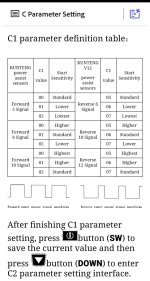
My KT controller allows for 5, 8, 10, and 12 magnet PAS sensors.

No 7 magnet version though, and the only 5, 8, and 10 magnet versions that I could find on Aliexpress are the old-school Huge ring types,..
 

Attachments

  • Screenshot_20260603_230028_Adobe Acrobat.jpg
    Screenshot_20260603_230028_Adobe Acrobat.jpg
    170.8 KB · Views: 24
  • Screenshot_20260603_231224_AliExpress.jpg
    Screenshot_20260603_231224_AliExpress.jpg
    144.4 KB · Views: 29
The original controller missed shifts. I put on a KT. The manual said nothing about the number of magnets in the cadence sensor. These 12-magnet sensors are supposed to be nearly universal. The 12 magnets are supposed to provide a quicker response.This new type also has "double Halls."
 
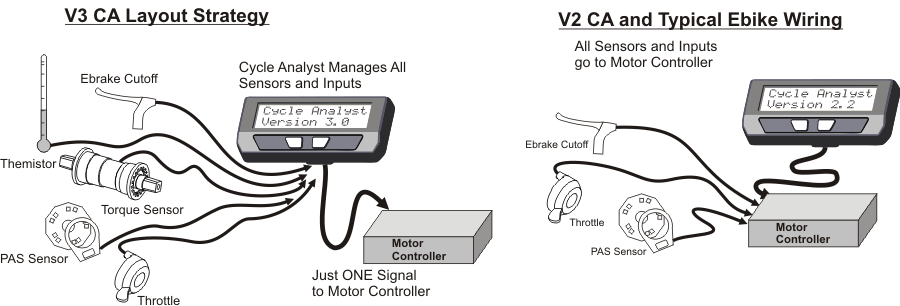
You can buy a Cycle Analyst, attach the PAS sensor and throttle to the CAv3 and the CAv3 to the throttle input of your controller. The CAv3 can be programed for any number of poles on the PAS sensor. You will have to use the CAv3 to program and control your PAS levels though.

https://ebikes.ca/ebike-parts/control-stuff/cycle-analysts/ca-sa.html
Cycle Analyst wants to know how many poles you have so it can display your cadence.

I don't need that because I have no gearshift. It's always 21.25 feet per crank revolution. If the speedometer says 9 mph, that's 47,520 feet per hour, or 792 feet per minute. Dividing by 21.25, it's a cadence of 37.27. What could be simpler? :rolleyes:
 
The 12-magnet replacement sensor arrived. It comes on at a cadence of 33. With my one-speed bike, that's 8 mph. Around here, that means PAS is not available much of the time.

The original comes on at a cadence of 10, or 2.5 mph. I can guess why they're different. It would be dangerous for pedal movement to start the motor before the rider was underway. For a bike in low gear, a cadence of 33 might be 3 miles an hour, so that's when my new sensor kicks in.

How would they design a cadence sensor to kick in at a certain speed? I think the controller reads the Hall-transistor pulse through a capacitor. A somewhat square 5v pulse would be sent to the capacitor. On the other side of the capacitor, the controller would see a positive spike from the rising edge and a negative spike from the falling edge. The voltage of those spikes would depend on the steepness of the rise and fall. The steepness would depend on how fast the magnets passed the transistor.

If the new 12-magnet sensor kicks in at 33 rpm, how can the original 7-magnet sensor kick in at 10 rpm? The steepness of the leading and trailing edges would depend not only on RPM but the gain of the Hall-effect transistor. I guess my original transistor has a gain 3.3 times higher than the replacement.

I don't know where to get a cadence sensor for a single-speed bike. I popped the old one open and touched a steel circlip to each magnet. Six magnets would lift one side of the disk. One was dead. I wonder how that happened! If one dead magnet caused trouble in 2/7ths of a revolution, I guess the transistor reads not the magnets but the gaps between them.

@PedalUma wrote about replacing magnets. I haven't popped the bad one out, but it appears to be 1.5mm in diameter and 2mm long. Where could I get a replacement?
 
I am not sure about replacement magnets. On most 12 magnet systems 3-6 pulses need to pass the pick-up before it kicks in. That is the lag, surge, and lurch. Then there is a 2-3 second overrun.
 
On most 12 magnet systems 3-6 pulses need to pass the pick-up before it kicks in.

That's what doesn't make sense to me.
I would think that the 3-6 pulses would happen faster and at a lower cadence?
But the opposite happened?

Maybe that single dead magnet is supposed to be dead, like the missing tooth on the flywheel on my car? (for the crank shaft position sensor)
 

Attachments

  • IMG-20180711-133341.jpg
    IMG-20180711-133341.jpg
    120.3 KB · Views: 8
That's what doesn't make sense to me.
I would think that the 3-6 pulses would happen faster and at a lower cadence?
But the opposite happened?

Maybe that single dead magnet is supposed to be dead, like the missing tooth on the flywheel on my car? (for the crank shaft position sensor)
Yes, it is a quarter turn to a half turn of the cranks. That is the lag. It is so it does not do a wheelie if it accidently bumped.
 
Yes, it is a quarter turn to a half turn of the cranks. That is the lag. It is so it does not do a wheelie if it accidently bumped.

I'm thinking that maybe there's something proprietary going on and the seventh magnet is dead on purpose to leave out a pulse on every rotation?
(Like the missing tooth on my crankshaft pulley.)
 
I'm thinking that maybe there's something proprietary going on and the seventh magnet is dead on purpose to leave out a pulse on every rotation?
(Like the missing tooth on my crankshaft pulley.)
Except that he said he replaced the original controller with a KT controller. So probably not proprietary. Unfortunately, I don't have any experience with configuring KT controllers.
 
Except that he said he replaced the original controller with a KT controller.
The original controller missed shifts. I put on a KT. The manual said nothing about the number of magnets in the cadence sensor.

OK, so I'm confused??
@spokewrench Did you install a KT controller??

You said that your original had "missed shifts", but a KT controller is for a hub drive, and doesn't have a shift sensor input.

Did you replace the controller in your original mid-drive motor with a KT controller?

I didn't get a manual with my KT controller and downloaded the manual on-line.


Either way,..
This is how you "program" a KT controller to accept a KT V12 cadence sensor,..


Screenshot_20260608_191854_Adobe Acrobat.jpg
Screenshot_20260608_192027_Adobe Acrobat.jpg


If you did install a KT controller (not just the KT V12 cadence sensor), then you need to have a KT display that allows you to program the settings.
(Not all KT displays have a programming mode.)
 
This is my C1 setting on my KT display.
It goes from 0-7

20260608_194456.jpg
20260608_194427.jpg


Just start at 0, try it and see what happens.

Increase it one number at a time until it gets to where you like it.


There's no reason why a KT V12 cadence sensor won't work with a KT controller.
(unless it's some kind of proprietary controller using KT programming and it's locked or something?)
 
Back