You are using an out of date browser. It may not display this or other websites correctly.
You should upgrade or use an alternative browser.
You should upgrade or use an alternative browser.
bought a gas generator for myLiFePO power station
- Thread starter spokewrench
- Start date



spokewrench
Well-Known Member
- Region
- USA
It's rated at 1800 W (15 A), 3600 W (30 A ) peak.
I think it bears repeating that the preferred "design" now for home backup is a suitable battery (power station) that is then recharged via the ICE generator ... and not using the generator to directly power some or most of your appliances. Yes battery power stations cost quite a bit more than an ICE generator up front but incorporating one does provide some solid benefits and some longer term cost savings. As spokewrench has pointed out multiple times that using the generator only to recharge the battery really conserves fuel (sometimes dramatically). The generator only runs long enough to charge the battery and not continuously to handle the varied loads of our households. Less fuel used, and less load on the generator means lower costs over the long term. Everyone's needs and budgets will be different but even a small battery based power station and a few extension cords added to an ICE generator can help extend how long a gallon of fuel lasts which can become a crucial issue in a prolonged outage.
Another benefit of this type of configuration is that the battery power station now handles the AC creation - and virtually all of them on the market provide sine wave inversion so that you no longer care about the quality of the AC (within reason, there are minimum standards) coming out of the ICE generator. The battery effectively isolates your appliances from the generator. This can be a real benefit as not all of us have a nice gold plated Honda powered inversion generator sitting in the garage.
Many of the battery power stations can also function as an uninterruptible power source which can be a cost savings - so no need for the old style lead acid battery based UPSs for sensitive or critical loads (computers, routers, CPAP machines, etc.), plus the UPS functionality can now be extended to heavier load appliances such as fridge/freezers.
The battery setups also let you add alternative recharging options. The obvious one is recharging from the grid which aside from bringing a battery up to full charge after an outage also allows you to time shift the use of expensive electricity (assuming you are on a variable rate electricity plan). This requires juggling some of the connections to the battery (or setting up a more expensive automated system tied directly into your household wiring) but it does over time help offset some of the cost of the battery system. The other recharging options are from your car/truck or solar so you can add solar panels at your convenience to eventually replace the ICE generator and further reduce long term costs.
Incorporating a battery into a backup power setup injects a lot of flexibility into the configuration and can really change the way you look at protection during power outages.
Finally I (and quite a few others around here on EBR) found it's also really easy and fun to use a simple solar/battery configuration to recharge an ebike's battery and ride almost cost and grid free. No it's not as cost effective as simply recharging from the grid but it does demonstrate how simple a grid free setup can be, and that can put a smile on most faces.
Another benefit of this type of configuration is that the battery power station now handles the AC creation - and virtually all of them on the market provide sine wave inversion so that you no longer care about the quality of the AC (within reason, there are minimum standards) coming out of the ICE generator. The battery effectively isolates your appliances from the generator. This can be a real benefit as not all of us have a nice gold plated Honda powered inversion generator sitting in the garage.
Many of the battery power stations can also function as an uninterruptible power source which can be a cost savings - so no need for the old style lead acid battery based UPSs for sensitive or critical loads (computers, routers, CPAP machines, etc.), plus the UPS functionality can now be extended to heavier load appliances such as fridge/freezers.
The battery setups also let you add alternative recharging options. The obvious one is recharging from the grid which aside from bringing a battery up to full charge after an outage also allows you to time shift the use of expensive electricity (assuming you are on a variable rate electricity plan). This requires juggling some of the connections to the battery (or setting up a more expensive automated system tied directly into your household wiring) but it does over time help offset some of the cost of the battery system. The other recharging options are from your car/truck or solar so you can add solar panels at your convenience to eventually replace the ICE generator and further reduce long term costs.
Incorporating a battery into a backup power setup injects a lot of flexibility into the configuration and can really change the way you look at protection during power outages.
Finally I (and quite a few others around here on EBR) found it's also really easy and fun to use a simple solar/battery configuration to recharge an ebike's battery and ride almost cost and grid free. No it's not as cost effective as simply recharging from the grid but it does demonstrate how simple a grid free setup can be, and that can put a smile on most faces.
spokewrench
Well-Known Member
- Region
- USA
I love another advantage. Corded tools are likely to be cheaper, lighter, and less trouble than those powered by gasoline or batteries. However, if a task is 50 yards from an outlet, that's a lot of trouble laying out and bringing in cords. You'll have to move them as you move, and you won't be able to go farther than the length of the cords available. A cart is helpful on most outdoor tasks, and that makes it easy to take my 26-pound battery. This morning I made cuts for half an hour. The biggest thing I cut was a 5" stump. The display said I'd used only 4% of the battery.
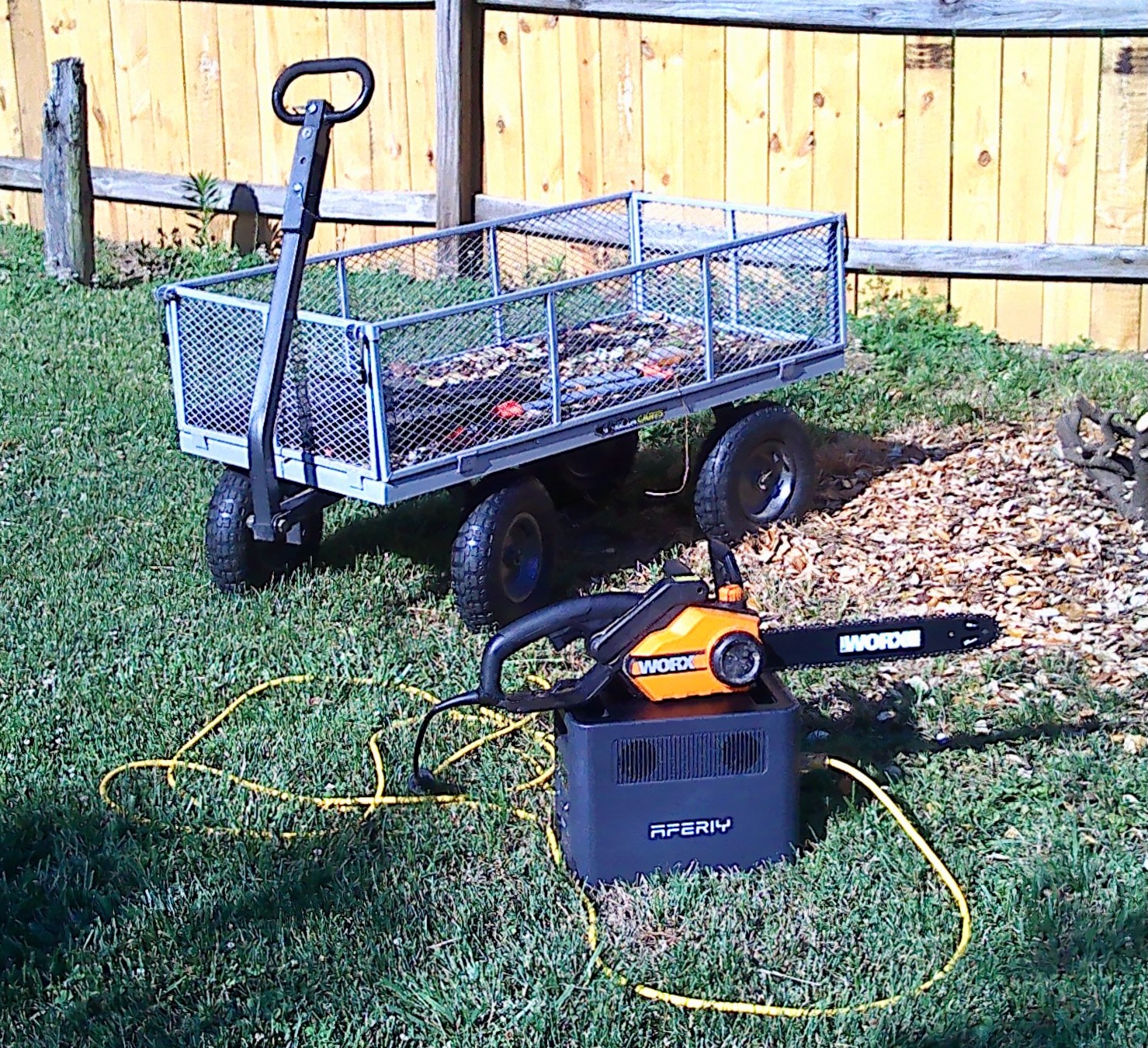


I do similar but use a wheelbarrow to move my Jackery unit from place to place. However I do have a cart just like that which I use to carry a 200 watt adjustable solar panel and my Jackery unit to wheel around and face the sun at different angles depending on the time of year.I love another advantage. Corded tools are likely to be cheaper, lighter, and less trouble than those powered by gasoline or batteries. However, if a task is 50 yards from an outlet, that's a lot of trouble laying out and bringing in cords. You'll have to move them as you move, and you won't be able to go farther than the length of the cords available. A cart is helpful on most outdoor tasks, and that makes it easy to take my 26-pound battery. This morning I made cuts for half an hour. The biggest thing I cut was a 5" stump. The display said I'd used only 4% of the battery.
View attachment 210242

PCeBiker
No-Hands No-Pedaling No-Credentials
- Region
- Canada
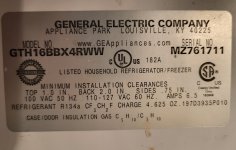
It's rated at 1800 W (15 A), 3600 W (30 A ) peak.
How many watts or amps can your Power Station charge at??
If you could charge your Station while running your fridge and freezer at the same time, you might be closer to the most efficient power output of your generator of probably ~3000 Watts.
LandoftheGiants
Active Member
- Region
- Australia
Are you posting from a phone PCe? Your images are HUGE and take forever to mouse past.I spent dozens of hours reading through it.
PCeBiker
No-Hands No-Pedaling No-Credentials
- Region
- Canada
Are you posting from a phone PCe? Your images are HUGE and take forever to mouse past.
Yeah, I'm using my phone.
I don't have a computer.
I'll try to repost them as thumbnails.
I deleted them from my post above, so now they're attachments
Last edited:
spokewrench
Well-Known Member
- Region
- USA
It can charge at 500 or 1000. There's a switch. The generator is rated at 3400. The manual says it will run 3.5 hours on a tank at full power and 14 hours at 1/4 power (850). I guess the efficiency is similar from 850 to 3400.How many watts or amps can your Power Station charge at??
If you could charge your Station while running your fridge and freezer at the same time, you might be closer to the most efficient power output of your generator of probably ~3000 Watts.
PCeBiker
No-Hands No-Pedaling No-Credentials
- Region
- Canada
,.. I guess the efficiency is similar from 850 to 3400.
That's weird ?
I wonder why the Honda is so different ?
Maybe its a gasoline vs diesel thing?
LandoftheGiants
Active Member
- Region
- Australia
" Preferred design"? I've never heard of such a design unless you are talking about a generator backup for powerWall type installs, which are useless after two days of overcast. I know a few people who have installed generators in their home in case of blackout, some with auto-start features. But a $10,000 lipo array is not needed for them, they will generate power day after day as long as you keep the fuel up. As for the 'quality of AC', generators by design put out the purest sine-wave current there is, it's inverters that have the problems.I think it bears repeating that the preferred "design" now for home backup is a suitable battery (power station) that is then recharged via the ICE generator ... and not using the generator to directly power some or most of your appliances.
Another benefit of this type of configuration is that the battery power station now handles the AC creation - and virtually all of them on the market provide sine wave inversion so that you no longer care about the quality of the AC (within reason, there are minimum standards) coming out of the ICE generator. The battery effectively isolates your appliances from the generator. This can be a real benefit as not all of us have a nice gold plated Honda powered inversion generator sitting in the garage
If sincerely wish people would stop trying to force LiPO technology into every square inch of our lives. Yes it has it's clear advantages for many uses but it also is inefficient for many. Running a generator to charge a battery (losses) to then drain the battery (losses) to power home appliances is obviously inefficient. You cut the battery out of the loop and you also save 3/4 of the cost of the system. It's like non-plugin hybrid cars. They charge their batteries off the ICE engine, with very little from regenerative. So two complete motor systems and a battery to do the same job as one little ICE engine, and all of it running on Gasoline. Retarded!
To deal with blackouts there's a whole lot of real-estate between lighting a couple of candles and a totally automated 10-15kW whole home natural gas/propane generator that's plumbed into the gas source and wired into your home's electrical - and so there are a lot of different solutions for different budgets and needs. This thread was started about using a smaller gasoline generator to recharge a battery based power station ... and that's the "design" that I'm talking about.
Home electrical loads are not in any way a steady state load. Fridges, freezers, water pumps, microwaves, air conditioners, kettles, hot water tanks, etc. all come on and off at different times producing mutli hundred or thousand kW swings in the loading of any power source. ICE generators are hugely inefficient (fuel usage wise) when powering variable loads, they are much happier running at a steady state (rpm and load). Batteries on the other hand simply don't care about the loads if used within their design specs. Plus who cares if there's an extra step within a battery power station to convert AC to DC back to AC (with the few % point loss with each step) when you're comparing it to an ICE design that't maybe at best 30% efficient in turning burning hyrdocarbons into electrons. If you are dealing with a multi day blackout having an ICE generator plus the battery that uses one gallon of fuel a day vs two or three gallons without the battery is a big advantage. The idea is to size the power station (in kW) for the peak loads and then to recharge it multiple times to break the day down into smaller chunks so you don't need the total battery capacity (in kWhr) for the whole 24hrs. Now the battery can be 2 or 3 times smaller (and much less $) when you use the ICE generator to just recharge it. If you are buying the two things new the ICE generator can also be smaller since it only has to be sized to recharge the power station and not handle the peak kW loads.
When sized correctly the battery power stations are just as happy putting out a few hundred watts to power just your lights and TV as they are when the fridge's compressor kicks in and draws many hundreds more. ICE generators vary in rpm as the loads change (assuming that the new loads are above a baseline so this is much more noticeable on smaller generators). As the ICE generator changes rpms the frequency of the AC output changes. Ever put an oscilloscope on the output of a generator and varied the loads? Yes It's a sine wave, but an ugly one ... and often also very clipped and choppy with the smaller generators. This is why there are cautions and warnings on the usage of many less expensive ICE generators with "sensitive electronics". They work great with steady loads that are not anywhere near their rated capacities, but load them up and they use a lot more fuel and put out very dirty AC power.
This is where the battery power stations come in. When used to only re charge the power station they isolate the variable loads from the generator and any dirty AC from the household appliances. You're absolutely correct that they are also more expensive than just a simple generator but they provide a wide variety of additional benefits plus they're constantly coming down in price as battery technology evolves (an area where around the world more $ and manpower is currently applied to than any other power technology). Mid sized (1-4kWhr) power stations are currently priced in the 1.5-3 Whr per dollar (USD) range and are virtually all using LFP battery technology (nobody in this market of portable sized power stations uses LiPO any more - but that's still offered in the whole house setups like Powerwalls, etc. ... for now).
I heard an interesting comment about batteries the other day ... Our modern world is in a constant state of energy usage that comes in constant peaks and valleys. Warmth, cooling, cooking, transportation, etc. are all delivered in those peaks. However we're also much more efficient (in delivery, cost, generation, etc.) when we deal with energy in a steady state. There is simply nothing in our world these days that does a better job at creating that steady state of energy for all of our different needs than the rechargeable battery.
Home electrical loads are not in any way a steady state load. Fridges, freezers, water pumps, microwaves, air conditioners, kettles, hot water tanks, etc. all come on and off at different times producing mutli hundred or thousand kW swings in the loading of any power source. ICE generators are hugely inefficient (fuel usage wise) when powering variable loads, they are much happier running at a steady state (rpm and load). Batteries on the other hand simply don't care about the loads if used within their design specs. Plus who cares if there's an extra step within a battery power station to convert AC to DC back to AC (with the few % point loss with each step) when you're comparing it to an ICE design that't maybe at best 30% efficient in turning burning hyrdocarbons into electrons. If you are dealing with a multi day blackout having an ICE generator plus the battery that uses one gallon of fuel a day vs two or three gallons without the battery is a big advantage. The idea is to size the power station (in kW) for the peak loads and then to recharge it multiple times to break the day down into smaller chunks so you don't need the total battery capacity (in kWhr) for the whole 24hrs. Now the battery can be 2 or 3 times smaller (and much less $) when you use the ICE generator to just recharge it. If you are buying the two things new the ICE generator can also be smaller since it only has to be sized to recharge the power station and not handle the peak kW loads.
When sized correctly the battery power stations are just as happy putting out a few hundred watts to power just your lights and TV as they are when the fridge's compressor kicks in and draws many hundreds more. ICE generators vary in rpm as the loads change (assuming that the new loads are above a baseline so this is much more noticeable on smaller generators). As the ICE generator changes rpms the frequency of the AC output changes. Ever put an oscilloscope on the output of a generator and varied the loads? Yes It's a sine wave, but an ugly one ... and often also very clipped and choppy with the smaller generators. This is why there are cautions and warnings on the usage of many less expensive ICE generators with "sensitive electronics". They work great with steady loads that are not anywhere near their rated capacities, but load them up and they use a lot more fuel and put out very dirty AC power.
This is where the battery power stations come in. When used to only re charge the power station they isolate the variable loads from the generator and any dirty AC from the household appliances. You're absolutely correct that they are also more expensive than just a simple generator but they provide a wide variety of additional benefits plus they're constantly coming down in price as battery technology evolves (an area where around the world more $ and manpower is currently applied to than any other power technology). Mid sized (1-4kWhr) power stations are currently priced in the 1.5-3 Whr per dollar (USD) range and are virtually all using LFP battery technology (nobody in this market of portable sized power stations uses LiPO any more - but that's still offered in the whole house setups like Powerwalls, etc. ... for now).
I heard an interesting comment about batteries the other day ... Our modern world is in a constant state of energy usage that comes in constant peaks and valleys. Warmth, cooling, cooking, transportation, etc. are all delivered in those peaks. However we're also much more efficient (in delivery, cost, generation, etc.) when we deal with energy in a steady state. There is simply nothing in our world these days that does a better job at creating that steady state of energy for all of our different needs than the rechargeable battery.
Last edited:
spokewrench
Well-Known Member
- Region
- USA
For chainsaw work out of range of an electrical outlet, it seems a LiFePO4 battery is far more efficient than a gas saw or a generator. It's a 14.5 A saw, so it might have pulled 1750 W cutting through the stump, yet in half an hour it reduced the battery energy about 40 Wh. Chainsaw work is often like that. You want the saw ready, but it's idle more than 95% of the time. In that half hour of idling, my generator would have burned gas with which it might have increased the battery charge by 391 Wh, making the battery 9.8 times more efficient. A gas saw would likewise have been wasteful unless I shut if off immediately after each cut.
spokewrench
Well-Known Member
- Region
- USA
Mine has the AFERIY brand. The manual calls it the UPS mode. The manual shows a bypass circuit to power equipment during charging. Running off the battery, it's rated at 1800 W. In UPS, it says the overload may trip if the load is more than 1200 W.
Similar threads

- Replies
- 11
- Views
- 2K


- Replies
- 16
- Views
- 3K


- Replies
- 93
- Views
- 13K

- Replies
- 19
- Views
- 5K
