My daughter and brother have Ego mowers. Both would never go back to gas. My brother actually has 2 (one for each property). Over an acre mowed each; I think he has 2 batteries and does each without recharging. They do not appear to be very good mulchers. Brother also has Ego snow blower which does a surprisingly good job.The value of an electric mower depends on how much you need to mow and the quality of the mower.
You are using an out of date browser. It may not display this or other websites correctly.
You should upgrade or use an alternative browser.
You should upgrade or use an alternative browser.
Do you file depth gauges on safety chain?
- Thread starter spokewrench
- Start date



PCeBiker
No-Hands No-Pedaling No-Credentials
- Region
- Canada
30 degree angle on one side for lawn mower blades,helps beat the grass off cleaner.
I like the way you say "beat the grass off cleaner"
My string trimmer can really plow through the grass, but the string is round, and is probably the dullest shape possible?
Even a blunt edge would have corners that would help make it sharper.
PCeBiker
No-Hands No-Pedaling No-Credentials
- Region
- Canada
The value of an electric mower depends on how much you need to mow and the quality of the mower.
I read one review (I forget what mower it was?) where a guy bought a new battery operated mower that crapped out in a couple weeks.
It had a one year warranty, but could only be serviced at a qualified repair shop that was a two hour drive away.
It took 5 months for the mower to get fixed, but his grass kept growing.
So he had to buy another lawnmower, or hire someone to cut his grass while waiting for his mower to get fixed.
So, I guess it's like an ebike where you want a local LBS.
Just cuz you bought it at Home Depot, doesn't mean that's where you take it for repairs.
PCeBiker
No-Hands No-Pedaling No-Credentials
- Region
- Canada
The value of an electric mower depends on how much you need to mow and the quality of the mower.
I've already got Milwaukee batteries and chargers, and was considering the Milwaukee mower,..
I knew better than to buy a no-name mower, and I figured that a Milwaukee mower would be a good quality mower, but it's still $1,000 without the batteries.
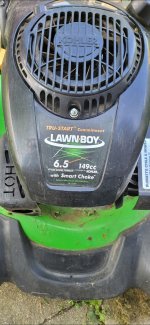
I ended up buying a used 21" self-propelled Lawnboy gas burner for $100,..
It just needed some adjustments and it's working great.
Then I realized that cutting grass is a pain in the ass, so I hired someone to cut my grass.

Ohh well. I'm only out a hundred bucks, and I can always cut my own grass to save a few dollars, but cutting grass is even worse than pedaling my ebike, so that's not gunna happen unless it's an emergency.
Attachments


PCeBiker
No-Hands No-Pedaling No-Credentials
- Region
- Canada
I grew up with a 2-stroke model and have always had a fondness for them.
Me Too !!
That thing just kept going !!
It had an Aluminum frame, so it was light, and the wheels didn't fall off like when a steel frame rusted out.
It was really light even the engine was lighter being 2-stroke.
Always started and the only maintenance was to fill it with mixed gas.
Reminds me of a guy in school in 1982 that had an RZ350 (2-stroke) that would beat Anything on the road.
He raced a VMAX 1200 cc 4-stroke from a stop and just left it in the dirt.
Until he hit his top speed, (around 100 mph I think?) then the VMAX could finally catch up and pass him.
I used to hang out at the record shop at that time, and the owner had a VMAX.
He hammered the throttle once and the bike took off without him, and he landed on his back.
He ended up crashing it and was killed.
When I bought my dirtbike, I knew that I didn't want a 2-stoke because I didn't like the throttle response, and how the power band would kick in, and I didn't want to have to rebuild the engine every winter as part of normal maintenance.
So I bought a 4-stoke dirt bike.
I've got the same throttle issues with my ebikes.
Seems everybody wants a "2-stroke" type throttle response except me.
Last edited:

spokewrench
Well-Known Member
- Region
- USA
Filing the depth gauges didn't help much. Then I discovered that I hadn't been getting the teeth really sharp.amen,too aggressive on the depth gauge makes a chain more kickback prone and jerky,the general consensus is the depth gauges don't really need any attention till later on in the chains life.If you rock or hit metal a couple times the best thing to do is discard the chain,the set is gone and the teeth are not uniform, the first set of "Tallox" chains I bought were as good as any Oregon,Stihl,( ugh Carlton) chains I had ever bought at a fraction of the cost the second set not so much,the correct file size has a bearing on performance,I always liked the 72 LP profile( fast cutting easy to file with a semblance of good cutting.
It goes back to October, 2017, when I cut down a Bradford pear that left a 30" stump in my front yard. With a diamond burr and a foot switch, resharpening my chain worked so well that I decided to saw the stump flush, so that I could mow over it and it wouldn't be a trip hazard. I discovered that at ground level, the wood was very hard, fine-grained, and gnarly. I had to sharpen at least once because teeth that were sharp enough for other cutting would bounce off.
Lately I've been cutting similarly hard stumps. Teeth bumped a lot before starting to cut. I couldn't get it to cut except at the heel of the bar, which meant the toe could end up in the dirt. Sawdust was fine, a bad sign. With a stump, I want to be able to tilt the bar a little like the elevator of an airplane so that if I started 1/2 inch off the ground, I'd be at that height on the other side. Now the kerf was so narrow that I couldn't steer the cut at all up or down.
Sharpening made little difference, so I filed the depth gauges. When that didn't help much, I sharpened again. A glint on the side of a cutting tooth told me it wasn't sharp. I'd just dragged the back of a fingernail along the side of that tooth, and it had felt sharp.
Ha! It was only as sharp as cheap kitchen cutlery. The back of a fingernail will slide smoothly across the edge of a dull knife. If the nail drags, that's about as sharp as you can get cheap stuff. Better cutlery can take more of a razor edge. It feels as if it could shave a layer off the back of a nail.
The first time I sharpened with a diamond burr, the edge felt even more razor-like than new. After that, I was concerned only that I felt a drag as I dragged my nail against a tooth edge. That tool spun so fast that if the burr reached the edge, it was probably well-sharpened. I was more concerned with not overheating the edge.
In 2023 I changed to an adjustable-speed Dremel. A slower speed reduced the risk of burning diamond points or an edge. Now I see it also meant that an edge that would drag against my nail might need a couple of seconds longer to be fully sharpened. I believe my chain has only 28 cutters. It didn't take long to go around, touching up top and side edges until they felt sharp enough to shave the back of a nail.
What a difference! It went through a troublesome 14x8" holly stump quickly and smoothly, with the toe of the bar. Sharper side edges gave me a wider kerf, which helped me keep the cut 1/2" off the ground, where it started, where it ended, and on each side. That's close to flush. If I want it lower, I can use a framing hatchet as a chisel.
Last edited:
PCeBiker
No-Hands No-Pedaling No-Credentials
- Region
- Canada
Sharpening anything takes practice.
It's kind of an art and a science, that I was never good at.
I've always been a fan of good enough and my sharpening skills left things at that.
The AccuSharp knife sharpener doesn't make a very sharp edge, it's kinda serrated and a rough, but it's sharper than any knife edge that I could manage to get with other sharpeners.
It's so quick and easy to get a reasonably sharp knife, that I will sharpen a knife while I'm using it.
I used to just buy a new knife when it got too dull to cut anything.
It's kind of an art and a science, that I was never good at.
I've always been a fan of good enough and my sharpening skills left things at that.
The AccuSharp knife sharpener doesn't make a very sharp edge, it's kinda serrated and a rough, but it's sharper than any knife edge that I could manage to get with other sharpeners.
It's so quick and easy to get a reasonably sharp knife, that I will sharpen a knife while I'm using it.
I used to just buy a new knife when it got too dull to cut anything.
PCeBiker
No-Hands No-Pedaling No-Credentials
- Region
- Canada
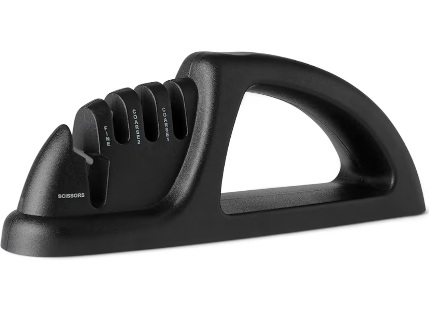
I've had knife sharpeners like these,..
But they put the knife in your hand with the tool on the bench.
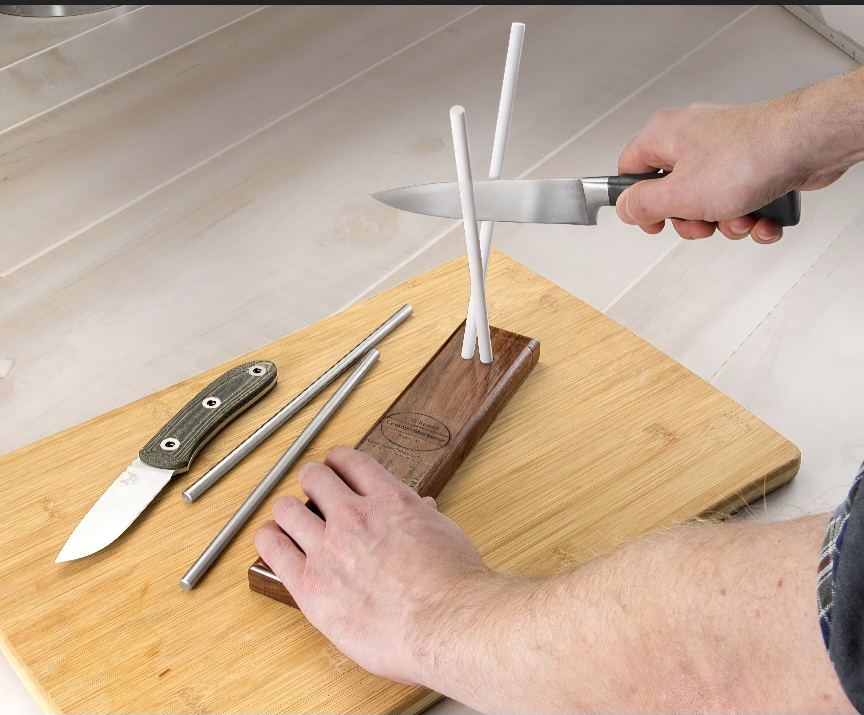
I tried one of these, but it only sharpens one side of the blade, and I had No Luck holding the damn thing at the correct angle to sharpen a blade.
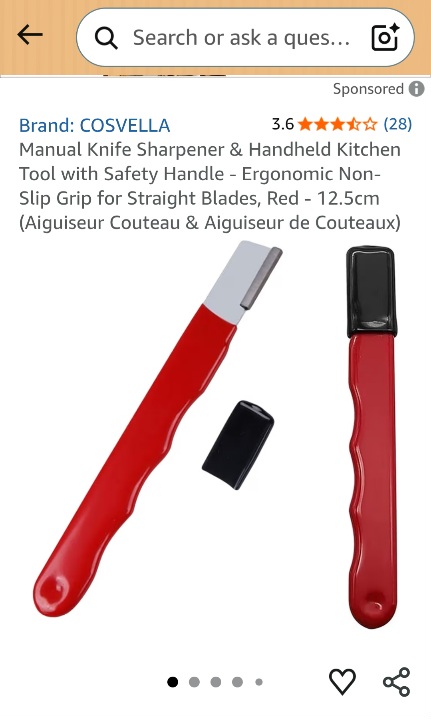
I still have my Wiltshire knives like these and they sharpened Easily because the housing kept the knife at the proper angle.
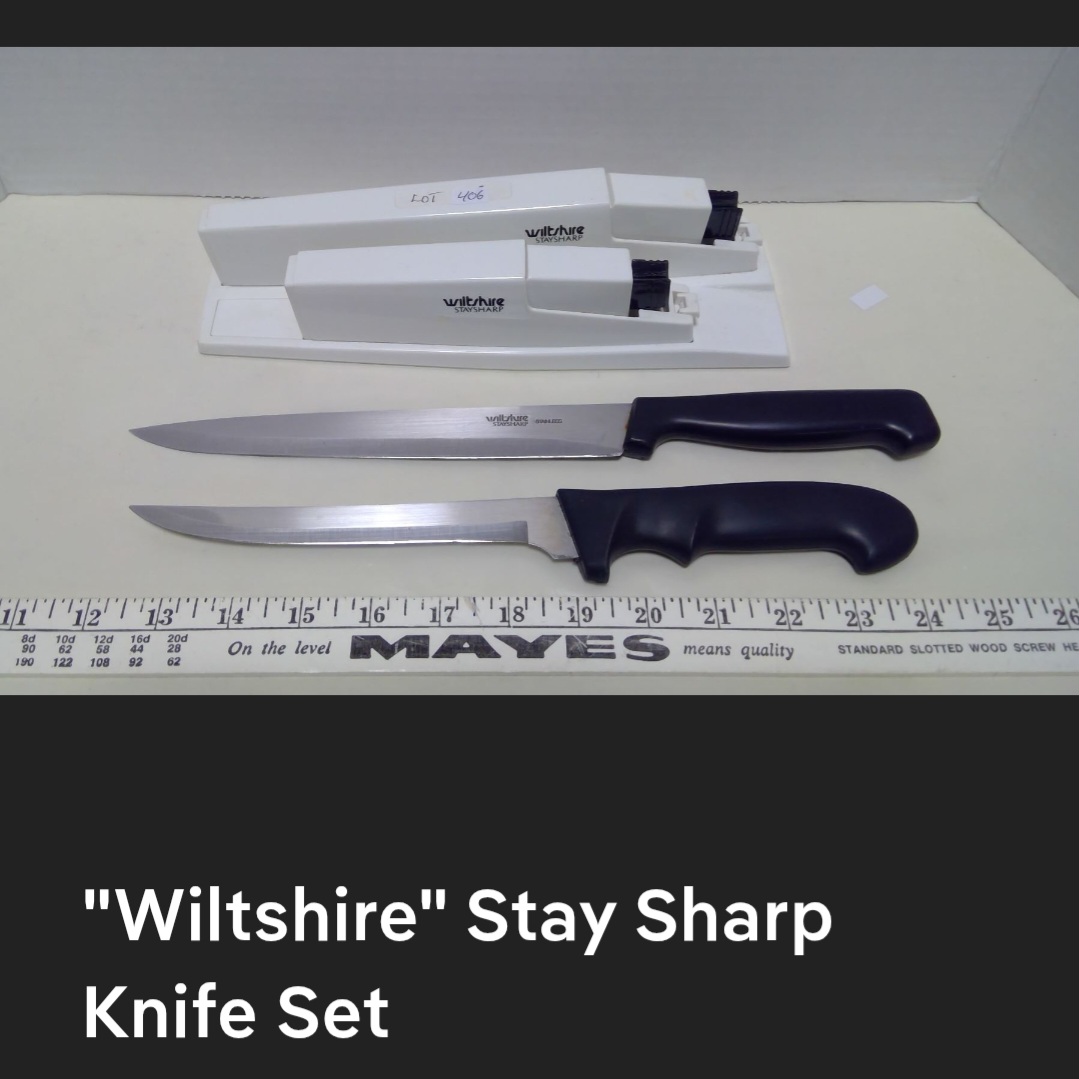
The housing that hold the carbide cutters finally had one of the cutters fall out and it no longer worked.
That's when I started looking for a new knife sharpener.
The AccuSharp leaves an edge similar to the Wiltshire.
Kinda rough and a bit serrated, but it will cut my finger right to the bone with almost no effort or sawing motion.
But they put the knife in your hand with the tool on the bench.
I tried one of these, but it only sharpens one side of the blade, and I had No Luck holding the damn thing at the correct angle to sharpen a blade.
I still have my Wiltshire knives like these and they sharpened Easily because the housing kept the knife at the proper angle.
The housing that hold the carbide cutters finally had one of the cutters fall out and it no longer worked.
That's when I started looking for a new knife sharpener.
The AccuSharp leaves an edge similar to the Wiltshire.
Kinda rough and a bit serrated, but it will cut my finger right to the bone with almost no effort or sawing motion.

dodgeman
Well-Known Member
- Region
- USA
- City
- Macomb, Illinois
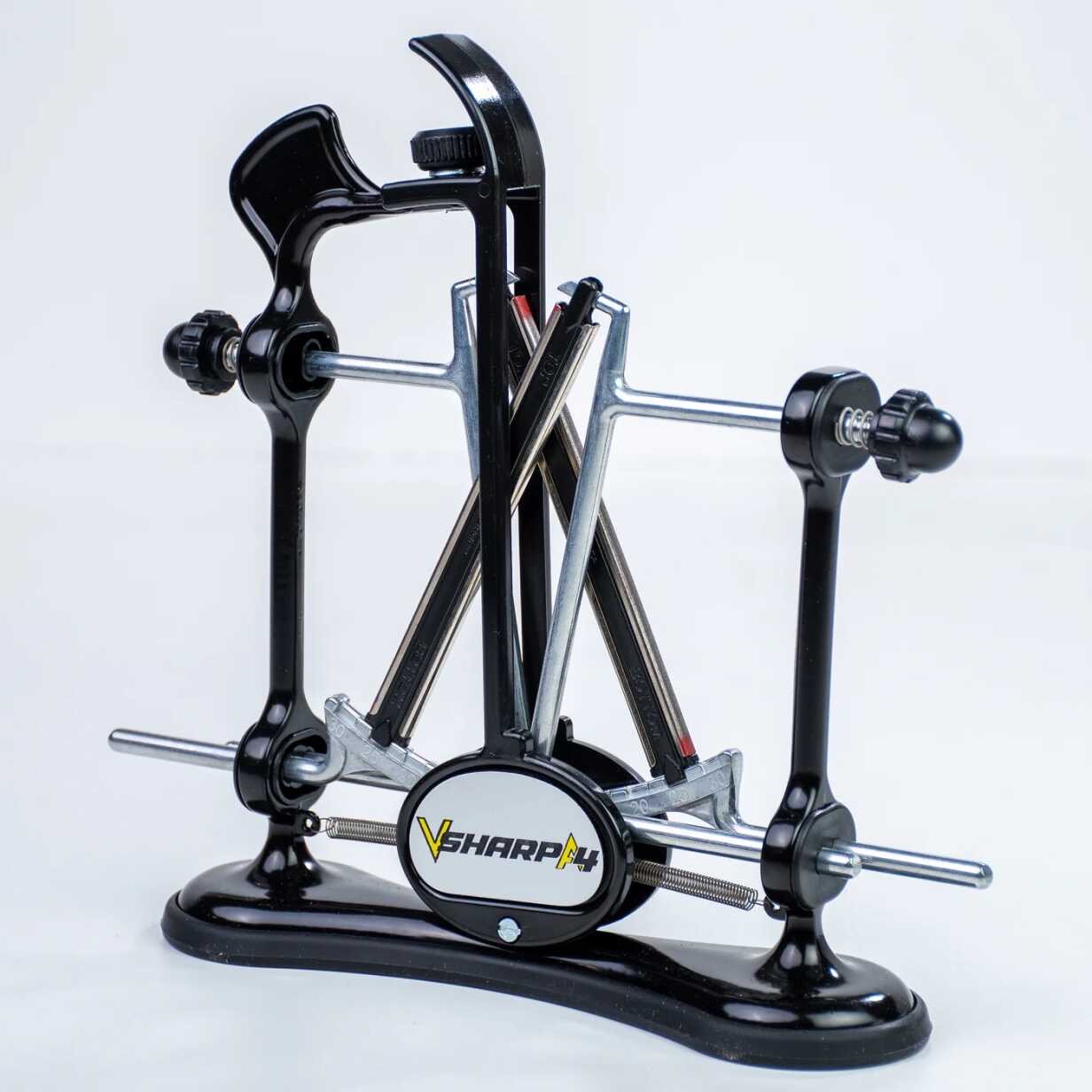
Knife sharpener? I recently bought something called a Warthog. Not cheap, about a $100. Works amazing and I’ve tried everything. Kind of like the twin angled sticks but spring loaded.
For sharping a chainsaw chain I will recommend getting a file with a guide and using that. It takes some practice but it’s not that hard. I’ve learned to take a look at them with a magnifying glass to see how I’m doing. They also make a Two In One file that has a flat file along with a round file and it files the rakers along with the teeth.
I had a two stroke Lawn Boy, self propelled, aluminum deck, I loved that thing. It got to the point I couldn’t keep it running and I feel I can fix most small engines. I gave up and sold it cheap.
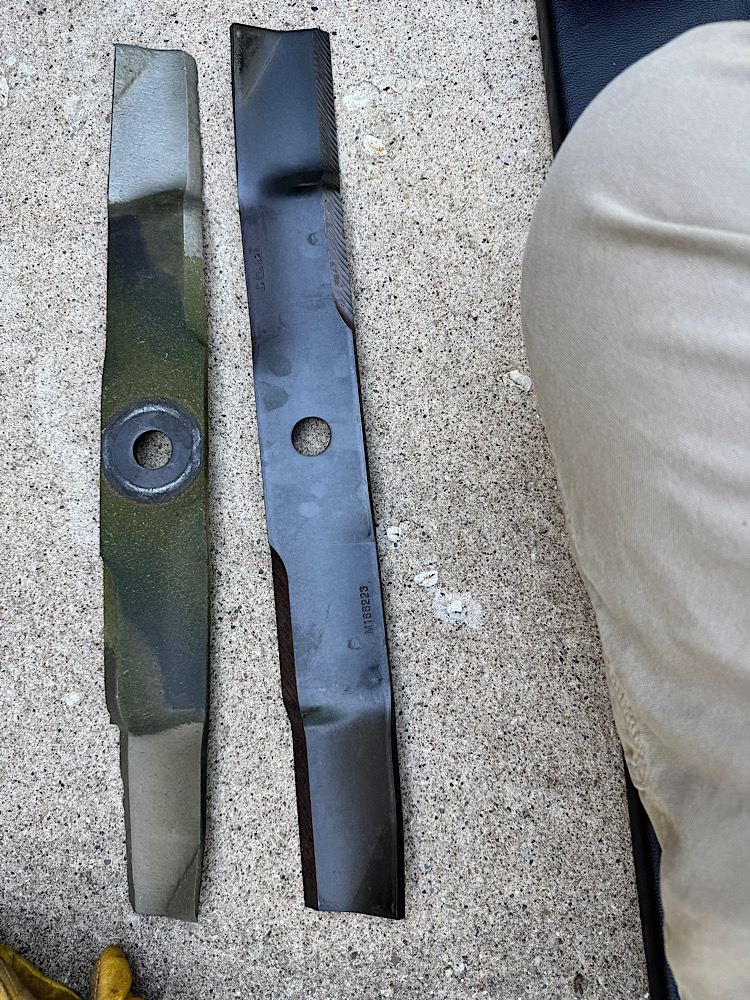
I sharpen mower blades with a bench grinder. Eventually they need replaced. I just replaced mine with three new blades, it’s a 60” deck.
For sharping a chainsaw chain I will recommend getting a file with a guide and using that. It takes some practice but it’s not that hard. I’ve learned to take a look at them with a magnifying glass to see how I’m doing. They also make a Two In One file that has a flat file along with a round file and it files the rakers along with the teeth.
I had a two stroke Lawn Boy, self propelled, aluminum deck, I loved that thing. It got to the point I couldn’t keep it running and I feel I can fix most small engines. I gave up and sold it cheap.
I sharpen mower blades with a bench grinder. Eventually they need replaced. I just replaced mine with three new blades, it’s a 60” deck.
PCeBiker
No-Hands No-Pedaling No-Credentials
- Region
- Canada
Knife sharpener? I recently bought something called a Warthog.
I'm pretty sure that I wouldn't be able to get that to work for me, because I'd still be holding the knife in my hand.
I'd just keep taking the edge off with one crooked stroke after another?
I’ve tried everything.
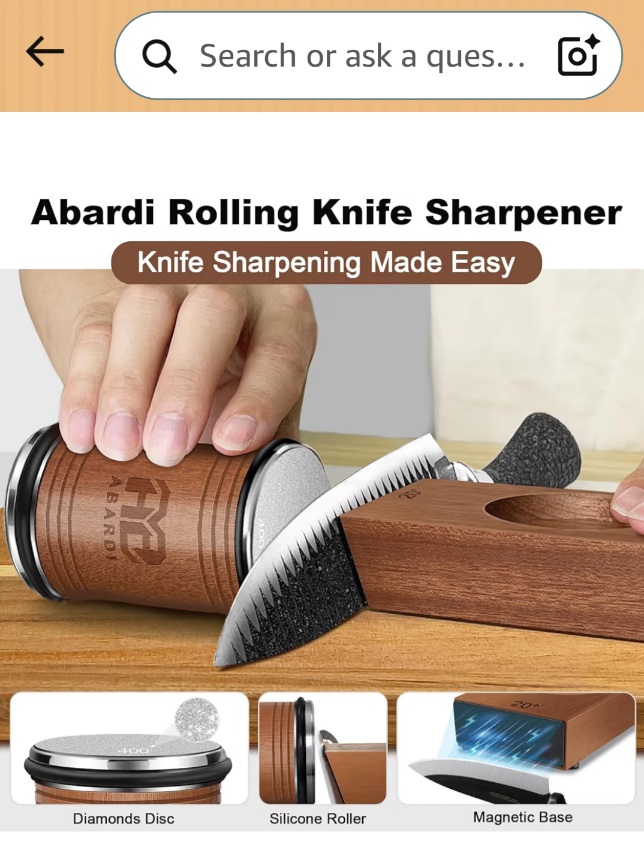
What about this one?
It seems to suit me because the knife is stationary, and the "sharpener" seems to keep everything square by itself ??
I was considering trying one.
dodgeman
Well-Known Member
- Region
- USA
- City
- Macomb, Illinois
With the Warthog knife sharpener there is a guide and it sharpens both sides at the same time. You have to see it used to understand. It sharpens a knife in just a couple of minutes. The store I bought it at had one setup for you to try and I always did my pocket knife when I was there.
PCeBiker
No-Hands No-Pedaling No-Credentials
- Region
- Canada
With the Warthog knife sharpener there is a guide ,..
OK, I get it.
I wouldn't be able to wobble the knife off kilter.

And it works for a pocket knife too, even though it's kinda Huge. Lol
spokewrench
Well-Known Member
- Region
- USA
I went to work at a golf course in 1969. For greens we used walk-behind reel mowers. We used larger reel mowers for fairways. For brush we used little yellow aluminum 2-stroke Lawnboys. I loved them. I bought a 21-inch commercial 2-stroke Lawnboy to go into business in 1976. For the farmyard in 1982 I bought a 20" 2-stroke Lawnboy. In all those cases, lightness was my primary consideration.I had a corded electric mower years ago and it was a gutless piece of crap too.
They have to have a really narrow cutting swath to help it cut.
It would draw ~12 amps from the 120VAC outlet, so over 1,400 watts to make a small gutless electric lawnmower.
Since 1981 I've used 4-stroke push mowers for the half-acre in town. It wasn't until 2013 that I got a 20-year-old riding mower. It got the open areas, but sometimes I'd do them with the push mower. In 2015, the widow next door asked me to do her half-acre. She had set up so many obstacles that I could ride for less than half. The other half was constant pushing, pulling, and turning. That's when you notice the weight of a mower. I'd have to take breaks to cool off.
My 4-stroke push mower weighs 61 pounds. I wouldn't want Milwaukee's battery mower at 85 pounds. B&D's corded 20" mower weighs only 43 pounds. I don't know how that compares to the Lawnboys I loved, but it sure beats my 4-stroke.
When I learned to sharpen with a belt sander, I found that my push mower and my riding mower engines were quieter. They could mow at idle volume because with sharper blades, governors didn't have to open throttles as much. Sharper blades could also keep an electric mower from bogging.
In the past I wouldn't consider a corded mower because I'd need 200 feet of cords. My LiFePO4 power station changed that. I could cart a mower, 25-foot cord, and power station wherever needed.
PCeBiker
No-Hands No-Pedaling No-Credentials
- Region
- Canada
"Do you file depth gauges on safety chain?"
I didn't know what the heck you were talking about ??
This is a safety chain that I'm familiar with,..
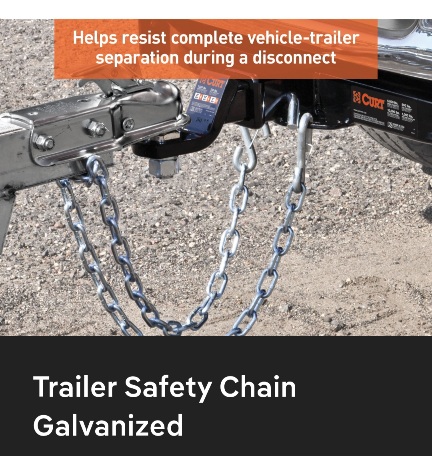
The depth gauge is the ground.
If it's rubbing on the ground, then the depth is too deep.??
So I just did some investigating.
This is the brand new chain on my Milwaukee hatchet chainsaw,..
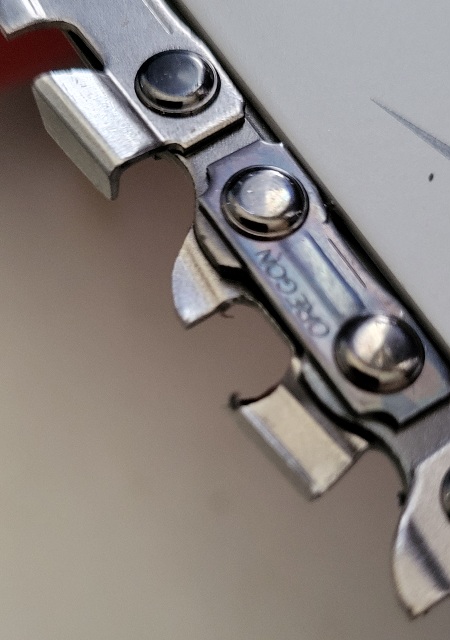
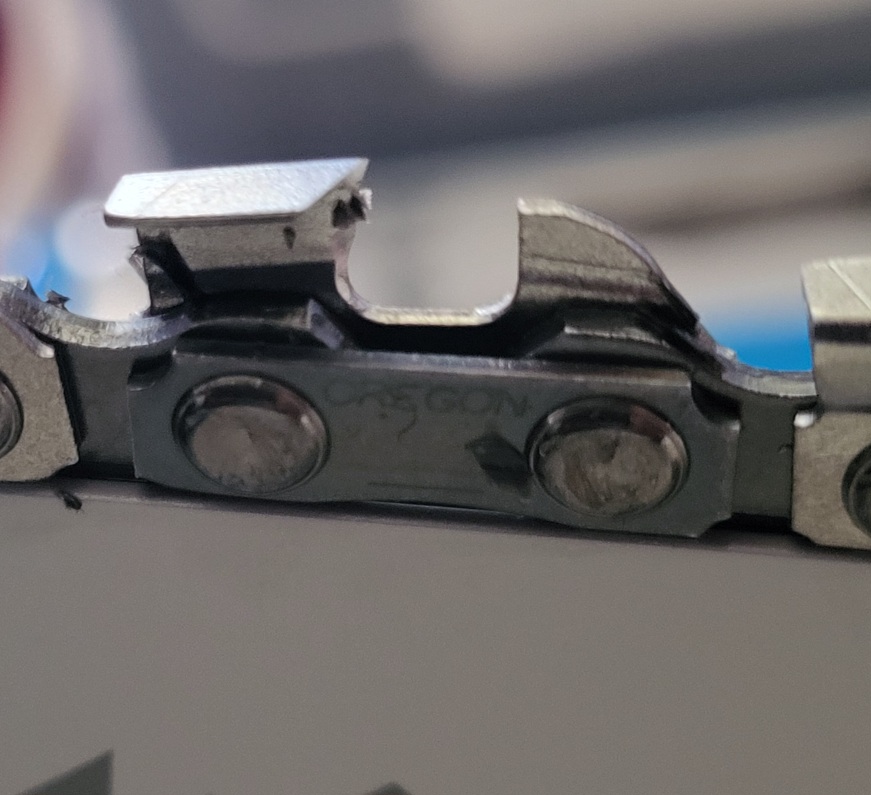
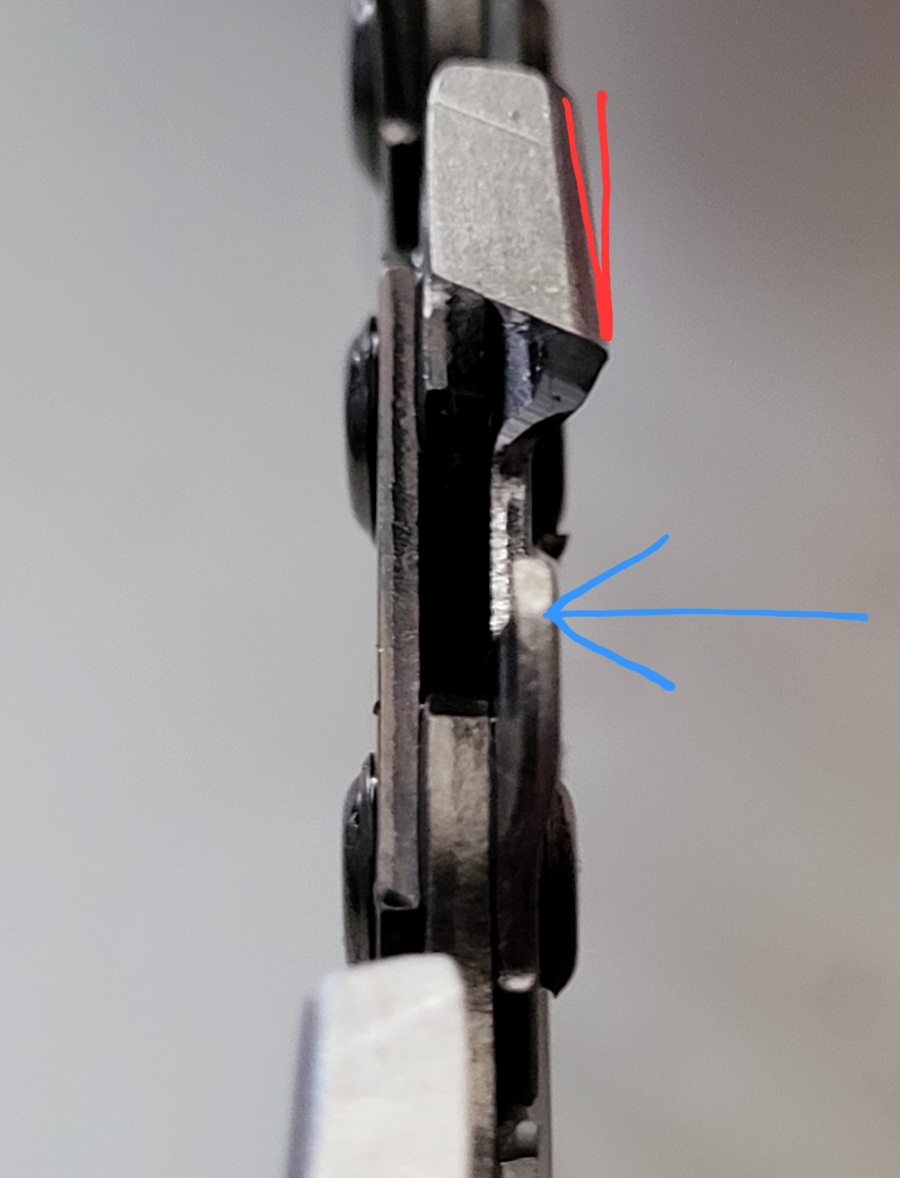
So the blue arrow must point to the depth "guide"
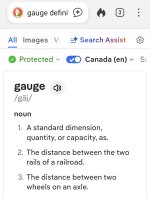
(A "gauge" is a measuring device not a "device")
So,..
As the chain wears and the teeth get filed down after multiple sharpenings, the "angle of attack" into the material gets reduced because the tooth is angled and tapered.
(The red angular finger drawn arrow)
So,..
I guess that some day after many sharpenings, I'd have to thin out the depth "guide" (not gauge) so that I'd take more meat off with the cutter following it ??
Then I did another search and found this,..
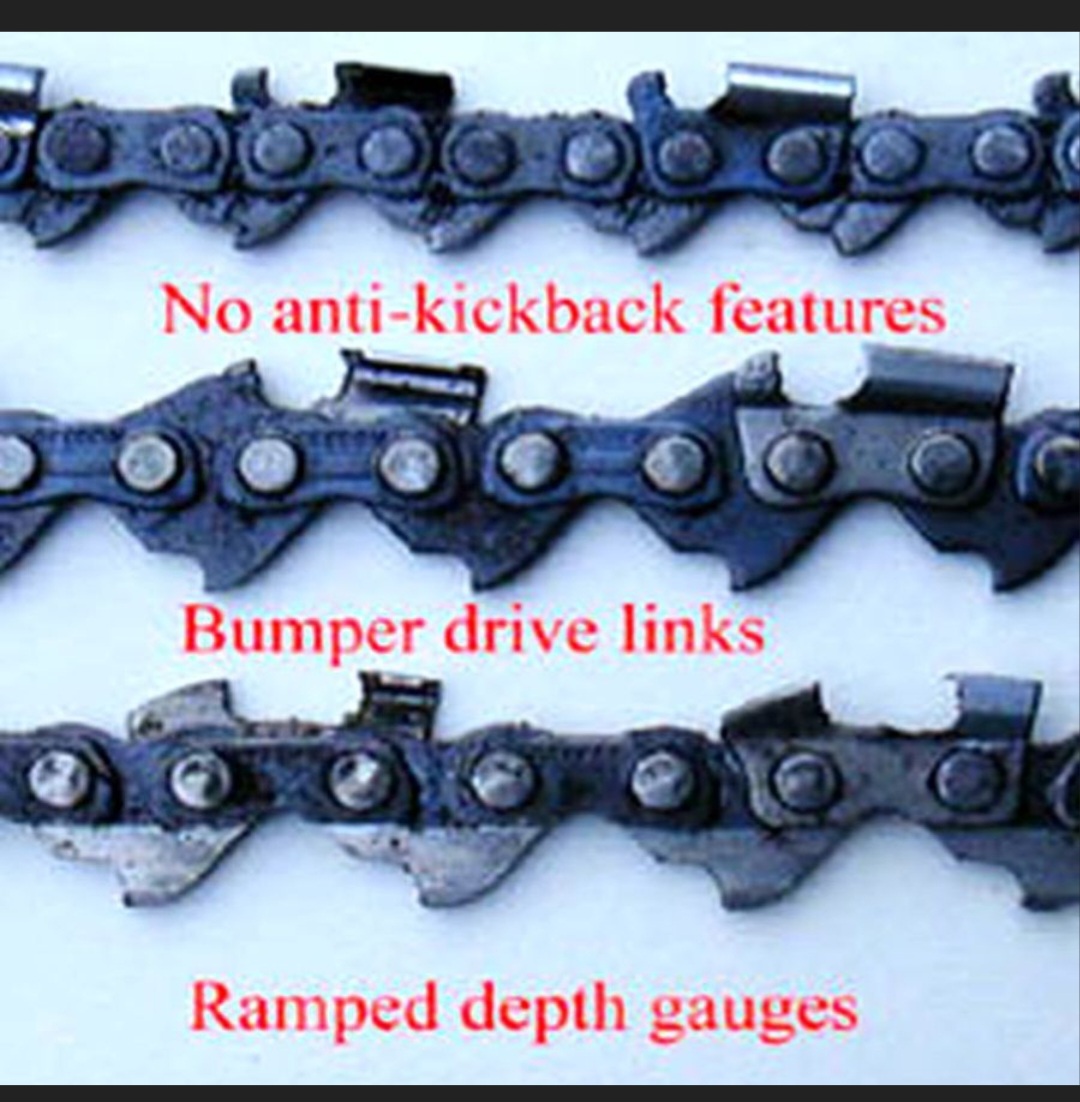
What the hell is an "anti-kickback chain" ??
Or "Safety Chain" as you call it??
I thought the underside of the cutters were only there to keep the chain on the bar, I had no idea that there were different kinds of undercarriages ??
After more investigation and pictures, I found this on my new saw,..
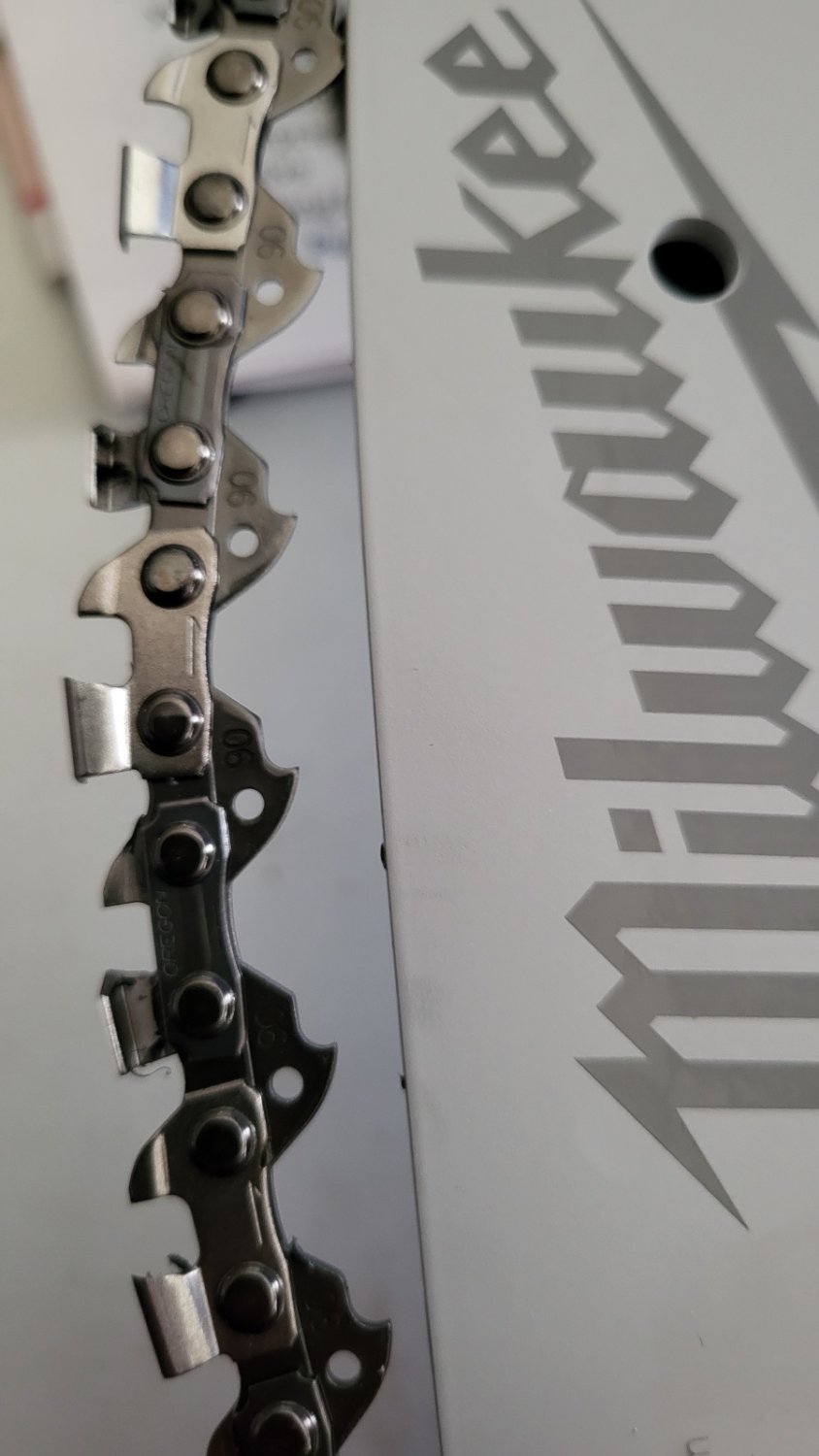
So,..
It looks like I've got "ramped depth gauges" that automatically take care of all that angular momentum stuff and always cut perfectly no matter what ??
That's a good thing because I have no intention of ever servicing it.
I ordered an Oregon depth gauge tool and flat file. That’s when I realized that the tie straps on my chain are almost as high as the depth gauges.
I didn't know what the heck you were talking about ??
This is a safety chain that I'm familiar with,..
The depth gauge is the ground.
If it's rubbing on the ground, then the depth is too deep.??
So I just did some investigating.
This is the brand new chain on my Milwaukee hatchet chainsaw,..
So the blue arrow must point to the depth "guide"
(A "gauge" is a measuring device not a "device")
So,..
As the chain wears and the teeth get filed down after multiple sharpenings, the "angle of attack" into the material gets reduced because the tooth is angled and tapered.
(The red angular finger drawn arrow)
So,..
I guess that some day after many sharpenings, I'd have to thin out the depth "guide" (not gauge) so that I'd take more meat off with the cutter following it ??
Then I did another search and found this,..
What the hell is an "anti-kickback chain" ??
Or "Safety Chain" as you call it??
I thought the underside of the cutters were only there to keep the chain on the bar, I had no idea that there were different kinds of undercarriages ??
After more investigation and pictures, I found this on my new saw,..
So,..
It looks like I've got "ramped depth gauges" that automatically take care of all that angular momentum stuff and always cut perfectly no matter what ??
That's a good thing because I have no intention of ever servicing it.
Attachments
Last edited:
PCeBiker
No-Hands No-Pedaling No-Credentials
- Region
- Canada
"Do you file depth gauges on safety chain?"
I honestly thought that you were filing tiny little marks on the flat side of every cutting tooth on your chain to "gauge" the amount of wear over time.
"Do you file down your depth guides on safety chain"
Makes Way More Sense To Me,..
I honestly thought that you were filing tiny little marks on the flat side of every cutting tooth on your chain to "gauge" the amount of wear over time.
"Do you file down your depth guides on safety chain"
Makes Way More Sense To Me,..
dodgeman
Well-Known Member
- Region
- USA
- City
- Macomb, Illinois
You do file down the rakers on a safety chain, they control how deep the teeth dig in. If the rakers are too tall, a poor cutting chain. If the rakers are tool low the chain can bog down the saw because it’s cutting too deep. A safety chain reduces kickback. That’s where the saw grabs and kicks up toward your face. I included a picture of a Stihl sharpener kit I bought years ago. You need to replace the round file on occasion.
The tool on the left is the round file with a guide on it to help you get the correct angle. The file on the right is a flat one for the rakers. The tool in the middle is the gauge I use for the rakers. You set the gauge on top off the chain until the raker is in the u shaped area at the bottom of my picture. The raker shouldn’t be sticking up above the surface of the gauge. If it is you file it down. You should do every single raker this way but I check a couple and then just file them the same amount. Like I say with a little practice it’s a 5 or 10 minute job and it saves time because the saw cuts so much better.
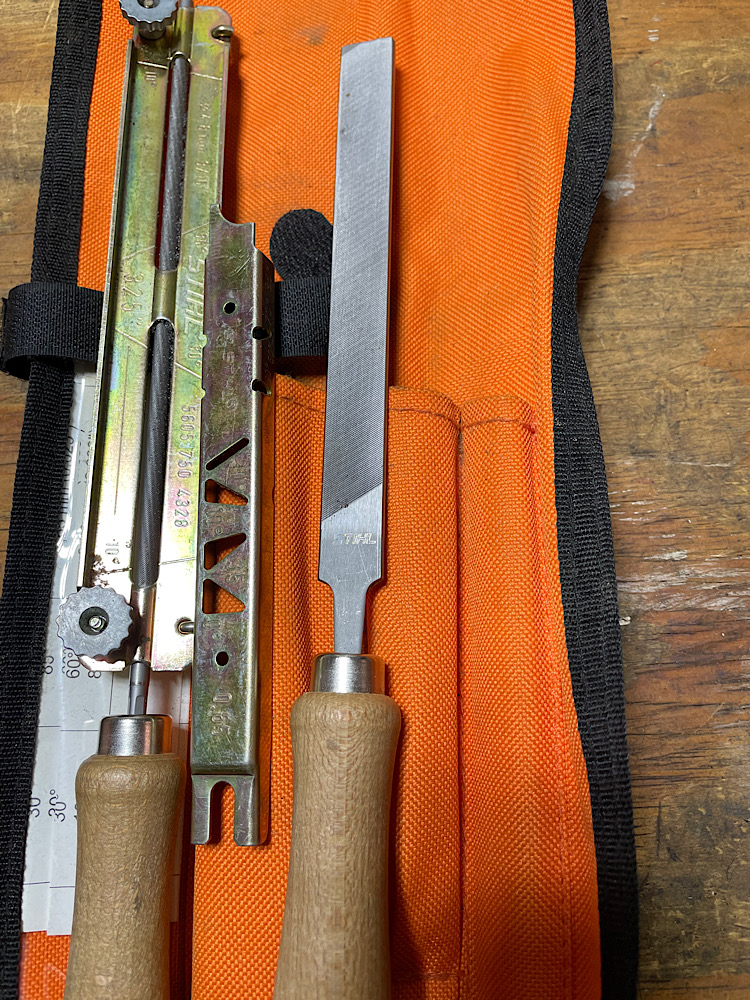
The tool on the left is the round file with a guide on it to help you get the correct angle. The file on the right is a flat one for the rakers. The tool in the middle is the gauge I use for the rakers. You set the gauge on top off the chain until the raker is in the u shaped area at the bottom of my picture. The raker shouldn’t be sticking up above the surface of the gauge. If it is you file it down. You should do every single raker this way but I check a couple and then just file them the same amount. Like I say with a little practice it’s a 5 or 10 minute job and it saves time because the saw cuts so much better.
dodgeman
Well-Known Member
- Region
- USA
- City
- Macomb, Illinois
Another tip. In PCeBikers post above with the red and blue marks in the picture, if you look at the picture of the tooth(the red mark beside it) there is an etched line of the tooth towards the back. The etched line shows the correct angle to sharpen at plus when you hit the etched line from filing the tooth down, it’s time to throw the chain out. You can see how much wear you can get out of a chain.
PCeBiker
No-Hands No-Pedaling No-Credentials
- Region
- Canada
.. there is an etched line of the tooth towards the back.
Ohh,.. OK
I thought the dude that painted the chain had a problem with his spray gun.
EDIT:,..
You mean this line,..
That makes more sense.
Similar threads

- Replies
- 12
- Views
- 2K

- Replies
- 3
- Views
- 756

- Replies
- 62
- Views
- 6K

