Picked up a couple of these on sale last week:

1769873291289.png
1769873730225.jpeg
1769873772548.jpeg


Among other uses, they work great for making quick bike adjustments without putting the bike on the work stand. With the bike supported by the kick stand, I just put this hand jack under the bottom bracket and lift the rear wheel off the ground an inch or so.

 
Soldering 20-30 amp or 16-14 gauge discharge wires with even a good soldering iron with a fresh tip can be a pain. You need to heat them for 3 or four minutes and might end up with a grey surface (bad) instead of a bright surface (good) and have to redo it. All electrical conductors also conduct heat away. So, I took a tip from people with high developed meh-heads, also folks like Richard Pryor and Whitney Houston and am using a little butane torch. Both fuel delivery and oxygen mix, with a top carb, are adjustable. The point of the blue flame makes the process take about four seconds. It always looks shined and nice. If I recall it was $6.35 in a Tractor Supply check-out bin. Maybe for truckers looking for a 2 AM pick-me-up. What is funny is that the huge gleaming downtown electric bike shop does not own a multimeter or a soldering iron. They cannot diagnose or fix stuff. Only using guess work to start replacing parts. Oh, it might be the $1200 battery, lets order one and see it that works! It will take three weeks of prime ride time to get here. Nope that didn't work so, let's order a new display and try that. With no rides from April 15th to June 2nd.

1770080444273.jpeg
 
Last edited:
Soldering 20-30 amp or 16-14 gauge discharge wires with even a good soldering iron with a fresh tip can be a pain. You need to heat them for 3 or four minutes and might end up with a grey surface (bad) instead of a bright surface (good) and have to redo it. All electrical conductors also conduct heat away.
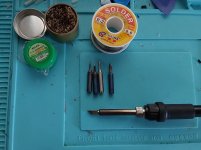
The mass of the tip is important. I have a temperature-controlled pencil iron of just a few watts. It came with assorted tips. With the right tip and temp, it's good on 14 gauge. For bigger stuff, I use a much bigger tip that attaches to a propane torch.

In 7th grade we learned to make boxes of tin-plated steel. Cut with tin snips. Bend with a brake. Take an iron with a tip about an inch in diameter and two inches long. Clean it with sandpaper, add flux, and stick it in a toaster-size electric furnace on the bench. When it's hot, melt and wick solder from a bar. Run the tip of the iron along a seam of your box. The method must have been foolproof because it worked for me!
 
True dat.... a larger chisel point works much better for larger wires and connectors than a small pencil tip.
Screenshot_20260203_092739_Photos.jpg
Plug in a spare mating connector to hold everything true.Then I wrap the plastic of the connector with a small piece of damp cloth to keep it cool.
Tin the wire first and use lots of flux on the connector. Don't rely on just the flux core of the solder.
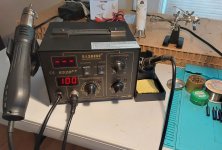
No 3 - 4 minutes of heating necessary if you use the right temperature, +400°c. and it's more like 10 seconds at most.. especially if you use a quality low temp solder for electronics.

Screenshot_20260203_092909_Photos~2.jpg
This said nothing works better than factory connector with leads and a butt splice imo.
Your Melting Point May Vary. . .
 
Last edited:
It is ironic that yesterday I saw a guy get busted with one. I was in a restaurant, there was a guy outside acting crazy and smoking from a small glass pipe. He kept going over to my bike. The manager called the cops. They got the torch and pipe and put him in the back of the Explorer.
I have a similar torch thats great for browning cheese and flan.
 
Back