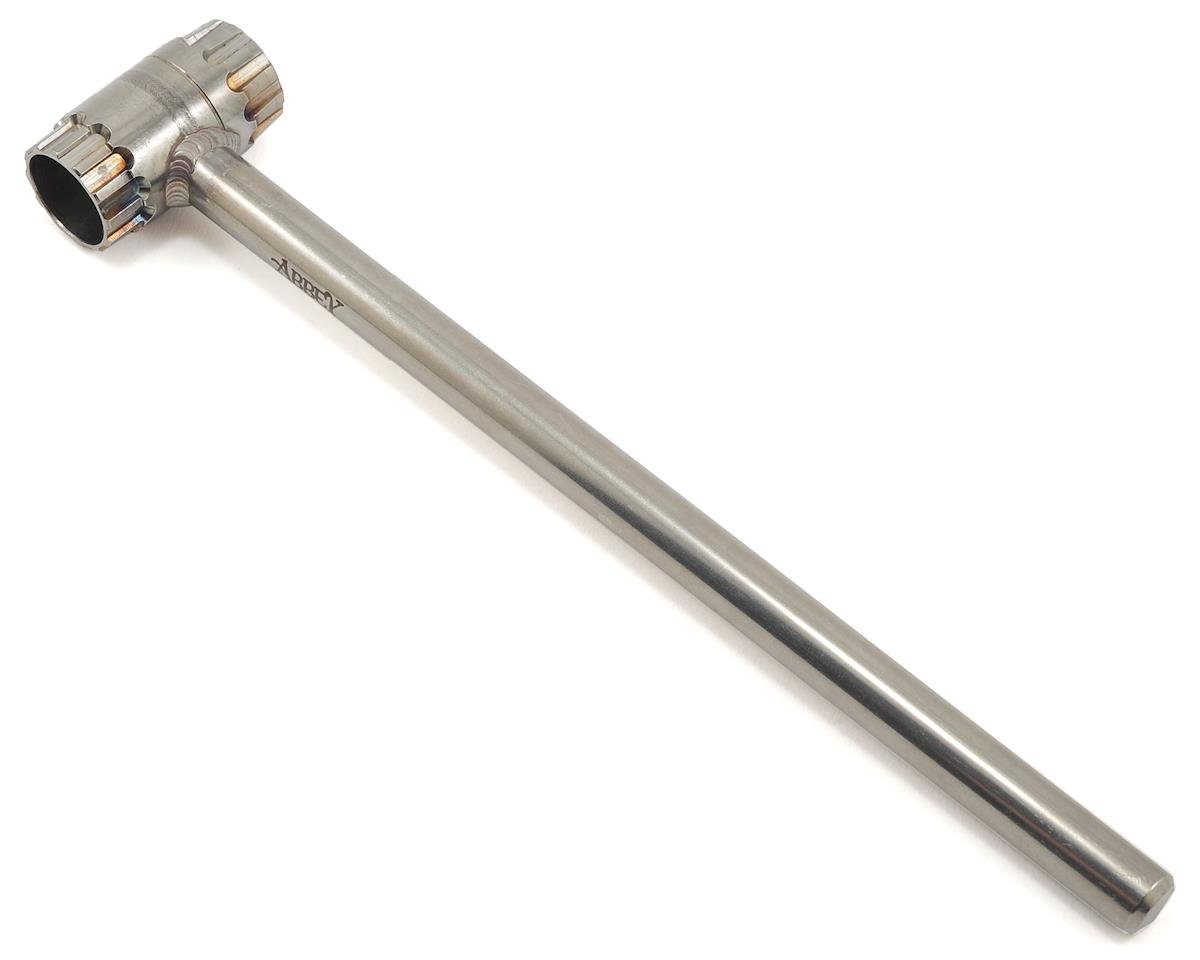
I just wanted the leverage. I mostly deal with cassettes and not freewheels and I don't care if I slightly mar the seldom used socket, That sucker is longer than the edge of the rim. Another way is if you have a good vice (most vices are bad, like that '80's show) put the freewheel socket in it and drive the bus to the left. You get leverage on both sides of the rim.
1767213817344.png

Well I got the new freewheel cluster on, the new chainring, and new chain. This is how it should be.
1767213540177.jpeg
 
Last edited:
Happy New Year 2026. I had no idea this thread would last for five years! I really though it might be for about five geeks & for maybe three weeks back in 2021.
I have my prop-tools. Whenever I give a Free five-minute initial consultation I have a digital caliper, a voltmeter, a notebook, and pen, along with a laptop. My closing ratio on free consultations is 100%, because I will treat the grandson like a man in front of the grandmother. And do actually listen. The technical is fine, but bikes are for humans. It is the human side that makes all the difference. There is no tool for that. I stole an 8mm hex from a Specialized Roll Cargo install kit. I love that thing for pedal crankarms.
 
On that white Public conversion with a TSDZ2b, I did a shifting tune. It first got a new cable with CLR gun oil in the housing. Then I removed the derailleur, cleaning and lubing it. And I applied the hanger adjustment gauge. Besides the items mentioned, ring, chain, and freewheel. Finally I checked the limits and cable tension. Now the shifting is great. There was some white dust corrosion on the cable. And the hanger was slightly bent and twisted.
 
Good find on the twisted derailleur hanger. Misalignment in the vertical plane is easy to see with the naked eye, but a twist in the horizontal plane usually can only be found with the DAG. A twist in the hanger can cause side friction on the jockey wheels, which causes downshifts to skip cogs and upshifts to hang, among other anomalies.
 
If you get a chance to do a bike safety demo at maybe a Jr. High, here are some good proven tips. ABCD Quick.

 
It looked, visually, perfect. Always lube the threads of the DHAG. Hangers are often aluminum and can get cross threaded.

Plus the hanger threads can get junked up from dirt and road salt, except in Jeremy Land where they don't have snow (often).
 
I just removed a rear wheel and changed the tire. Straight forward stuff. Putting it back I had a Mobius chain. How the F could that happen? I wasted an hour trying to figure it out. Then I ended up breaking the chain and giving it a half untwist to make it right. This must be my punishment for making a Mobius toilet seat cover and placing it back in the holder.


1767903986210.png
 
I did a dumb and amateurish blunder. One of my bikes with a steel frame had, as a starter analog bike, a couple of exposed sections of shift cable that was routed under the bottom bracket. With a mid-drive the cables needs to run over the bottom bracket so they are not crushed by the motor. I installed contiguous housing from the shifter to the derailleur, routed over the bottom bracket. Because it was steel I could not do internal routing. So, I was forced to use paint matched zip ties on three points of the down tube for the display wire and shift housing. I over tightened them. Over the years it slowly crimped the housing at those points. I would shift and there would be lag for up to a minute. I replaced that housing today before a large group ride up a mountain, making sure that I could move the zip ties and they were not too tight. I learn best from mistakes.
 
These belonged to my grandfather, born in 1889. He grew up at the house and turbine-powered mill his grandfather had built in 1856 on 12x12" oak sills 30 feet long.

Thinking they were axes, I used JB Weld to tighten one head, smoothed the handles, and improved the edges. Then I realized they weren't used as axes.

The heads are badly mushroomed with pitting 1/4" deep, but the handles have been kept dry. Axes are cheap, and the quality of axe steel improved, decade after decade, from about 1850 well into the 20th century. Why take the trouble to put handles on heads like these?

Axe handles are cheap. They need to fit tightly to last long. These fit loosely. Axe handles need to be shaped for comfort and safety. Grandfather could make everything from furniture to barns, but he left these handles rough and uneven. I thought about it and realized what he, and maybe his father, and maybe his grandfather, used these tools for. I'll bet you know, too!

Here's a clue. He didn't buy a tractor until he retired. Until then, he relied on a pair of mules.

axes.jpeg
 
Last edited:
Back