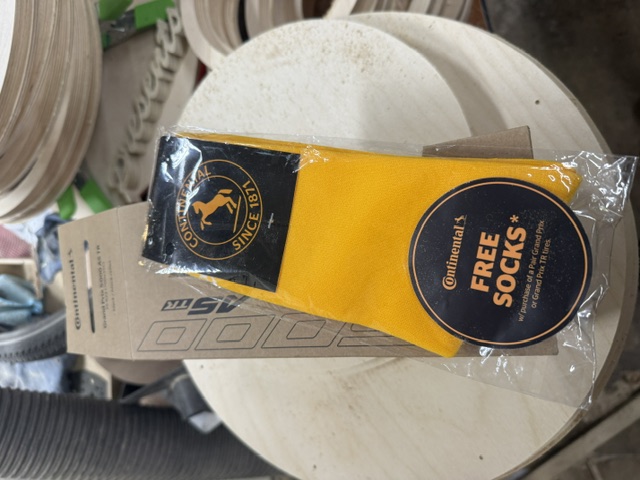
are socks tools?? free socks with tires.
IMG_2397.JPG
 
ju jian tec.jpeg


Through this forum I discovered that JIS screws are really Phillips. If I don't know in advance which #2 crosshead screwdriver will best fit a screw, maybe Phillips screws and drivers are easy to damage, and a little damage can make a big difference. Maybe I should stick with easy-to-replace bits.

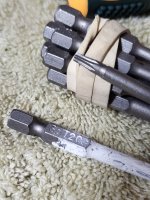
I love my set of ISO ball-end hex keys. Then I saw this set. The removable caddy holds 8 Security Torx and 2 Phillips bits as clearly labeled as the hex keys, along with a magnetic adapter that fits the H8 key. It made changing brake fluid more convenient. To keep it on my bike, I'd remove the H10 key. If I still encounter Pozidriv screws, I can replace a couple of Torx bits with PZ.

From the outset, toolmakers favored hex keys for applying torque. Assembly lines adopted Phillips to keep power tools from snapping screws. The downside was that drivers needed frequent replacement. Torx was patented in 1967, when assembly-line drivers had reliable clutches. The selling point was long tool life. On an assembly line, a Torx driver would also outlast a hex driver. With a hex key, each pound of torque generates 1.75 pounds of radial force, trying to crush the driver and burst the socket. On an assembly line, that's wear and tear for the tool. Torx drivers generate very little radial force.

Security was also a reason Torx screws were used: consumers didn't have the drivers. When consumers bought Torx drivers, the Security Torx screw was invented.
 
When consumers bought Torx drivers, the Security Torx screw was invented.


You'll need a T-15 bit for your Tektro brakes, and an S2 T-20 bit for your Bafang motor, and to install a speed magnet on your spoke (a @spokewrench won't work 😁).

Installation And Servicing of Bafang products is for Professionals only !! 😁
 

Attachments

  • 20260716_205603.jpg
    20260716_205603.jpg
    398.1 KB · Views: 15
  • 20260716_210046.jpg
    20260716_210046.jpg
    144.7 KB · Views: 16
  • 20260716_210206.jpg
    20260716_210206.jpg
    194.9 KB · Views: 17
  • 20260716_205528.jpg
    20260716_205528.jpg
    216.9 KB · Views: 18
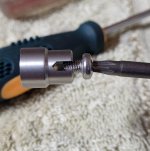
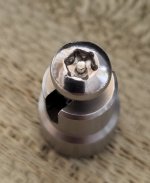
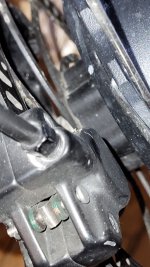
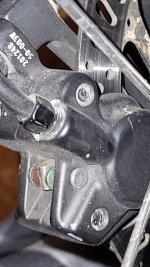
I also needed a T-30 for a bolt that, it turned out, held the caliper together.

That's not a T-30 (but it does kinda fit in a sloppy way)
It's an H-5mm


20260716_221212.jpg
20260716_221232.jpg


These bits will allow me to ruin more equipment than ever before.

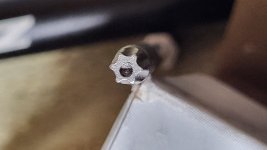
Well, chances are pretty good that your T-30 will ruin your Hex bolts.

If your 5mm Hex key no longer fits your caliper bolts, then the damage is already done.
 
This was 1 of 2 T-30 screws that hold the halves of the caliper together. Tektro really didn't want me to remove it. I showed them!

Huh, I dunno 🤔

My two halves are pinned or riveted together,..

Looks like I'll have to drill them out if I wanna open up my calipers?

It's probably your fault ya know.
They heard about what you did and put up a Firewall. 😁
 

Attachments

  • 20260716_224531.jpg
    20260716_224531.jpg
    201.4 KB · Views: 17
  • 20260716_224501.jpg
    20260716_224501.jpg
    219.5 KB · Views: 22
Huh, I dunno 🤔

My two halves are pinned or riveted together,..

Looks like I'll have to drill them out if I wanna open up my calipers?

It's probably your fault ya know.
They heard about what you did and put up a Firewall. 😁
proprietary equals more junk in toolbox!( new old Celtic saying)
 
Through this forum I discovered that JIS screws are really Phillips. If I don't know in advance which #2 crosshead screwdriver will best fit a screw, maybe Phillips screws and drivers are easy to damage, and a little damage can make a big difference. Maybe I should stick with easy-to-replace bits.
I shopped at Amazon for a set of Phillips bits, and some advertised altered shapes to avoid camout (the reason factories adopted Phillips). So screwdriver manufactures are taking liberties with the Phillips name, and maybe screw manufacturers are, too. Where camout would be bad, why not use Pozidriv? (In the 1970s, I often encountered Reed & Prince crosshead screws, a crosshead that with the right driver, didn't cam out.)

Better yet, if a designer doesn't want camout, why not use Allen or Torx? I'm impressed that like 12-point sockets, Torx don't require a tight fit. Yesterday I broke loose a screw on my brake rotor before realizing the bit was too small. No damage. The correct bit also fit loosely.

The other day I put up an outdoor railing. Each of 4 brackets was to be secured with 4 20mm M5 screws with #2 crossheads. My Klein, which usually works, didn't. Neither did a PZ2 or a PH2 bit. My old Craftsman worked beautifully.

With coarse, thin threads, these screws looked like what you'd use for tin roofing. I suppose most people use power tools for kits like this, and those threads wouldn't stand much torque. I guess the screw manufacturer used a Phillips variation designed to cam out easily, and it took the right variation of a Phillips driver to put even a little torque on it.
 
Last edited:
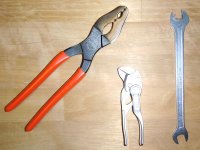
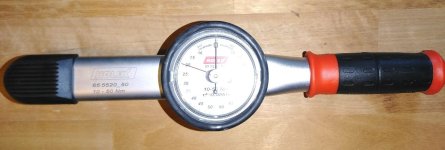
My latest new tools, cone wrench (my old one is presumably now very happy with an unknow co-worker...) and a nut wrench for tight spots, also very thin spanner for balljoints and a checking tool for torque on bolts.
 

Attachments

  • IMG_20260722_132401.jpg
    IMG_20260722_132401.jpg
    169.8 KB · Views: 7
  • IMG_20260722_132449.jpg
    IMG_20260722_132449.jpg
    79.1 KB · Views: 7
Yesterday I repaired a bike with a chopstick. The connection pins to the rear hub motor were bent. Another bike, a Velotric was attacked by a cat who bit through the display wires and shorted it. I spliced it and did a system reset. It took all of ten minutes. Who ever heard of a cat attacking a bike? A cat biting live wires will soon get a visit by Karma holding hands with Darwin.
 
I have a cat that likes to chew on my USB cables. I am sure that if he bit down on a live high voltage wire it would cure him of this bad habit.
 
I just made this. Karma and Darwin holding hands while they visit a SurRon kid. Or, maybe a cat that chews wires.

1784752346888.png
 
Back