Do you file depth gauges on safety chain?

spokewrench

Well-Known Member
Region
USA
In the 80s I heated with wood. Filing teeth left a burr, which wore quickly. Sharpening was imprecise the chain would rock in the bar groove.

I got a Craftsman electric sharpener: a Dremel tool with a stone and guide. A Dremel typically spun at 20-35 thousand rpm. Contact before the stone was perfectly aligned meant damage to the tooth. With each sharpening, teeth became less uniform. Grinding often produced yellow sparks (1000 C) or white sparks (1200 C). Steel can lose its temper at 204 C. That explained why a fine edge quickly lost its keenness. The stone needed pressure because it was clogged with bar oil. More pressure meant higher temperatures.

The situation reminded me of my uncle’s farm in Connecticut and my grandfather’s in North Carolina. Both had bench grinders, but it was their old pedal grinders that they kept close. Before electrical power, some were made with chain drives for speed, but theirs were direct drive, which had always been more popular. At a comfortable cadence, surface speed was maybe 4 mph. What’s more, they had funnels designed to run water on the slowly moving stone. My uncle and my grandfather knew the importance of maintaining temper.

When I bought a chainsaw in 2017, diamond burrs were 4 for $10. Maybe they wouldn’t clog like stones, or they could be cleaned. That might allow me to save edge temper with a light touch. A diamond point vaporizes at 850 C, so a light touch would be important.

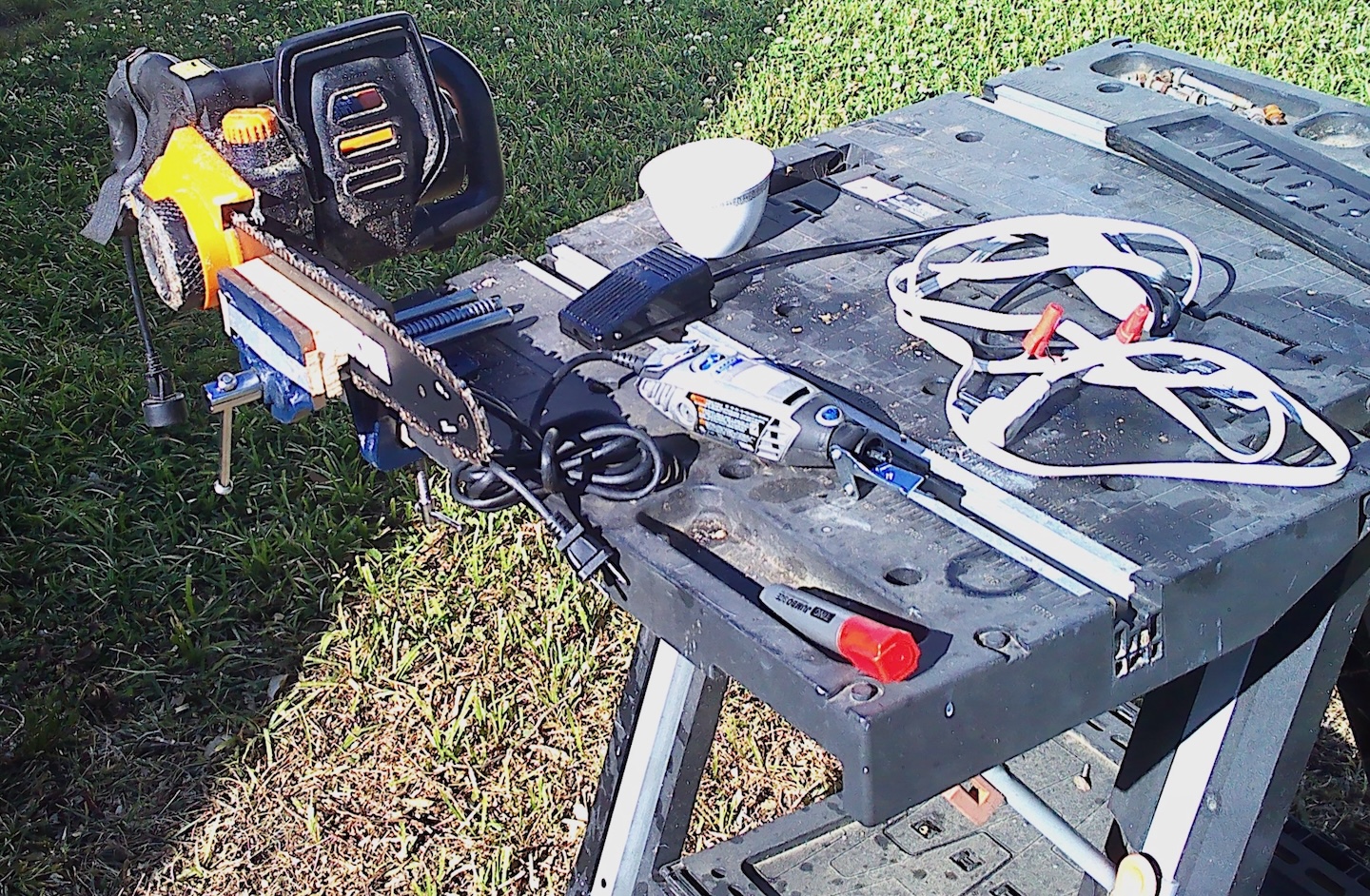
A foot switch would let me spin the burr only after it was properly positioned. I used wire nuts to splice the switch into an extension cord. I tinned the stranded conductors for stiffness, snipped them to the proper length, and screwed the wire nuts down to clamp the wires where they were insulated and not only where they were bare. Those connections have been trouble-free in 9 years of unpacking, use, and repacking. (In the photo, the red marker is to paint a top plate so I'll know when I've been around. The cup holds soapy water to dip my burr. Maybe it will keep it cleaner, and maybe it will keep a tooth a little cooler.)

Sharpened this way, the chain held its edge as well as a new chain. It might have needed only 1 or 2 touch-ups a year if I hadn’t used to to cut stumps flush with the ground. I’d remove all the soil I could with a trowel, rake, and brush, but of course the wood was gritty enough to dull a chain.

Sometimes an accidental bump would produce sparks. In 2022, I bought an adjustable-speed Dremel tool. At a slower speed, I’m sure there’s less risk of taking the temper out of an edge or burning diamonds. I began wearing a magnifying visor over my reading glasses to see precisely what I was doing.

In the past month I’ve sharpened 3 times because I’ve cut several stumps flush. The sharp teeth weren’t very aggressive. I realized that in 9 years I’d never filed the depth gauges. I guess that shows how little metal I’d needed to remove each time I sharpened.

I ordered an Oregon depth gauge tool and flat file. That’s when I realized that the tie straps on my chain are almost as high as the depth gauges. The tool wouldn’t work until I lengthened the slot with the Dremel tool. To get the required .025”, I had to take extra strokes after removing the tool, taking care not to hit the tooth. The steel of some depth gauges was much harder than others.

I never had much trouble with depth gauges in the 80s. Then I discovered that replacement chains cost only 3 for $21. I plan not to mess with depth gauges again. How about you?
chainsaw.jpeg
 
I'm very simple compared to you. Just like a kitchen knife that gets a pass over a steel every use and maybe once a year gets on a sharpener, unless you hit the dirt with the chain a quick pass with a file should keep the chain cutting efficiently.

I don't cut like I used to, but when we were heating with wood, 2 chains lasted me through the several cords of wood we cut. Once done for the season, saw and blades went to pro for sharpening and truing the bar.
 
I switched to carbide chains. Yes, you need a diamond burr sharpener, but it only needs to be done every couple of years.
 
I'm very simple compared to you. Just like a kitchen knife that gets a pass over a steel every use and maybe once a year gets on a sharpener, unless you hit the dirt with the chain a quick pass with a file should keep the chain cutting efficiently.

I don't cut like I used to, but when we were heating with wood, 2 chains lasted me through the several cords of wood we cut. Once done for the season, saw and blades went to pro for sharpening and truing the bar.
I see that Oregon professional chain sharpeners are bench models using grinding wheels advertised to "resist burning of cutters and leave a clean, sharp finish." I guess professional sharpening saves the temper.
 
Last edited:
I switched to carbide chains. Yes, you need a diamond burr sharpener, but it only needs to be done every couple of years.
I wonder why they don't have carbide razor blades for shaving.

At Oregon's site, they advertise 9 families of chain. Duracut is the family for harsh and abrasive environments. "Advanced plating process with extra layers of chrome extends sharpness up to three times longer than conventional saw chain."

Carbide sounds like a great idea. I wondered why they don't offer it. Wikipedia says it's more brittle than steel, which would be a problem for a fine edge violently hitting wood. Carpet installers swear by carbide utility knife blades, but a chef wouldn't want it. Maybe Oregon has found that a pro can cut more in a day with chromium.
 
Last edited:
I wonder why they don't have carbide razor blades for shaving.

At Oregon's site, they advertise 9 families of chain. Duracut is the family for harsh and abrasive environments. "Advanced plating process with extra layers of chrome extends sharpness up to three times longer than conventional saw chain."

Carbide sounds like a great idea. I wondered why they don't offer it. Wikipedia says it's more brittle than steel, which would be a problem for a fine edge violently hitting wood. Carpet installers swear by carbide utility knife blades, but a chef wouldn't want it. Maybe Oregon has found that a pro can cut more in a day with chromium.
Carbide chains don't cut quite as fast as standard types. I'm told it's due to the thicker cutting edge. They can't create as fine an edge due to it's more brittle nature. Pro's generally don't use them for this reason, but I can live with it rather than use a sharpener more frequently. IMO, a carbide chain cuts like a slightly dull standard chain creating smaller chips but I only have to sharpen it every 2 years or so with the moderate amount of cutting I do.
 
Im filled with shame typing this. I've worked with chainsaws for 28 years and have never sharpened a chain! I've even been to our in house servicing schools, and I guess i avoided the chain section of the classes. I am in the process of buying a mower blade sharpening kit though.
 
I remember when I was about 16 and my dad borrowed a chainsaw to cut up some wood, and it was dull AF and completely useless.
So being as we had nothing to do, I took it to the garage, found a Dremel stone bit, and ground the stone down to the diameter of the file for sharpening the chain (I remember that there was two different sizes)

I Completely Suck at using the damn file and had No luck with it.

It took me about ½ hour to make the bit and try to sharpen the saw, then I gave it to my dad to try it again.
He was actually impressed, and noticed the difference in seconds


,.. I am in the process of buying a mower blade sharpening kit though.


Just take the grinder to it.
Takes 10 minutes.
You don't even have to remove the blade from the mower.

It's a lawnmower not a French Chef Knife. 😁

(unless it's one of those gutless battery mowers. They need all the help they can get to get your lawn cut. Lol)
 
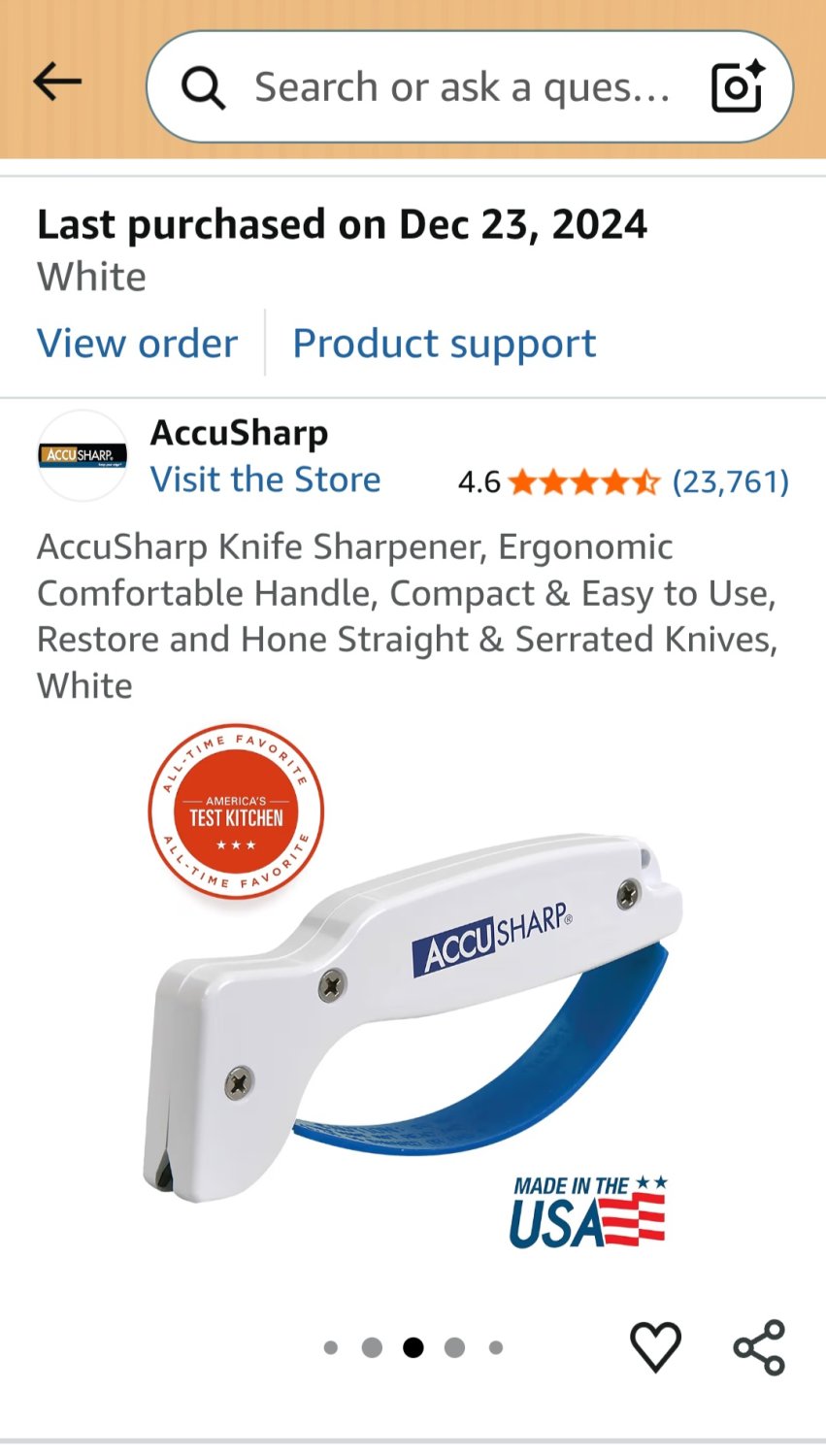
@spokewrench do you have one of these for sharpening knives??,..


Screenshot_20260525_165904_Amazon Shopping.jpg


It's the Only knife sharpener that I've tried (at least a dozen) that actually Works for me!!

I had even more trouble sharpening a knife than sharpening a chainsaw chain.


This thing Just Fricken Works,.. Easily.
And it's made in America.
It ain't junk, but its a stupid simple design with ergonomics built into the design.

I've even managed to sharpen my kitchen shears with it because the cutting blade had more of a knife edge, and I could hold one cutting blade flush with the flat side of the shear blade and the second cutting blade put a proper edge on the shear blade.

The blade was dull and could only cut through chicken bones, but couldn't cut the skin or plastic packaging anymore like when it was new, so I had to use two pairs of scissors to cut up a whole chicken.
Now I can do the whole job with one pair of scissors again.


20260525_171741.jpg
 
Last edited:
I have a Dremel style sharpener but I hand file mine usually. I burn about 1 to 2 chords per year so I do a fair amount of cutting. The part of the chain that controls the depth of your cut is called a raker and yes you should lower them. They make a depth gauge to check your rakers, you don’t need to lower them every time you sharpen. I sharpen often, every tank or two of fuel and it probably takes me about 5 minutes. A picture of my tools from a couple of weeks ago.
IMG_2026-05-03-112857.jpeg
 
@spokewrench do you have one of these for sharpening knives??,..

It's the Only knife sharpener that I've tried (at least a dozen) that actually Works for me!!

I've depended on this since 2019. I bought it to replace something similar I'd bought from LL Bean in 1984. (After only 35 years of frequent use, the plastic stone holder broke. I still use those diamond stones freehand, maybe to remove the burr after I sharpen a mower blade.)

Before 1984, this was what worked best for me.

When you say to use a grinder on a mower blade, do you mean an angle grinder? That's what a lot of pros recommend. They say not to grind sharper than a butter knife because the blades won't hold an edge anyway. I switched to a 1/2" belt sander. It hits the blade ten times slower, so you can keep your fine edge below the critical 204 C.
 
Last edited:
I've depended on this since 2019.

Before 1984, this was what worked best for me.

Yeah, those sharpeners are similar to everything that I had tried.
With the accusharp, you pull the sharpener along the knife blade instead of pulling the knife blade along the sharpener.
That keeps your hand an inch away from where the cutting blades are contacting the knife edge, and it's Way Easier to keep everything lined up squarely.

You're always an inch away from where the cutter is contacting the knife edge, instead of reaching out the full length of the knife blade to contact the cutter.

It's a bit like having a Dremel bit that would have a 6" shaft holding the grinding stone.
It's too difficult to control the stone when it's way out in front of the tool.

When you say to use a grinder on a mower blade, do you mean an angle grinder?

Yeah, I meant an angle grinder.

Sharpening a lawnmower blade vs. sharpening a kitchen knife, is like the difference between sharpening a wood chisel vs. a masonry chisel.
 
In the 80s I heated with wood. Filing teeth left a burr, which wore quickly. Sharpening was imprecise the chain would rock in the bar groove.

I got a Craftsman electric sharpener: a Dremel tool with a stone and guide. A Dremel typically spun at 20-35 thousand rpm. Contact before the stone was perfectly aligned meant damage to the tooth. With each sharpening, teeth became less uniform. Grinding often produced yellow sparks (1000 C) or white sparks (1200 C). Steel can lose its temper at 204 C. That explained why a fine edge quickly lost its keenness. The stone needed pressure because it was clogged with bar oil. More pressure meant higher temperatures.

The situation reminded me of my uncle’s farm in Connecticut and my grandfather’s in North Carolina. Both had bench grinders, but it was their old pedal grinders that they kept close. Before electrical power, some were made with chain drives for speed, but theirs were direct drive, which had always been more popular. At a comfortable cadence, surface speed was maybe 4 mph. What’s more, they had funnels designed to run water on the slowly moving stone. My uncle and my grandfather knew the importance of maintaining temper.

When I bought a chainsaw in 2017, diamond burrs were 4 for $10. Maybe they wouldn’t clog like stones, or they could be cleaned. That might allow me to save edge temper with a light touch. A diamond point vaporizes at 850 C, so a light touch would be important.

A foot switch would let me spin the burr only after it was properly positioned. I used wire nuts to splice the switch into an extension cord. I tinned the stranded conductors for stiffness, snipped them to the proper length, and screwed the wire nuts down to clamp the wires where they were insulated and not only where they were bare. Those connections have been trouble-free in 9 years of unpacking, use, and repacking. (In the photo, the red marker is to paint a top plate so I'll know when I've been around. The cup holds soapy water to dip my burr. Maybe it will keep it cleaner, and maybe it will keep a tooth a little cooler.)

Sharpened this way, the chain held its edge as well as a new chain. It might have needed only 1 or 2 touch-ups a year if I hadn’t used to to cut stumps flush with the ground. I’d remove all the soil I could with a trowel, rake, and brush, but of course the wood was gritty enough to dull a chain.

Sometimes an accidental bump would produce sparks. In 2022, I bought an adjustable-speed Dremel tool. At a slower speed, I’m sure there’s less risk of taking the temper out of an edge or burning diamonds. I began wearing a magnifying visor over my reading glasses to see precisely what I was doing.

In the past month I’ve sharpened 3 times because I’ve cut several stumps flush. The sharp teeth weren’t very aggressive. I realized that in 9 years I’d never filed the depth gauges. I guess that shows how little metal I’d needed to remove each time I sharpened.

I ordered an Oregon depth gauge tool and flat file. That’s when I realized that the tie straps on my chain are almost as high as the depth gauges. The tool wouldn’t work until I lengthened the slot with the Dremel tool. To get the required .025”, I had to take extra strokes after removing the tool, taking care not to hit the tooth. The steel of some depth gauges was much harder than others.

I never had much trouble with depth gauges in the 80s. Then I discovered that replacement chains cost only 3 for $21. I plan not to mess with depth gauges again. How about you?

View attachment 210423
amen,too aggressive on the depth gauge makes a chain more kickback prone and jerky,the general consensus is the depth gauges don't really need any attention till later on in the chains life.If you rock or hit metal a couple times the best thing to do is discard the chain,the set is gone and the teeth are not uniform, the first set of "Tallox" chains I bought were as good as any Oregon,Stihl,( ugh Carlton) chains I had ever bought at a fraction of the cost the second set not so much,the correct file size has a bearing on performance,I always liked the 72 LP profile( fast cutting easy to file with a semblance of good cutting.
I wonder why they don't have carbide razor blades for shaving.

At Oregon's site, they advertise 9 families of chain. Duracut is the family for harsh and abrasive environments. "Advanced plating process with extra layers of chrome extends sharpness up to three times longer than conventional saw chain."

Carbide sounds like a great idea. I wondered why they don't offer it. Wikipedia says it's more brittle than steel, which would be a problem for a fine edge violently hitting wood. Carpet installers swear by carbide utility knife blades, but a chef wouldn't want it. Maybe Oregon has found that a pro can cut more in a day with chromium.
I think you can get a razor made of the second hardest material on the "Mohs" scale,"Speciality Blades" used to make industrial blades of this material,the( was it Alumina"?)or sapphire? pretty expensive though seen them advertised years back.You can also get "carbide" lawnmower blades these days.Carbide chains were a favorite with fire departments,had some kind of a blue circular saw blade( maybe Hercules) best blade I ever had it laughed at nails,never had one that good since.
 
Yeah, those sharpeners are similar to everything that I had tried.
With the accusharp, you pull the sharpener along the knife blade instead of pulling the knife blade along the sharpener.
That keeps your hand an inch away from where the cutting blades are contacting the knife edge, and it's Way Easier to keep everything lined up squarely.

You're always an inch away from where the cutter is contacting the knife edge, instead of reaching out the full length of the knife blade to contact the cutter.

It's a bit like having a Dremel bit that would have a 6" shaft holding the grinding stone.
It's too difficult to control the stone when it's way out in front of the tool.


Yeah, I meant an angle grinder.

Sharpening a lawnmower blade vs. sharpening a kitchen knife, is like the difference between sharpening a wood chisel vs. a masonry chisel.
30 degree angle on one side for lawn mower blades,helps beat the grass off cleaner.
 
Im filled with shame typing this. I've worked with chainsaws for 28 years and have never sharpened a chain! I've even been to our in house servicing schools, and I guess i avoided the chain section of the classes. I am in the process of buying a mower blade sharpening kit though.
its an art some wood cutters I have worked with could freehand a chainsaw chain to like new performance one thing I noticed if your teeth get to be different lengths the saw will tend to cut in a circle,I used to cut timber and right of way wore out many chains some chains would get so worn they would break( down to the rivets and even lose a tooth) the boss was stingy with chains,one time he bought a roll of chain and a length chart,I used to make up chains for the crew,never had one break,so its pretty safe,when you buy a chain make sure the gauge,pitch and spacing are right.
 

I've depended on this since 2019. I bought it to replace something similar I'd bought from LL Bean in 1984. (After only 35 years of frequent use, the plastic stone holder broke. I still use those diamond stones freehand, maybe to remove the burr after I sharpen a mower blade.)

Before 1984, this was what worked best for me.

When you say to use a grinder on a mower blade, do you mean an angle grinder? That's what a lot of pros recommend. They say not to grind sharper than a butter knife because the blades won't hold an edge anyway. I switched to a 1/2" belt sander. It hits the blade ten times slower, so you can keep your fine edge below the critical 204 C.
I used to use "crock sticks" works almost like a butchers steel,I seen an old knife sharpener made of washers,worked surprisingly well,in prison the convicts sharpened tin cans with the sidewalk( for cutting up commissary not shanks)
 
I remember when I was about 16 and my dad borrowed a chainsaw to cut up some wood, and it was dull AF and completely useless.
So being as we had nothing to do, I took it to the garage, found a Dremel stone bit, and ground the stone down to the diameter of the file for sharpening the chain (I remember that there was two different sizes)

I Completely Suck at using the damn file and had No luck with it.

It took me about ½ hour to make the bit and try to sharpen the saw, then I gave it to my dad to try it again.
He was actually impressed, and noticed the difference in seconds


Just take the grinder to it.
Takes 10 minutes.
You don't even have to remove the blade from the mower.

It's a lawnmower not a French Chef Knife. 😁

(unless it's one of those gutless battery mowers. They need all the help they can get to get your lawn cut. Lol) are they that bad,I have a string trimmer and electric blower,I will never go back to gas on those things!
 
are they that bad,I have a string trimmer and electric blower,I will never go back to gas on those things!


I've got a battery powered trimmer and blower, and they work fine.

I was considering buying a battery powered lawnmower and after reading all kinds of reviews on different mowers, I decided against it.

The biggest complaint was lack of power, and lack of run time.
Like a 20 minute run time then 4-5 hours to charge the batteries. So it takes 2-3 days to get your grass cut.

Or simply not enough power to cut through long grass.

It's a bit like buying an ebike that needs to go 50 mph. You need Huge batteries and a Huge motor, then everything gets heavy and expensive.
The battery powered lawnmowers are about 4 times the price of a gas mower, and some of the brand name lawnmower manufacturers have battery operated mowers available.

If I were ever to get one, I'd want to try it first, and that can be difficult to do.

I had a corded electric mower years ago and it was a gutless piece of crap too.
They have to have a really narrow cutting swath to help it cut.

It would draw ~12 amps from the 120VAC outlet, so over 1,400 watts to make a small gutless electric lawnmower.
 
Last edited:
30 degree angle on one side for lawn mower blades,helps beat the grass off cleaner.
I love a 1/2" belt sander, and it's not only because of the slow and variable speed and the ease of changing grit size. The length makes it easy to stay on the bevel. I paint the bevel with a felt tip pen. If the sander removes the "paint" from top to edge, I'm on the bevel, and it's easy to keep the sander at that angle until I stop to check the edge. If I want to do more grinding, I repaint the bevel.
 
Back