Chargeride
Well-Known Member
Whichever one is working that day



Wait till they both fail then you won’t have to worry about hitting the brakesWhichever one is working that day


But when they both fail.... which one should you use first?Wait till they both fail then you won’t have to worry about hitting the brakes
I am sure I would have a heart attack and not have to worry about itBut when they both fail.... which one should you use first?




Exactly... anything else is just plain stupidOn dry pavement the front brake does most of the stopping, because weight transfers forward under braking. So for a quick stop you generally want both brakes, with a smooth squeeze on the front and the rear used to stabilize.
I don’t really think in terms of “which first” — I feather the rear, then progressively load the front. In low traction (wet/gravel) you use less front and keep everything smooth to avoid lockups. Rear-first as a habit can mean longer stopping distances, but grabbing front too hard is what sends people over the bars.
Rule of thumb: both brakes, smooth + progressive, adjust front/rear bias to conditions.

You must be a NYC bike messengerBrakes, who needs them; they only slow you down.

Factz...and practice sober, and then after a few drinks. The computer doesn't react the same and it's good to know, if you're not wanting to kiss the pavement.

Brakes are for wimps.

In 1969, BMW motorcycles adopted Porsche fade-proof brake linings. That was a disgusting marketing decision. I've never heard of brake fade on a motorcycle, and if these linings absorbed moisture from the air, touching them could lock the wheel, especially the front wheel, with dual leading shoes. I had to be ready to release a brake in milliseconds, before the situation proved fatal. A couple of very brief locks would dry the linings so I could use the brake.
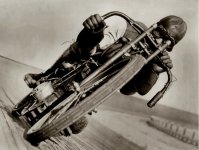
That was the least of their problems. Some tracks were only 1/2 mile and banked at 50 degrees. A racer who went down would be impaled with large splinters, often fatally. Control of a motorcycle was tenuous, and when one flew over the rim, there could be mass decapitations. I wonder if any champions lived to see 1930, when maintenance costs drove wood tracks out of business.Brakes are for wimps.
In the 1910s/1920s, board track racer motorcycles traveled at 100 mph and had no brakes! Unthinkable today.