What are the 5 slots on an Aventon battery?

If you don't want to believe me... Listen to Professor Google 🙃

Do you silicone grease conductors or connector housing?

Silicone grease is used to seal the connector housing and exterior terminals, rather than the mating surface of the conductors themselves. It is an electrical insulator. Applying it directly between mating electrical contacts can increase resistance and cause connection failures, though it creates an excellent weather barrier on the outside.

Connector Housing (Yes)What it does:
Silicone grease provides a protective barrier on weather packs, O-rings, and rubber seals.
Benefits: It prevents water, salt, dust, and debris from reaching the pins.
It also lubricates the plastic components, making the connectors much easier to plug in and uncouple without damaging the seals.

Conductors / Mating Pins (No)
What it does:
Because it is an electrical insulator (dielectric), it blocks the flow of electricity if it sits between the metal-on-metal contact points.
The risk: Coating the conductive pins can introduce a resistive barrier, leading to voltage drops, intermittent disconnections, and localized heating.
For low-voltage or signal-level circuits, this can completely disable the connection.

Best Practices for Application
Make the connection first: Always ensure the wire-to-wire or pin-to-pin mechanical connection is fully seated and secured.
Apply to the exterior: Smear a thin coat on the back of the connector wire seals, the connector’s outer mating lip, or over exposed exterior hardware (like battery terminals) after they are tightened.
Use a contact enhancer if necessary: If you are looking to protect metal contacts from corrosion while improving conductivity, a specific conductive grease (not silicone-based) should be used.

Full disclosure... Google nor I are certified RCA engineers 🙃
 
Last edited:
I used to grease spark plug boots so they wouldn't stick. Another benefit was to keep dampness out. Silicone grease is hydrophobic, so condensing moisture wouldn't creep under the boot. Other kinds of grease could have lubed and kept moisture out, but voltage from the wire might have followed the film of grease to ground. That's where "dielectric" comes in. Popular wisdom said to be careful not to get it on the terminal at the top of the plug. I believed it until I read the article by the engineer. Experts say it's good to get silicone grease on the metal because it can prevent corrosion.

Under "Electrical Use (dielectric grease):
"Such greases are formulated to withstand the high temperature generally associated with the areas in which spark plugs are located, and can be applied to contacts as well (because the contact pressure is sufficient to penetrate the grease film). Doing so on such high-pressure contact surfaces between different metals has the further advantage of sealing the contact area against electrolytes that might cause rapid deterioration of the metals by galvanic corrosion."

Other greases could cause trouble. I had an old car with a stalk on the left side of the steering column that controlled relays for turn signals and high-low beams. Nissan has used white grease to keep the contacts from oxidizing. In time, oxidation hardened the grease so that it prevented metal-to-metal contact. Silicone grease would not have hardened.
 
Context... Context...
Spark plugs operate at tens of thousands of volts.
Additionally it's a very tight connection, displacing the grease when mated. (you're post states this)

Now.... See Post # 18
 
Last edited:
Back in 1981 we had to call Bell Canada because there was something wrong with our phones ??
(I cut the phone line. 😁)

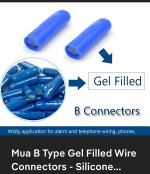
When the Bell dude showed up, he reconnected the telephone wires with these,..


Screenshot_20260605_125359_DuckDuckGo.jpg


Silicone grease filled quick connectors.

He simply stuffed the two wires into the connector (without stripping off the insulation) a pressed the button.

The metal "blade" crimped the wire while the button squeezed the jelly all around the connection and out where the wires went in.


I remember seeing bare copper telephone wire at the junction box, and they were all dark brown with oxidation.

That's the kind of wire that won't take solder. It has to be cleaned off first.

If solder won't stick to dirty, corroded wires, then I would argue that electricity would also have a hard time conducting through the film of darkened oxidized copper.


Electronics and electricity are related but different.

The Cable TV guy was here last year and said that they are allowed to work with voltages up to 90 volts without a ticket.

Anything over 90 volts and it starts to tingle when you touch it. 😁

The Cable lines operate at ~70 Volts.

 

Attachments

  • Screenshot_20260605_130424_Gallery.jpg
    Screenshot_20260605_130424_Gallery.jpg
    233.4 KB · Views: 5
The only time I screwed something up was when I put it on a video cable connector and the video turned pale red.

I tried to remove it with contact cleaner and brake cleaner, but it didn't work.

I figure that the super high frequency of a video signal gets lost in the silicone?
Sounds like an RGB cable. Silicone grease has 2.5 to 3 times the capacitance (dielectric constant) of air, and that would affect high frequencies more than low. Was the connector flawless without grease? Maybe it fit too loosely to squeeze the grease out of the way.

Isopropyl alcohol above 180 proof is used to remove silicone grease.
 
Sounds like an RGB cable.

One of these connectors for my outdoor camera,..


20260605_140652.jpg


Silicone grease has 2.5 to 3 times the capacitance (dielectric constant) of air, and that would affect high frequencies more than low. Was the connector flawless without grease?

Yeah, it was fine.
I tried to make it better.
I didn't work. 😁

Maybe it fit too loosely to squeeze the grease out of the way.

I might cut out the connector and try to solder it ??


Isopropyl alcohol above 180 proof is used to remove silicone grease.


The highest % I've seen now is 70%.

They used to have isopropyl alcohol that was over 90%
 
One of these connectors for my outdoor camera,..

I might cut out the connector and try to solder it ??


The highest % I've seen now is 70%.

They used to have isopropyl alcohol that was over 90%
If it's a single cable, I don't know why grease would affect the color.

As an antiseptic, 70% is better than 90%. The water opens pores on the germ so the alcohol can get in.

Amazon has 99%, which is better as a solvent. This alcohol doesn't like salt. If you put salt in the 70% solution, the alcohol will form a separate layer from the water.
 
Back in 1981 we had to call Bell Canada because there was something wrong with our phones ??
(I cut the phone line. 😁)

When the Bell dude showed up, he reconnected the telephone wires with these,..


View attachment 210964


Silicone grease filled quick connectors.

He simply stuffed the two wires into the connector (without stripping off the insulation) a pressed the button.

The metal "blade" crimped the wire while the button squeezed the jelly all around the connection and out where the wires went in.


I remember seeing bare copper telephone wire at the junction box, and they were all dark brown with oxidation.

That's the kind of wire that won't take solder. It has to be cleaned off first.

If solder won't stick to dirty, corroded wires, then I would argue that electricity would also have a hard time conducting through the film of darkened oxidized copper.


Electronics and electricity are related but different.

The Cable TV guy was here last year and said that they are allowed to work with voltages up to 90 volts without a ticket.

Anything over 90 volts and it starts to tingle when you touch it. 😁

The Cable lines operate at ~70 Volts.

You guys are killing me with these.... "One time at band camp" stories.
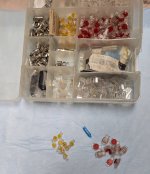
Yeah I've used those many times....
PXL_20260605_193639732~2.jpg

... do you know how they work?
Because I do.
I'll let Google explain as I'm getting bored with you two 🙃
Read the "Why this matters" part twice

Additionally these are permanent connections and you'll destroy the connector and wire trying to disassemble once installed.

So yeah... Exactly the same as the Julet connectors you'all struggling with on your ebike.
Context
old.gif
 
This is how I pack and seal my Julet connectors,..
YMMV 😁

20260605_172952.jpg
20260605_173337.jpg
20260605_173454.jpg


The connector tries to push itself apart while I'm connecting it.
I have to "burp" it by slightly wobbling the connector as I'm pushing.
You can hear the bubbles of air popping.


20260605_173515.jpg


And this is how I pack and seal my battery wires,..


20260307_145030.jpg
20260307_143309.jpg
20260307_143540.jpg
20260307_143722.jpg


This is how I made a Julet connector.
I didn't want to cut the connector off the brake switch because I only had a few inches of wire to work with and I didn't want to replace the switch.
(screenshots from an earlier post of mine),..


Screenshot_20260605_180657_DuckDuckGo.jpg


Screenshot_20260605_180920_DuckDuckGo.jpg
 
Last edited:
I've learned that in most situations. . .
Less is more, and more only when necessary.
ymmv

Yeah,.. I deleted and didn't install all kinds of stuff when I installed my BBS02B.

I sealed up all the connectors that I'm not using on the BBS02B with dielectric grease and covered them with shrink tube.


Screenshot_20260605_202819_Gallery.jpg

20260605_201547.jpg


I'm not using the wheel speed sensor, shift sensor, or headlight.


With the hub motor, I'm not using the head light or rear tail light, and I removed my PAS sensor, so I sealed up those connectors and tacked them to my seatpost with hot glue.

20260605_201645.jpg

20260605_201847.jpg


KISS - Keep it simple stupid?


Yeah my electric bicycle is Stupid Simple.

Just two throttles, two motors and two batteries with no unnecessary or proprietary hardware or software.


I'm keeping my brake switches for the hub motor, and adding brake switches to my brake levers for the BBS02B.

I'm gunna have a half twist throttle in each hand working two separate motors.
Shits gunna happen. 😁
 
Last edited:
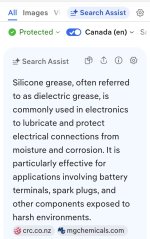
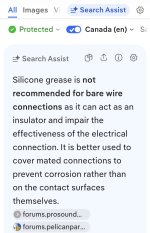
If you don't want to believe me... Listen to Professor Google 🙃

Do you silicone grease conductors or connector housing?

Silicone grease is used to seal the connector housing and exterior terminals, rather than the mating surface of the conductors themselves. It is an electrical insulator. Applying it directly between mating electrical contacts can increase resistance and cause connection failures, though it creates an excellent weather barrier on the outside.
I used to wonder why everyone used to say, "Don't get grease on battery posts or spark-plug terminals!" I'll bet they read it on the internet! And you have Google AI read it on the internet for you. If Google AI read it on the internet, it must be true!

Your AI internet education sure beats experience. You know what they say about education: "Those who can't do, teach."

Are you aware of the DeoxIT family of contact cleaners? I have a tub of DeoxIT Marine Grease. Grease is important in shipboard connectors to protect contacts from corrosion. Marine Grease goes further. It will increase conductivity.

I love Dow Molykote 111 for plumbing and pneumatic connections. Because it's silicone, hot water won't melt it, and high-pressure air won't oxidize it. It seals well because it's NLG I 3-4, almost like beeswax. For that reason, I would not use it on electrical contacts. Most silicone grease is NLGI 2, like peanut butter. RCA engineers found out decades ago that the contacts in TV tuners would easily cut through peanut-butter-grade silicone grease to make metal-to-contact. If you have often wondered why it was not necessary to crimp the contacts in a mechanical TV tuner each time you changed channels. NLGI 2 is the answer you were looking for.
 
You're a fuckin tool and I've said so since your first post and your 3 year struggle with valve cores.
If you paid attention you'd know that I'm an electrician by trade and i have far more experience with this s*it than you do.
But really all you need to know is you're the one with constant issues... Not me.
So have a nice day d_bag... I'm off to buy stock in silicone grease, I hear there's going to be a huge demand in the near future 🙃
Post # 18
 
I'll let Google explain as I'm getting bored with you two 🙃

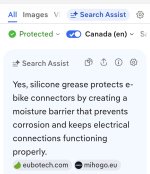
I read the Google Explanation, and I followed all the basic principles while making my connections.

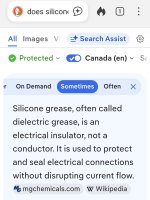
The biggest take-away for me was this,..


Screenshot_20260605_230713_DuckDuckGo.jpg


,.. as an electrician we were always taught to keep metal to metal contacts clean and free of any contaminants.

That makes sense to me when working with voltages over the 90 volt limit for cable TV, Telephone, and Automotive technicians.

I'm allowed to work on my cars electrical systems without an electricians ticket.

I used to have my car undercoated with synthetic oil every year.

He would hose down Everything in the entire engine bay including the battery, fuse box, and all the connectors.

I've got a can of the stuff, and I sprayed down the inside of my batteries to help protect them from corrosion.


I wouldn't even Think about spraying down my fuse panel with 240AC running through it.
 
Back