What are the 5 slots on an Aventon battery?

If you don't want to believe me... Listen to Professor Google 🙃

Do you silicone grease conductors or connector housing?

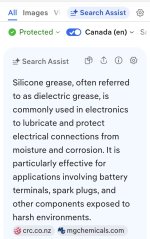
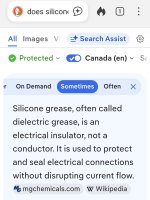
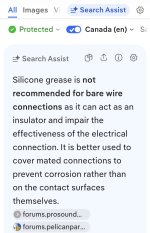
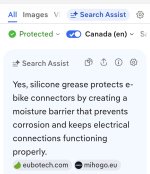
Silicone grease is used to seal the connector housing and exterior terminals, rather than the mating surface of the conductors themselves. It is an electrical insulator. Applying it directly between mating electrical contacts can increase resistance and cause connection failures, though it creates an excellent weather barrier on the outside.

Connector Housing (Yes)What it does:
Silicone grease provides a protective barrier on weather packs, O-rings, and rubber seals.
Benefits: It prevents water, salt, dust, and debris from reaching the pins.
It also lubricates the plastic components, making the connectors much easier to plug in and uncouple without damaging the seals.

Conductors / Mating Pins (No)
What it does:
Because it is an electrical insulator (dielectric), it blocks the flow of electricity if it sits between the metal-on-metal contact points.
The risk: Coating the conductive pins can introduce a resistive barrier, leading to voltage drops, intermittent disconnections, and localized heating.
For low-voltage or signal-level circuits, this can completely disable the connection.

Best Practices for Application
Make the connection first: Always ensure the wire-to-wire or pin-to-pin mechanical connection is fully seated and secured.
Apply to the exterior: Smear a thin coat on the back of the connector wire seals, the connector’s outer mating lip, or over exposed exterior hardware (like battery terminals) after they are tightened.
Use a contact enhancer if necessary: If you are looking to protect metal contacts from corrosion while improving conductivity, a specific conductive grease (not silicone-based) should be used.

Full disclosure... Google nor I are certified RCA engineers 🙃
 
Last edited:
I used to grease spark plug boots so they wouldn't stick. Another benefit was to keep dampness out. Silicone grease is hydrophobic, so condensing moisture wouldn't creep under the boot. Other kinds of grease could have lubed and kept moisture out, but voltage from the wire might have followed the film of grease to ground. That's where "dielectric" comes in. Popular wisdom said to be careful not to get it on the terminal at the top of the plug. I believed it until I read the article by the engineer. Experts say it's good to get silicone grease on the metal because it can prevent corrosion.

Under "Electrical Use (dielectric grease):
"Such greases are formulated to withstand the high temperature generally associated with the areas in which spark plugs are located, and can be applied to contacts as well (because the contact pressure is sufficient to penetrate the grease film). Doing so on such high-pressure contact surfaces between different metals has the further advantage of sealing the contact area against electrolytes that might cause rapid deterioration of the metals by galvanic corrosion."

Other greases could cause trouble. I had an old car with a stalk on the left side of the steering column that controlled relays for turn signals and high-low beams. Nissan has used white grease to keep the contacts from oxidizing. In time, oxidation hardened the grease so that it prevented metal-to-metal contact. Silicone grease would not have hardened.
 
Context... Context...
Spark plugs operate at tens of thousands of volts.
Additionally it's a very tight connection, displacing the grease when mated. (you're post states this)

Now.... See Post # 18
 
Last edited:
Back in 1981 we had to call Bell Canada because there was something wrong with our phones ??
(I cut the phone line. 😁)

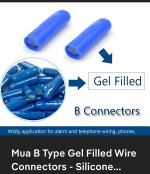
When the Bell dude showed up, he reconnected the telephone wires with these,..


Screenshot_20260605_125359_DuckDuckGo.jpg


Silicone grease filled quick connectors.

He simply stuffed the two wires into the connector (without stripping off the insulation) a pressed the button.

The metal "blade" crimped the wire while the button squeezed the jelly all around the connection and out where the wires went in.


I remember seeing bare copper telephone wire at the junction box, and they were all dark brown with oxidation.

That's the kind of wire that won't take solder. It has to be cleaned off first.

If solder won't stick to dirty, corroded wires, then I would argue that electricity would also have a hard time conducting through the film of darkened oxidized copper.


Electronics and electricity are related but different.

The Cable TV guy was here last year and said that they are allowed to work with voltages up to 90 volts without a ticket.

Anything over 90 volts and it starts to tingle when you touch it. 😁

The Cable lines operate at ~70 Volts.

 

Attachments

  • Screenshot_20260605_130424_Gallery.jpg
    Screenshot_20260605_130424_Gallery.jpg
    233.4 KB · Views: 3
The only time I screwed something up was when I put it on a video cable connector and the video turned pale red.

I tried to remove it with contact cleaner and brake cleaner, but it didn't work.

I figure that the super high frequency of a video signal gets lost in the silicone?
Sounds like an RGB cable. Silicone grease has 2.5 to 3 times the capacitance (dielectric constant) of air, and that would affect high frequencies more than low. Was the connector flawless without grease? Maybe it fit too loosely to squeeze the grease out of the way.

Isopropyl alcohol above 180 proof is used to remove silicone grease.
 
Sounds like an RGB cable.

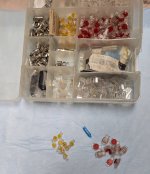
One of these connectors for my outdoor camera,..


20260605_140652.jpg


Silicone grease has 2.5 to 3 times the capacitance (dielectric constant) of air, and that would affect high frequencies more than low. Was the connector flawless without grease?

Yeah, it was fine.
I tried to make it better.
I didn't work. 😁

Maybe it fit too loosely to squeeze the grease out of the way.

I might cut out the connector and try to solder it ??


Isopropyl alcohol above 180 proof is used to remove silicone grease.


The highest % I've seen now is 70%.

They used to have isopropyl alcohol that was over 90%
 
Back