spokewrench
Well-Known Member
- Region
- USA
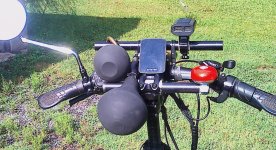
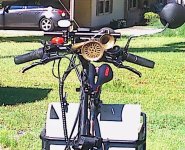
I shortened my 72cm Abound bar to a more traditional 54cm to make it easier to stay in control. Actually, because the Abound had riser bars, I used the flat bars from my Radmission. Their back sweep of 24 degrees was too much after they were shortened, so rotated them down to reduce it to 10 degrees. That rotation produced anhedral, like the wings of a Hawker Harrier or a C5. That downward slope of my handles was about 16 degrees.
I was better able to maintain control with one hand. As the bikesize site predicted, handling improved. On the second day, I realized I was charging into bumpy areas where I used to slow down because those bumps had been potentially painful, and now they weren't.
To get rid of that anhedral, I bought and shortened flat bars with only 6 degrees of back sweep. Professional racers like short bars for quick handling but describe steering as "twitchy" if they're too short. These 54cm bars without anhedral felt twitchy. For some reason, the 54cm bars with anhedral were more stable. Also, the bars without anhedral were making my wrists sore at the bases of my thumbs. I went back to the bars with anhedral. Now I noticed the pressure on the heels of my palms (the side opposite the thumb). The palm pads would leave prints, but that was okay because the heel of the palm is tough. At the same time, there was no pressure on the thumb side. Thumbs and forefingers circled grips for safety, but pressure was transmitted through heels.
The base of the thumb is farther inboard than the heel. When most of the pressure was at the base of my thumb, I figure that was like steering with a 38cm bar. That explains why it felt twitchy.
The trapesium is a tiny bone at the base of the thumb. Trapesiums often become inflamed, which can lead to arthritis or bursitis. Chronic inflammation can loosen the ligaments and tendons that hold the trapesium in place. Inflammation at the base of my left thumb was the big reason I hated my Radrunner and its tires. Where would I find alternate bars with a 9" rise? After 3 years, I bought a pair with a handle angle that looked better to me. Suddenly, bumps were comfortable, but it was too late. I now had two other bikes.
Bars with anhedral looked familiar. I finally realized they were typical on cafe racers. A cafe racer sat much farther behind the bars than a bicyclist with low bars. That means he put more weight on low bars, than a bicyclist. Even with a suspension, hitting bumps at 100 mph would transmit shocks through the wrists. I think anhedral was a way to keep the pressure on the heels of palms and off the bases of thumbs.
Yesterday I assembled an Adventure 3 for a neighbor. The bars have laser markings to show the correct position for the bars. Rotated that way, they have significant dihedral. I rode the bike and found that the pressure was on the heels of my palms and not the bases of my thumbs. Dihedral did for me on that bike what anhedral did on my bike.
I was better able to maintain control with one hand. As the bikesize site predicted, handling improved. On the second day, I realized I was charging into bumpy areas where I used to slow down because those bumps had been potentially painful, and now they weren't.
To get rid of that anhedral, I bought and shortened flat bars with only 6 degrees of back sweep. Professional racers like short bars for quick handling but describe steering as "twitchy" if they're too short. These 54cm bars without anhedral felt twitchy. For some reason, the 54cm bars with anhedral were more stable. Also, the bars without anhedral were making my wrists sore at the bases of my thumbs. I went back to the bars with anhedral. Now I noticed the pressure on the heels of my palms (the side opposite the thumb). The palm pads would leave prints, but that was okay because the heel of the palm is tough. At the same time, there was no pressure on the thumb side. Thumbs and forefingers circled grips for safety, but pressure was transmitted through heels.
The base of the thumb is farther inboard than the heel. When most of the pressure was at the base of my thumb, I figure that was like steering with a 38cm bar. That explains why it felt twitchy.
The trapesium is a tiny bone at the base of the thumb. Trapesiums often become inflamed, which can lead to arthritis or bursitis. Chronic inflammation can loosen the ligaments and tendons that hold the trapesium in place. Inflammation at the base of my left thumb was the big reason I hated my Radrunner and its tires. Where would I find alternate bars with a 9" rise? After 3 years, I bought a pair with a handle angle that looked better to me. Suddenly, bumps were comfortable, but it was too late. I now had two other bikes.
Bars with anhedral looked familiar. I finally realized they were typical on cafe racers. A cafe racer sat much farther behind the bars than a bicyclist with low bars. That means he put more weight on low bars, than a bicyclist. Even with a suspension, hitting bumps at 100 mph would transmit shocks through the wrists. I think anhedral was a way to keep the pressure on the heels of palms and off the bases of thumbs.
Yesterday I assembled an Adventure 3 for a neighbor. The bars have laser markings to show the correct position for the bars. Rotated that way, they have significant dihedral. I rode the bike and found that the pressure was on the heels of my palms and not the bases of my thumbs. Dihedral did for me on that bike what anhedral did on my bike.