You are using an out of date browser. It may not display this or other websites correctly.
You should upgrade or use an alternative browser.
You should upgrade or use an alternative browser.
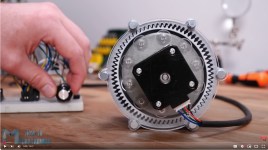
Another new TQ motor: hpr40
- Thread starter Calcoaster
- Start date



TRW
New Member
- Region
- Australia
That is indeed an interesting video but...Ran across the following video, helped me better understand how a Harmonic Drive works .https://www.youtube.com/watch?v=xlnNj9F37MA
The strain wave drive is quite different to the TQ HPR, it has a flexible element, the HPR has all rigid elements
The cycloidal drive is also similar but different, but is more similar in that all elements are rigid
TQ's HPR (Harmonic Pin Drive) is unique to TQ I believe (they have a patent!)
At the end of my video you can see how the HPR works
Last edited:

apctjb
Active Member
- Region
- USA
Thanks, I was wondering if there was a flexible element and if so the long term durability of that.The strain wave drive is quite different to the TQ HPR, it has a flexible element, the HPR has all rigid elements
The cycloidal drive is also similar but different, but is more similar in that all elements are rigid
TQ's HPR (Harmonic Pin Drive) is unique to TQ I believe (they have a patent!)
At the end of my video you can see how the HPR works

Jeremy McCreary
Bought it anyway
- Region
- USA
- City
- Carlsbad, CA
Wow, that guy's got skills — including video-making.Ran across the following video, helped me better understand how a Harmonic Drive works .https://www.youtube.com/watch?v=xlnNj9F37MA



stompandgo
Well-Known Member
- Region
- USA
Your numbers are ok for spitballing, but you are making a lot of assumptions about bike weight, rider weight, rider pedaling efficiency, cadence, and with the e-bike, drive unit efficiency. You can't just mash power numbers.yes, and even 150w of assist is really quite a lot on a road bike, that's the difference between a spirited amateur and a pro in a lot of cases. you won't go "fast" up a hill, but you'll go a lot faster than almost any human powered bike. beware though, with the small internal battery that sort of thing will drop the range very low. of course it's fairly rare to find hills that just keep going up at 10% for miles and miles, but if that's your jam....
an example climb here in san francisco might be mt diablo. to the top is around 10 miles and 3,200 feet of climbing, more or less without breaks, call it 6% the whole way. 150w from the bike and 150w from the rider would have you going 10mph the whole way (at which point you'd need to not be at 100% power on the x20, or you'd be drawing more than 150w), so it would take an hour and you'd use around 180wh of battery, which is 75% or so! of course you'd use none coming down, so the range in that scenario is around 25 miles.
i'd shoot for more like 75w from the bike and 150w from the rider and go 8mph. now it takes 1.25 hours, but you'll only use 120wh or so, and the climb only eats half the battery. now you've got enough juice to do a 40+ mile ride, depending on how much you use the battery on the flats. at 225w you're still going faster than almost anyone climbing on a road bike!
the problem with these bikes comes if the rider can't do 100-200w (the more the better), is very heavy, and/or the climbs get above 10% for any period of time. my last block on the way home is 14.5% and i really crawl up it on the addict if not feeling well. the HPR40 bikes would eat those climbs up, i'm sure, assuming gearing close to 1:1.

Jeremy McCreary
Bought it anyway
- Region
- USA
- City
- Carlsbad, CA
Excellent! Always wonder how the drawings and technical details needed for a video like this are obtained — e.g., CAD files and the 17.5 reduction. Are you connected with TQ somehow?Hopefully this is will be more enjoyable after that fiasco
Jeremy McCreary
Bought it anyway
- Region
- USA
- City
- Carlsbad, CA
Excellent! Always wonder how the drawings and technical details needed for a video like this are obtained — e.g., CAD files and the 17.5 reduction. Are you connected with TQ somehow?Hopefully this is will be more enjoyable after that fiasco

mschwett
Well-Known Member
- Region
- USA
Your numbers are ok for spitballing, but you are making a lot of assumptions about bike weight, rider weight, rider pedaling efficiency, cadence, and with the e-bike, drive unit efficiency. You can't just mash power numbers.
well, not really. we're talking about a specific bike - or at least a specific motor system which in a road bike means 23-30lb. not significant. i specifically mentioned rider weight, and 160-190lb probably covers most riders of this type of bicycle. a small difference, for sure, but in the previous message in the thread i stated 200lb. 25lb bike 175lb rider. pedaling "efficiency" is meaningless here, since i specifically referenced the rider's output power. how much energy it takes them to make 100w or 150w is only relevant to how tired it makes them, how much they have to refuel, etc. cadence is irrelevant, it's a hub motor. that's kind of the whole point of the discussion. of course you'll need appropriate gearing to make decent power down at 6-10mph, but again, if you aren't making the power, you aren't making the power.
drive unit efficiency is an interesting variable and one we don't definitively know about these small motors, but given the real-world results it would be pretty surprising for it be anything other than 70-80 percent in the ranges of speeds we're talking about.
i've owned and ridden an x20 bike for quite some time, thousands of miles, and it has a dual sided 4iiii power meter on it. i'm not speculating here, this is how the x20 system performs in the real world with a 200lb total load going up hills that range from 6 to 15 percent with rider outputs in the 100-200w range. i also had a 27lb creo before this, which i rode for many many more thousands of miles, and we know the performance characteristics of the SL system extremely well.
i wasn't just "mashing" power numbers, i pretty clearly stated the scenario and variables and the physics/math is pretty simple at these low speeds and steep grades. start going faster, and it becomes a real crapshoot with aero and friction and efficiency of a hub drive.
Last edited:
stompandgo
Well-Known Member
- Region
- USA
I don't know how your X20 would behave against the topic of this thread, the HPR40. I'll give you that. However, we will just have to agree to disagree about the rider stuff. You may not be spitballing, but you are drawing conclusions for others based on your one bike and your one power meter. I would never do that. If you've ever trained, raced, and coached with power, you'd understand that. It's not just "math". It never is.
Carry on.
Carry on.
mschwett
Well-Known Member
- Region
- USA
I don't know how your X20 would behave against the topic of this thread, the HPR40. I'll give you that. However, we will just have to agree to disagree about the rider stuff. You may not be spitballing, but you are drawing conclusions for others based on your one bike and your one power meter. I would never do that. If you've ever trained, raced, and coached with power, you'd understand that. It's not just "math". It never is.
Carry on.
i've had several different power meters on several different bikes - front hub, rear hub, mid-drive, acoustic - and we're not talking about training. we're talking about riding up hills on an ebike. going uphill at slow speeds is not racing, training, nor does it require coaching. of course training is not just math, and i never said it was. this is an e-bike forum, not slowtwitch or something...
TRW
New Member
- Region
- Australia
w
TQ have some exploded models that they display at various bike shows so the media tends to take plenty of photos of those which is helpful
It took me a long time to get the HPR50 right, but HPR40 was fairly easy because of the similarities. Also and the EuroBike show was shortly after the release so I found enough photos from that
Thanks. Not connected to TQ. I just look at photos and figure it out from there.Excellent! Always wonder how the drawings and technical details needed for a video like this are obtained — e.g., CAD files and the 17.5 reduction. Are you connected with TQ somehow?
TQ have some exploded models that they display at various bike shows so the media tends to take plenty of photos of those which is helpful
It took me a long time to get the HPR50 right, but HPR40 was fairly easy because of the similarities. Also and the EuroBike show was shortly after the release so I found enough photos from that
Last edited:
TRW
New Member
- Region
- Australia
Likewise, retired engineer (electronics), plenty of spare time to dabble with things of interest.I'm a retired engineer, and I had to watch those videos twice to figure out how it all works. It is an absolutely ingenious design that relies heavily on precision machining. I bet that any grit or dirt inside would wreck it in no time.
Probably if I was a mechanical engineer I wouldn't have been so intrigued by these motors and these videos would never have happened.
I like that you mention the precision machining, it is something I have heard TQ say that it one of their strengths.
stompandgo
Well-Known Member
- Region
- USA
But a human rides them. They don't ride themselves. You are using empirical data to draw conclusions using "math". If you've ever done any of those horrible, despicable things I've mentioned on an analog bike, you'd understand my point. I politely called you out on it, then you got nasty. See ya.i've had several different power meters on several different bikes - front hub, rear hub, mid-drive, acoustic - and we're not talking about training. we're talking about riding up hills on an ebike. going uphill at slow speeds is not racing, training, nor does it require coaching. of course training is not just math, and i never said it was. this is an e-bike forum, not slowtwitch or something...
apctjb
Active Member
- Region
- USA
Anyone know the ballpark efficiency (Power out/Power in) of the TQ40. I read that the downside of the Harmonic Drive is efficiency at the lower end of the range. Thanks to TRW I understand the TQ motor is unique and curious to learn if the benefits of the TQ come with a cost of lower efficiency and range?
Jeremy McCreary
Bought it anyway
- Region
- USA
- City
- Carlsbad, CA
FWIW, your call out didn't read polite to me.I politely called you out on it, then you got nasty.
mschwett
Well-Known Member
- Region
- USA
no, it wasn’t, and as most who have been around here for a while know, i’ve done plenty of “those things” on an analog bike. no matter, there’s an ignore list for a reason.FWIW, your call out didn't read polite to me.

Yako
Active Member
- Region
- Europe
Officially it’s 90%. I’m still putting the data together from my rides, but it’s not seeming to be inefficient in terms of average meters gained per full charge compared to the Mahle, for example. I‘m likely to use meters gained/Wh to take into account the difference in battery capacity (290Wh TQ, 350Wh Mahle in the Gain I tested) between the systems in my comparison video, though I’ll report on the overall range in m of each system (as it applies to me) too.Anyone know the ballpark efficiency (Power out/Power in) of the TQ40. I read that the downside of the Harmonic Drive is efficiency at the lower end of the range. Thanks to TRW I understand the TQ motor is unique and curious to learn if the benefits of the TQ come with a cost of lower efficiency and range?
apctjb
Active Member
- Region
- USA
Officially it’s 90%. I’m still putting the data together from my rides, but it’s not seeming to be inefficient in terms of average meters gained per full charge compared to the Mahle, for example. I‘m likely to use meters gained/Wh to take into account the difference in battery capacity (290Wh TQ, 350Wh Mahle in the Gain I tested) between the systems in my comparison video, though I’ll report on the overall range in m of each system (as it applies to me) too.
Thanks. 90% would be impressive. Looking forward to your upcoming reviews. And yes, comparing range can be difficult when you can't really measure Whr or Ahr or access the BMS data.
Calcoaster
Well-Known Member
- Region
- USA
Anyone know the ballpark efficiency (Power out/Power in) of the TQ40. I read that the downside of the Harmonic Drive is efficiency at the lower end of the range. Thanks to TRW I understand the TQ motor is unique and curious to learn if the benefits of the TQ come with a cost of lower efficiency and range?
When Specialized rolled out the Creo2 they published this chart comparing their new motor’s efficiency with the TQ hpr50 and others. I saw a lot of room for misleading marketing hype and I asked Spec if I could see their test data and methodology. Like “rider cadence between 80 and 100”, and how that could mean one motor tested at 100 while another at 80, or one at low load and another at maximum load, different temperatures, etc. They said it’s for “internal use only”.
Then I emailed TQ and asked for their comment and I was told they prioritized quietness over efficiency but it was better than the Specialized chart showed. That sounded like an honest (perhaps incomplete) answer. So looking at the chart I assume the specialized 1.2 sl is up to 80% under ideal conditions, likely less under real world conditions. And my assumption is that the TQ 50 is less than that, but at least 65%, and that low figure is probably under the least favorable conditions. All based on my interpretation of a marketing chart with no data supporting it.
Similar threads


- Replies
- 3
- Views
- 31K

- Replies
- 9
- Views
- 112K