bought a gas generator for myLiFePO power station

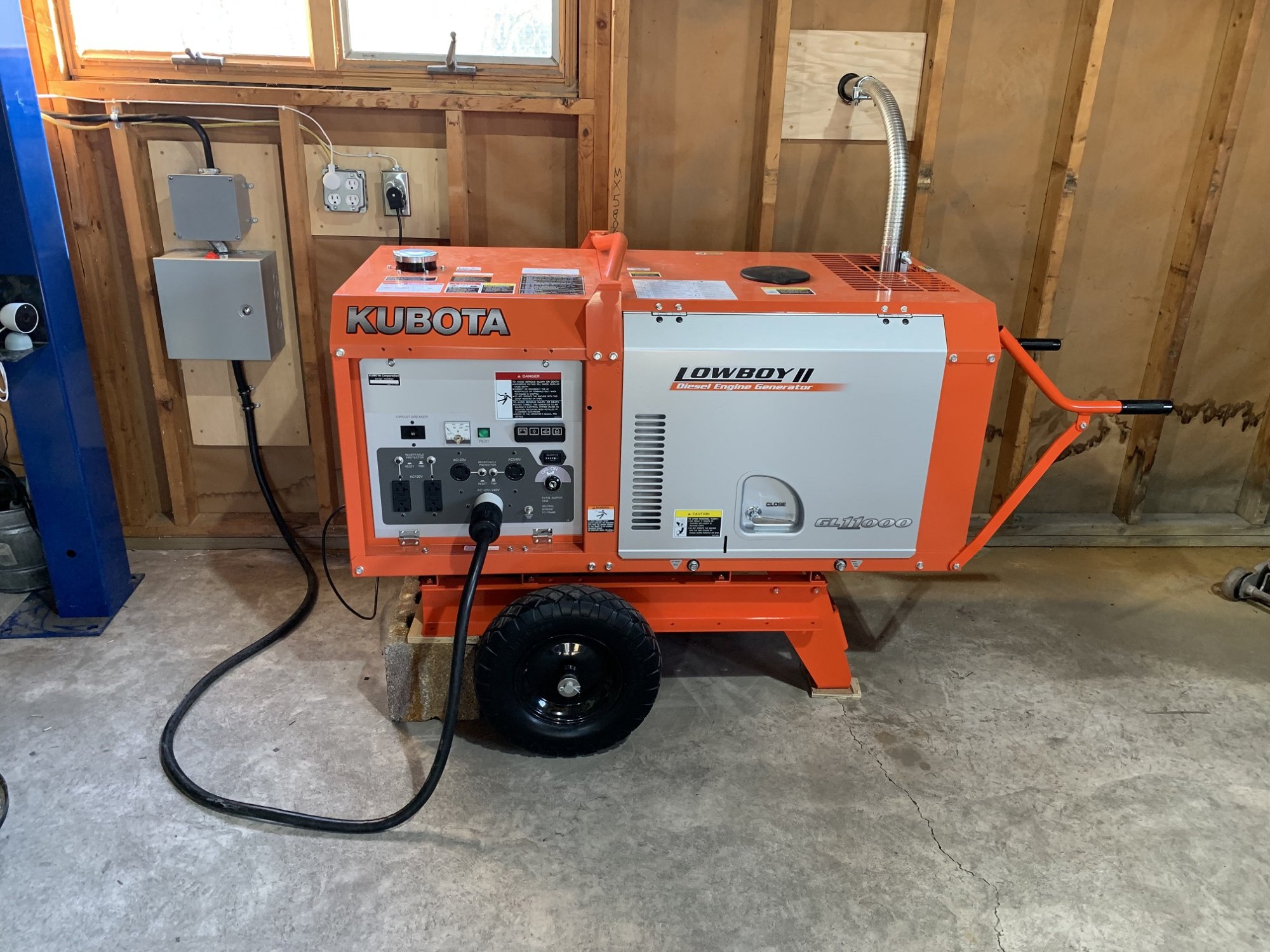
I actually do get some advantage from the waste heat generated by my Kubota GL11000. It's installed inside the garage with a thru wall exhaust. It's liquid cooled and the heat from the radiator keeps the garage warm during winter power outages. No advantage during warm weather though since I have to keep the doors & windows open.

1778614075681.jpeg
 
Keep in mind that a gasoline engine is just like an ebike motor, and is most efficient at about 80% of it's maximum output.

This is the generator that I wanna get,..


View attachment 209906


View attachment 209907


View attachment 209908


It runs for 3 hours at maximum output (900 watts continuous), so if all things are equal, it should run 4 times longer at 25% output, but it only lasts just over twice as long.


View attachment 209909


It's only about 30 pounds with gas, so it's easy to carry, and it's just under 50cc so I can use it legally as a bicycle engine.

It is more than the 500 Watt Canadian ebike limit, but if it's powering the ebike with 500 Watts, and charging a battery with the remaining 400 Watts, I might be able to float through the legal gray area. 😁
I bought one of those Honda generators a few years ago, put it in a Tupperware tub and have NEVER used it. Have no idea how it works. I think the wife and I are going to do a Generac natural gas back up.

A co-worker said to run the Honda because the poles could sag or something if left unused. I don't even have any large capacity fuel cans anymore.
 
If you can also take advantage of the heat they produce, pretty efficient!
That 5,000 W diesel is water cooled. I guess that coolant could be piped to an indoor heater. For each W of electricity, it produces approximately 5 W of waste heat. I don't know if it would prevent colds, but a 25 kW heater is nothing to sneeze at!
 
Last edited:
I bought one of those Honda generators a few years ago, put it in a Tupperware tub and have NEVER used it.

That's exactly why I am hesitating from getting one.
I don't really have a need for it.
It's just something that's kinda cool to have.

It's got enough power to run my fridge, but not enough to start my fridge, so I'd need a battery and a high power inverter to go along with it.

Then all the stored fuel to make it useful if there ever is a lengthy power outage.

Then I'd have to babysit everything to make sure it's going to work when I need it.

I've already got hundreds of dollars worth of brand new e-bike parts that I have never used, but at least they don't go bad by just sitting there.
 
If I pull it out and try to start it I'll post the date purchased and if I had any issues. I have a small house (900sq. ft.) and a small fridge, so this little Honda will run what we need. I also hate storing fuel. But I still hate the hassle and would love to swap to a natural gas hardwired generator. But if we go that route we need to get some wiring work done to the house. Old house, built in the 30's, has old problems.

Longest power outage we ever had in this house was 3 days. The power company does us first because the power companies main office is right down the street AND if they leave us in the dark for to long bullets start flying! This neighborhood used to be really rough but time, concerned neighbors and higher rent has really made it much more quiet.
 
If I pull it out and try to start it I'll post the date purchased and if I had any issues.

I'm just guessing, but if it's never been filled with fuel and started, then it might be better to keep storing it the way it is.

IIRC, it doesn't even have oil in it, the oil is in a bottle.
It might have longer shelf life that way and help with resale value?

Unless your poles got all saggy or something?
I don't know that means?? 😁
 
Apparently in Canada, the only ethanol free gas available is Shell Premium gas.

People are using it on there outboard motors because the alcohol in other gas was wrecking the rubber fuel pump on their motors.
 
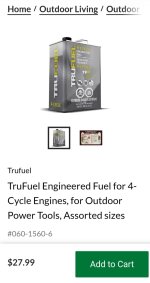
Tru Fuel is over $30 CAD for a full gallon, but it's still cheaper than buying a new string trimmer or chainsaw after you got pissed off and smashed your trimmer or saw because the damn thing wouldn't start or keep running. 😁

(It's $109 a liter on Amazon Canada. Lol)
 

Attachments

  • Screenshot_20260513_091950_DuckDuckGo.jpg
    Screenshot_20260513_091950_DuckDuckGo.jpg
    95.1 KB · Views: 3
  • Screenshot_20260513_092048_DuckDuckGo.jpg
    Screenshot_20260513_092048_DuckDuckGo.jpg
    98 KB · Views: 4
Tru Fuel is over $30 CAD for a full gallon, but it's still cheaper than buying a new string trimmer or chainsaw after you got pissed off and smashed your trimmer or saw because the damn thing wouldn't start or keep running. 😁

(It's $109 a liter on Amazon Canada. Lol)
Yeah, it's $24/gal US. Soon, it might be cheaper to run my pickup on it the way gas prices are going. :rolleyes:

I only use it for small jobs or short power outages. To me, it's worth the price to not have to drain fuel lines & tanks for little jobs.
 
Twenty months ago this area lost power for 4 days. A neighbor brought in an extension cord from his generator. A gas engine burns a lot of fuel even with no load. He kept it off much of the time. Even then, he and tens of thousands of others spent hours each day searching for an open gas station.

Years ago I quit using uninterruptible power supplies. They didn't store much energy, and the service life of a lead-acid battery wasn't good. LiFePO4 seems vastly better. Greater energy density, faster charging, longer service life. A 1 kWh station might supply basic household needs (not hot water), for 12 to 24 hours. They can be charged to 80% in maybe 50 minutes. This would demand power up in a range where a small gas generator is fairly efficient. It could give you emergency power 100% of the time while reducing fuel needs 90%. Fuel on hand would last 10 times longer.

I ordered a generator and a 1 kWh power station. The generator arrived first. They say on 2 gallons it will produce 3400 watts for 3.5 hours and 850 watts for 14 hours. That's 18% of the energy in the gasoline.

I put in a pound of fuel and weighed it on my package scale: 61.18 pounds. I ran it with no load for 12 minutes and weighed it again: 61.00. In grams, the difference was 81. I put water in a kitchen cylinder until it weighed 81 grams. When I put it on the generator, the package scale again said 61.18. It was verified. It had used 0.18 pounds of gas in 12 minutes. Two gallons would give me 13:20 unloaded, less time than listed 14:00 with an 850 watt load.

Wait. Before having hands free to start the stopwatch, I needed to pull the rope, then shut off the choke. If it had run 36 seconds before I pressed the stopwatch, it would agree exactly with a 14-hour run time. The delay was probably less, but the brief use of the choke would have increased fuel consumption. My figure for no load agrees closely with the published figure for 850 watts.

Each cycle of a gas engines needs a certain minimum of air and gasoline for complete combustion, to reduce air pollution. To keep an unloaded engine from overspeeding, the ignition module may retard the timing, for example. This seems to be why, as the load drops below 850 watts, fuel consumption doesn't drop.

My refrigerator needs 960 watt hours a day in winter and 1300 in summer. That averages 40 and 54 watts. Running the generator continuously to supply my refrigerator would require 3.4 gallons a day.

With three 40-minute charges a day, the power station could supply 1.75 kWh a day for the refrigerator and lots of other uses, and 3.4 gallons would last the generator 10 days. When fuel isn't readily available, fuel economy means peace of mind.
Is it an inverter generator? They seem to be a lot more efficient than the regular versions.
 
Inverters are the best, and the hi end ones with smart throttles are very efficient. When people talk to me about buying a generator I ask them how long to they want it to last. They give me that funny look you know. "What do you mean?" Well, I say, do you want it to play up in 6 months and be totally useless in 2 to 3 years or are you wanting it to be reliable for a few decades. Obviously they have never really ask this question but their assumption is that it will just be reliable and last for years and years. Alas the review sites are full of angry people who paid $500 for a generator and $800 for a camping fridge only to discover they got lumbered with a pile of crap.

Here is a worthless $350 800W Chinese generator, but it has a really 'Tough' name so would buy it on the basis of that :rolleyes:
I did, I got 6 months out of it. It still works but it takes 10 minutes to start and believe me I know a lot about small engines and have been right through it, just a crap design.

GEN SET BLACKRIDGE.jpg


Here is my Honda, Starts first pull, even after sitting idle for 3 months.

GEN SET HONDA.jpg


GEN SET HONDA-3.jpg


And this little sweetie is a 1966 Honda DC only. 6, 12 and 24V. It takes typically two pulls to start. I use it as a jump started if needed or I could charge my offgrid Trojan battery bank in a blackout if there was no sun was on the solar panels for it. Sniff around and you'll find these, I paid $60 for it but it wasn't running, I needed to clean out the carb bowl is all. It puts out 20A on the 12V setting

GEN SET HONDA DC.jpg
 
Here is my Honda, Starts first pull, even after sitting idle for 3 months.

That's what I was thinking.
It's A Honda !!
All I really think I know about generators is that Honda isn't crap.

The other thing that I know is that you can get square wave and sinewave generators/inverters.

Square wave generators/inverters are more efficient, but the AC output is "noisy" and can damage sensitive electronics that are plugged into it.

Sine wave generators/inverters make "clean" AC that's safe for anything you plug into it, but are 5%-10% less efficient.

@LandoftheGiants
What do you know about "pole sag"??

My guess is that Honda generators simply don't suffer from age related impotence?
"Use it or lose it" doesn't apply to a Honda generator.


I was thinking of making my own 12V DC generator using an old lawnmower, an alternator from a car, and a bank of 12V batteries, plugged into a quality, high power sinewave inverter.

The lawnmower output shaft would probably need to be geared with pulleys to get the RPM's up to about 5000 for the alternator to start getting efficient.
 
When I purchased the Honda the dealer did the following:

Put a splash of ethanol free fuel in the tank. (a local gas station sold it then).
Showed me how to start it and tested the output (wasn't paying attention).
Ran it till it starved itself of fuel.
Showed me how to verify it was "dry" in the tank and carb. (what, okay, whatever).
Put it back in the box.
I took it home, transferred it to a sealed Pelican box and forgot about it.
Ever since I purchased it I've never needed it. The box is buried in the garage now.

I was told by "old timers" that the polarity in the magnets will loose their magnetism, and sometimes flip, if they sit for to long. I know on vintage Lambretta and Vespa scooters you sometimes had to "re-magnetize" the flywheels. I had to do it to my Servetta 200 and my Lammy Li150. Weak ass spark that wouldn't zap ya if you tried. After the re-mag it would light ya up! Very weird!
 
I was told by "old timers" that the polarity in the magnets will loose their magnetism, and sometimes flip, if they sit for to long.

OK, now I get it.
I'm still thinking that the Honda generator has a better design and uses "quality" magnets?

I know that there's regular magnets, and "rare earth" magnets that are Much stronger.
Different materials used to make the magnets.

,.. you sometimes had to "re-magnetize" the flywheels.

I had a car in the 90's and installed a $1,500 stereo to make pizza delivery more enjoyable.
(Enjoyable to me anyway. My neighbors hated it. Lol)

I bought my 6x9's and 12" sub directly from a speaker factory.

They had a Huge demagnetiser in the shop, that they used to demagnetise the magnet on a speaker before taking it apart to rebuild it.
Then they'd remagnetise the speaker after they rebuilt it.

And in electronics class the teacher had a magnetiser that would give a quick pulse of magnetism and blow the breaker switch to magnetise something with iron in it.

I had one of these to demagetise my cassette deck back in the day, so that my cassette deck didn't rub out my tapes as I played them,..
 

Attachments

  • Screenshot_20260513_185455_DuckDuckGo.jpg
    Screenshot_20260513_185455_DuckDuckGo.jpg
    116 KB · Views: 1
Last edited:
I start the generator and run it on the synthetic fuel for short power outages. When an outage becomes lengthy, I switch to non ethanol gas.
Isn't that stuff gasoline? To quote the AI guy,
"Running a diesel generator on gasoline can cause severe damage to the engine and fuel system, as gasoline lacks the lubricating properties of diesel fuel, leading to potential failure of critical components."
 
EDIT: I got ebike controllers and power inverters mixed up together. 😁
The other thing that I know is that you can get sinewave and pure sinewave generators/inverters.

 Sinewave generators/inverters are more efficient, but the AC output is "noisy" and can damage sensitive electronics that are plugged into it.

Pure Sinewave generators/inverters make "clean" AC that's safe for anything you plug into it, but are 5%-10% less efficient.
 
Back