What are the 5 slots on an Aventon battery?

In the 1970s I kept a can of grease for wire nuts and terminal connections in 120/240 VAC wiring because the National Electrical Code required it in many cases.


I didn't use this stuff, but the description is noteworthy because it points out that "conductive grease" doesn't conduct electricity... not well enough to count. One function is to conduct heat so that everything warms and cools together. The main function is to prevent corrosion. It was often required with aluminum wire and could be beneficial in other cases.

I think this is the stuff I used.
It was applied to wires before making connections. Silicone grease might have done the job, but this had zinc for additional corrosion protection. The zinc made it opaque so I could tell at a glance that I had full coverage. It was thick, which made it a better heat conductor and harder to wipe off by accident.

 
In the 1970s I kept a can of grease for wire nuts and terminal connections in 120/240 VAC wiring because the National Electrical Code required it in many cases.


I didn't use this stuff, but the description is noteworthy because it points out that "conductive grease" doesn't conduct electricity... not well enough to count. One function is to conduct heat so that everything warms and cools together. The main function is to prevent corrosion. It was often required with aluminum wire and could be beneficial in other cases.

I think this is the stuff I used.
It was applied to wires before making connections. Silicone grease might have done the job, but this had zinc for additional corrosion protection. The zinc made it opaque so I could tell at a glance that I had full coverage. It was thick, which made it a better heat conductor and harder to wipe off by accident.

I've used gallons of Penetrox... and correctly.

If you're so smart and have this vast knowledge of and experience with silicone grease... Why is there none on your connections now?
Why are they so hard to take apart?
I'll tell you why... you're a moron with tons of information and not a lick of common sense.
Really hysterical are all these back in the day stories... Maybe you should be looking into a time machine.
I'll repeat this one last time and I'm out.
You're the one struggling with everything post after post... Not me.
So maybe you need to change your screen name to "The Tool"
 
Last edited:
I've used gallons of Penetrox... and correctly.

If you're so smart and have this vast knowledge of and experience with silicone grease... Why is there none on your connections now?
Why are they so hard to take apart?
I'll tell you why... you're a moron with tons of information and not a lick of common sense.
Really hysterical are all these back in the day stories... Maybe you should be looking into a time machine.
I'll repeat this one last time and I'm out.
You're the one struggling with everything post after post... Not me.
So maybe you need to change your screen name to "The Tool"
no penetrox,no pass to connect to grid in these parts, btw is there a glue I can use to repair delicate wires( I cannot solder these days arthritis ,nerves and smashed joints make fingers stiff.
 
no penetrox,no pass to connect to grid in these parts, btw is there a glue I can use to repair delicate wires( I cannot solder these days arthritis ,nerves and smashed joints make fingers stiff.
Not that I know of.
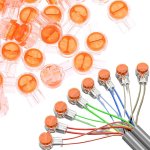
There's the crimp connections mentioned earlier in this thread that don't require special tools and are for small wires.
61s755OykdL._AC_UF1000,1000_QL80_.jpg

images.jpeg
 
Well, solder is essentially hot glue for wires. I think you will find that putting on connectors and crimping is more fiddly with arthritic fingers than twisting two wires together and soldering. A helping hand tool, lights and a magnifying glass can help. And just take your time.
 
One of the best purchases I have made for electronics projects was a Hakko soldering station. It gets hot quickly and makes short work of splicing.

51U2Q7sQP+L._AC_SL1024_.jpg


This also turned out to be a good purchase at less than $10:

71MlXC0j0YL._AC_SL1500_.jpg
 
Well, solder is essentially hot glue for wires. I think you will find that putting on connectors and crimping is more fiddly with arthritic fingers than twisting two wires together and soldering. A helping hand tool, lights and a magnifying glass can help. And just take your time.
Also very thin 0.8mm low temperature solder makes things go easier


The trade name for those connectors is Corning Presslok. Yes, the glass people. Lots of imitations abound.
Most of the electrical manufacturers make a version... 3M, Ideal.
3M scotchlok even has sizes up to 14ga.

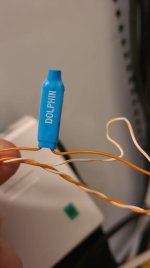
The blue long ones I've come across were always Dolphin brand
 

Attachments

  • Screenshot_20260607_124001_Amazon Shopping.jpg
    Screenshot_20260607_124001_Amazon Shopping.jpg
    156.9 KB · Views: 2
  • Screenshot_20260607_123929_Amazon Shopping.jpg
    Screenshot_20260607_123929_Amazon Shopping.jpg
    129.7 KB · Views: 2
Also very thin 0.8mm low temperature solder makes things go easier

Get the old-school solder with lead in it. (60/40)

That new silver solder doesn't work worth a crap. It needs to get Way hotter to melt, and it just doesn't flow into the wires like the lead solder for electronics does.
 
I haven't tried them.

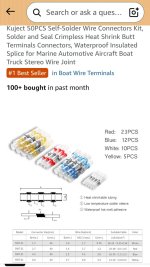
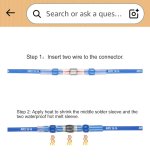
I also bought these crimp on butt connectors that I haven't tried yet either.

Screenshot_20260607_130133_AliExpress.jpg


,.. I also have a small tin of flux, but you probably won't need that.


I bought a tin of flux, but it was as hard as a rock and I couldn't add it to a wire connection before adding the solder.

So I recently bought a syringe of "gell" flux to pre-treat the connection before soldering.
I haven't tried the gell flux yet either.


Screenshot_20260607_130557_AliExpress.jpg
 
This also turned out to be a good purchase at less than $10:

71MlXC0j0YL._AC_SL1500_.jpg


I bought one of those too, but mine is hard plastic, and the damn wires kept popping out of the grooves.

Your rubber version looks like it would work better.


Screenshot_20260607_132425_AliExpress.jpg


You shouldn't need additional flux 99% of the time if you are using flux core solder.


I couldn't figure out why my damn solder wouldn't flow properly, so I bought flux thinking it would help.

It turned out that I had bought the shitty silver solder.😁

So I went to Canadian Tire and bought the proper toxic solder.😁


Screenshot_20260607_133305_DuckDuckGo.jpg


I didn't throw out the Shitty Silver solder, because it makes great adjustable spoke weights to help me balance my wheels.

I made sure to write "Shitty Solder" on the spool, to make sure I don't try to solder with it again. 😁


20240528_153841.jpg
 
Last edited:
I am pretty sure the wire holder I have is made from silicone. It is very flexible and heatproof. It works great as long as your project can be placed flat on a table or bench. Like when shortening extension cables.
 
Back