Yeah. I looked at manuals and took it apart. Couldn't figure it out. Just added a dab of glueIt's been 2 yrs since I messed with that light mount, but I don't recall a screw between mount and stem. Wiggled mine just now, and no left-right play.
I know you wouldn't be asking if it were just a matter of tightening the screw holding the light to the mount.
You are using an out of date browser. It may not display this or other websites correctly.
You should upgrade or use an alternative browser.
You should upgrade or use an alternative browser.
Specialized Turbo Vado SL: An Incredible E-Bike (User Club)
- Thread starter Stefan Mikes
- Start date



Jeremy McCreary
Bought it anyway
- Region
- USA
- City
- Carlsbad, CA
The SL 1 makes a pretty good flat-bar gravel bike. Good discussion of gravel tire options and trade-offs.
My recent SL 1 makeover was mainly to get a better-for-purpose tubeless rear gravel tire (a 40 mm Tracer) than the existing semi-slick 38 mm Pathfinder Pro.
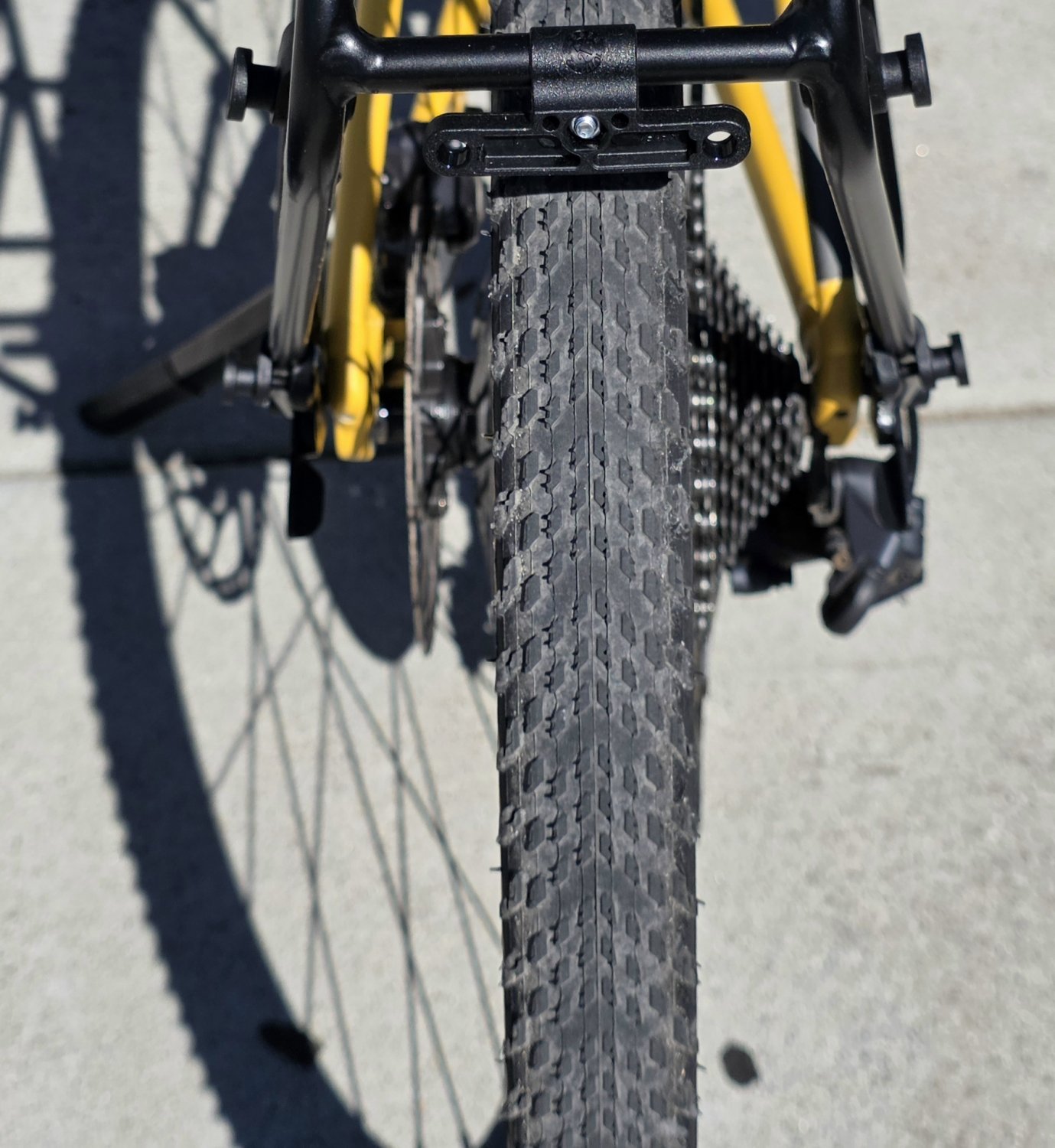
40 mm Tracer with low center lugs.
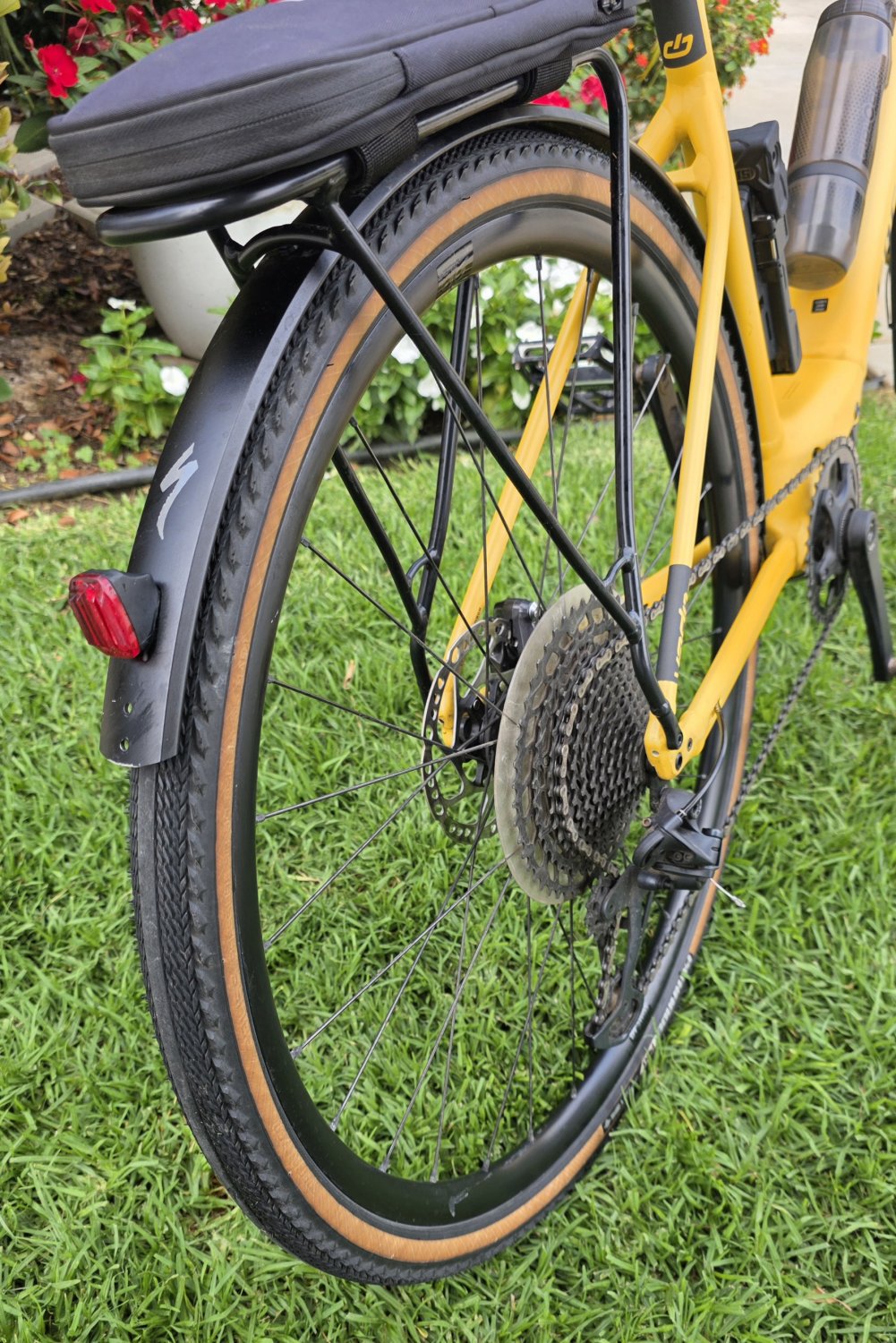
38 mm Pathfinder with center slicks.
Not pretending that the Tracer's the best possible tire for me, but definitely a big improvement in rear traction and a noticeable bump in comfort. No obvious hit in pavement rolling resistance, just a little more tire noise at speed.
My recent SL 1 makeover was mainly to get a better-for-purpose tubeless rear gravel tire (a 40 mm Tracer) than the existing semi-slick 38 mm Pathfinder Pro.
40 mm Tracer with low center lugs.
38 mm Pathfinder with center slicks.
Not pretending that the Tracer's the best possible tire for me, but definitely a big improvement in rear traction and a noticeable bump in comfort. No obvious hit in pavement rolling resistance, just a little more tire noise at speed.
Last edited:

Stefan Mikes
Gravel e-biker
- Region
- Europe
- City
- Mazovia, PL
Well, Jeremy, I was happy with Pathfinder Pro when I had my Fearless "equipped". Many gravel cyclist value the 45 mm Pathfinders as these are very fast rolling on asphalt and are quiet. My idea of "de-equipping" my Vado SL 1 was to be able to install the 42 tyres of choice. At that time, Specialized Rhombus Pro were available both in 42 and 47 mm, so I installed that model on both my Specialized e-bikes and intend to keep them until they are worn (these look to be very durable). Unfortunately, Rhombus are discontinued, and the market gave up the size 42.
Where the Pathfinders were performing miserably was mud and sand. Now, I can ride through patches of sand on the Rhombus with full confidence! And I have at least next two warm seasons to enjoy them!
Interestingly, it was Schwalbe Smart Sam 47 mm that safely brought me through the mud of Sudovia Gravel 2025...
Where the Pathfinders were performing miserably was mud and sand. Now, I can ride through patches of sand on the Rhombus with full confidence! And I have at least next two warm seasons to enjoy them!
Interestingly, it was Schwalbe Smart Sam 47 mm that safely brought me through the mud of Sudovia Gravel 2025...
Jeremy McCreary
Bought it anyway
- Region
- USA
- City
- Carlsbad, CA
Well, Jeremy, I was happy with Pathfinder Pro when I had my Fearless "equipped". Many gravel cyclist value the 45 mm Pathfinders as these are very fast rolling on asphalt and are quiet.
My situation's a little different. Most offroad surfaces here are hardpack with anywhere from a fraction of a millimeter to several inches of loose dry sand on top. We also have a lot of grades above 8%.
Traction-wise, the 40 mm Tracers are VASTLY better than 38 mm Pathfinders on that stuff — especially when braking downhill.
Last edited:


Jeremy McCreary
Bought it anyway
- Region
- USA
- City
- Carlsbad, CA
Starting to experiment with Tracer tire pressures. The sidewalls say 30-65 psi.
First try was 40 psi, where I usually ran my 38 mm Pathfinders. The 40 mm Tracers were noticeably cushier on all surfaces and definitely grabbier — especially on dirt. As predicted by drum tests at www.bicyclerollingresistance.com, rolling resistance (RR) felt about the same.
Seeing no reason to go higher than 40 psi, tried 30 psi on flattist pavement next, going over every bump and dip I could find. WAY cushier than 40 psi but too bouncy for my taste. Maybe a little RR penalty but hard to say. Will see what it offers on dirt today, but don't see myself running 30 psi routinely.
Then on to 35 psi and play it by ear from there. Once I've picked a favorite for routine use just by feel, will see what the Silca, Rene Herse, and Pirelli pressure calculators have to say.
How do you guys dial in pressure?
First try was 40 psi, where I usually ran my 38 mm Pathfinders. The 40 mm Tracers were noticeably cushier on all surfaces and definitely grabbier — especially on dirt. As predicted by drum tests at www.bicyclerollingresistance.com, rolling resistance (RR) felt about the same.
Seeing no reason to go higher than 40 psi, tried 30 psi on flattist pavement next, going over every bump and dip I could find. WAY cushier than 40 psi but too bouncy for my taste. Maybe a little RR penalty but hard to say. Will see what it offers on dirt today, but don't see myself running 30 psi routinely.
Then on to 35 psi and play it by ear from there. Once I've picked a favorite for routine use just by feel, will see what the Silca, Rene Herse, and Pirelli pressure calculators have to say.
How do you guys dial in pressure?
Last edited:
Stefan Mikes
Gravel e-biker
- Region
- Europe
- City
- Mazovia, PL
It is the Wolf Tooth Bike Tire Pressure Calculator, Jeremy. Two examples, metric.
Vado 6.0
Vado SL 1
As I might expect some segments on the ride even more demanding, I set R/F to 2.7/2.6 bar (40/38 psi) for either e-bike for a weekend ride and never look back
Vado 6.0
- Bike Type: Gravel
- Weight: 133 kg (26 + 99 + 8)
- Tire setup: Tubed
- Casing type: Medium
- Riding conditions: Medium gravel/Rocks
- Inflation/Riding Temperature; 18/14 C
- Tire/Wheel Size: 29" (700c)
- Measured tire width (R/F): 48/49 mm
Vado SL 1
- Bike Type: Gravel
- Weight: 124 kg (17 + 99 + 8)
- Tire setup: Tubed
- Casing type: Medium
- Riding conditions:
- Medium gravel/Rocks
- Inflation/Riding Temperature; 18/14 C
- Tire/Wheel Size: 29" (700c)
- Measured tire width (R/F): 43/43 mm
As I might expect some segments on the ride even more demanding, I set R/F to 2.7/2.6 bar (40/38 psi) for either e-bike for a weekend ride and never look back
edobici_forza
Well-Known Member
- Region
- USA
- City
- San Mateo, CA
Jeremy, I have a bunch of different tire sizes across various bikes, so I need a cheat sheet. So I use Notes on my phone and computer to have reference. No spreadsheet, just text and sections.Starting to experiment with Tracer tire pressures. The sidewalls say 30-65 psi.
. . .
How do you guys dial in pressure?
I went through all of the calculators over the years and have each listed to see similarities and differences.
Wolftooth
Bike Tire Pressure Calculator
The Bike Tire Pressure Calculator allows cyclists to find their ideal tire pressure based on terrain and riding conditions for the route ahead for mountain bikes, gravel bikes, and fat bikes.
 www.wolftoothcomponents.com
SRAM is simple
SRAM | AXS
Vittoria is more complete
Bicycle Tire Pressure Calculator | Vittoria
The Vittoria Tire Pressure Calculator is a step-by-step tool that provides optimal tire pressure for your tires according to the variables that affect your performance.
 vittoria.com
Silca is advanced as well

SILCA Professional Tire Pressure Calculator
Dial in your ride with the SILCA Pro Tire Pressure Calculator. Get data-driven pressure recommendations for speed, comfort, and efficiency.
 silca.cc
Pirelli
Pirelli Cycling: Tires & Accessories Velo for Bike
Bike tires and accessories for all types of bicycles: MTB, road bikes, hybrid bikes and others
 www.pirelli.com
Note: these links may be stale
For each calculator, I have two pressures per tire listed: Dirt/gravel trail and pavement.
it is a very long file with many tires across 4 bikes.
I have a separate file with only the latest preferred pressures (after many rides) for both surfaces, for quick reference:
Grav 45: Creo, RD: 41f-42r, DT: 34f-37r
Grav 55: Creo, RD: 36f-38r, DT: 25f-26r
Road 32: Hakka, RD: 60f-62r, DT: 47f-48r
MTB 2.4: Exie, DT: 24f-25r, RD+GVL: 30f-32r
I always have a mini electric tire inflator with me on all rides -also functions as a gauge. So, if I come across a surface that is very different I change the pressure accordingly.
Occasionally, I will remember the preferred pressure, without referring to my reference file

Jeremy McCreary
Bought it anyway
- Region
- USA
- City
- Carlsbad, CA
I always have a mini electric tire inflator with me on all rides -also functions as a gauge. So, if I come across a surface that is very different I change the pressure accordingly.
Ditto — very, very handy. This capability alone is a good argument for an electic mini-pump. When I shopped for hand pumps with gauges a while back, couldn't find any I was willing to carry.
Thanks for the calculator links and preferred pressures for your various bikes. How did you resolve pressure discrepancies among the calculators and your own field testing?
Jeremy McCreary
Bought it anyway
- Region
- USA
- City
- Carlsbad, CA
Rode 16 mi today with the 40 mm Tracers still at 30 psi front and rear. Really liked the added comfort and sure-footed handling on the 3 mi of bumpy sandy hardpack. Especially good crossing the deeper sand pockets.Starting to experiment with Tracer tire pressures. The sidewalls say 30-65 psi...
Seeing no reason to go higher than 40 psi, tried 30 psi on flattist pavement next, going over every bump and dip I could find. WAY cushier than 40 psi but too bouncy for my taste. Maybe a little RR penalty but hard to say. Will see what it offers on dirt today, but don't see myself running 30 psi routinely.
The 30 psi also seemed plenty fast enough on the 13 mi of rolling Coast Highway pavement — which I easily did in mostly ECO with some OFF. Not as boucy today for some reason.
Conclusion: 30 psi is a great option for typical offroad surfaces here and certainly acceptable on rolling pavement as well. When speed's more important than compliance or grip or floatation, I can always air up with the portable electric mini-pump I carry.
Tomorrow: 35 psi.
Last edited:
edobici_forza
Well-Known Member
- Region
- USA
- City
- San Mateo, CA
via Butt dyno.How did you resolve pressure discrepancies among the calculators and your own field testing?
and on the rare occasion of riding with friends, I check their set up. My 15psi MTB friend has been influential! he is lighter than me, but it fun to experiment!
edobici_forza
Well-Known Member
- Region
- USA
- City
- San Mateo, CA
if you have a specific trail that is awesome! you can experiment. It is when you venture out to unknown trails where tires and pressures come into play!Rode 16 mi today with the 40 mm Tracers still at 30 psi front and rear. Really liked the added comfort and sure-footed handling on the 3 mi of bumpy sandy hardpack. Especially good crossing the deeper sand pockets.
The 30 psi also seemed plenty fast enough on the 13 mi of rolling Coast Highway pavement — which I easily did in mostly ECO with some OFF. Not as boucy today for some reason.
Conclusion: 30 psi is a great option for typical offroad surfaces here and certainly acceptable on rolling pavement as well. When speed's more important than compliance or grip, I can always air up with the portable electric mini-pump I carry.
Tomorrow: 35 psi.
Another thing...MTBers typically rides a wider front than rear. So if you are headed to unknown trails, wider front for more traction is a bonus.
if you are not riding in any mud. I suggest the widest tire fit with 3mm clearance. Yep the standard is 6mm clearance, but that is average. if you always ride the same routes and no surprises, wider is better. I am riding 32mm on my road tires for casual 25 mile rides, at 60psi. The Creo's 45s range from 35 to 42 depending on the surface
Last edited:
Jeremy McCreary
Bought it anyway
- Region
- USA
- City
- Carlsbad, CA
if you have a specific trail that is awesome! you can experiment. It is when you venture out to unknown trails where tires and pressures come into play!
Another thing...MTBers typically rides a wider front than rear. So if you are headed to unknown trails, wider front for more traction is a bonus.
if you are not riding in any mud. I suggest the widest tire fit with 3mm clearance. Yep the standard is 6mm clearance, but that is average. if you always ride the same routes and no surprises, wider is better. I am riding 32mm on my road tires for casual 25 mile rides. amazing.
Good arguments for having multiple widths to choose from, but the SL will likely be stuck with 40s for the foreseeable future.
Widths between 40 and 45 mm seem to be vanishing — at least in the gravel tires I'm interested in. Guessing the rear could take a 45 but the front may be too tight.
I think @Rás Cnoic may know the max tire sizes on a fenderless SL 1.
Last edited:
Stefan Mikes
Gravel e-biker
- Region
- Europe
- City
- Mazovia, PL
Jeremy, even if a wider tyre would fit, you need to leave a generous clearance for pebbles or any debris.
Jeremy McCreary
Bought it anyway
- Region
- USA
- City
- Carlsbad, CA
Jeremy, even if a wider tyre would fit, you need to leave a generous clearance for pebbles or any debris.
Understood. Didn't you get a 42 on the front of your de-fendered SL 1? With the stock rims? No room for a 45, right?
Stefan Mikes
Gravel e-biker
- Region
- Europe
- City
- Mazovia, PL
Even more complicated. First, my frame size is M. No issue with 42 mm tyres. However, the rear SKS Speedrocker fender would not fit. Our rims are 21mm internal width, which is narrow as for the standard of today. If you squeeze a wider tyre into a narrow rim then the tyre "swells", or becomes wider than the rated value.Understood. Didn't you get a 42 on the front of your de-fendered SL 1? With the stock rims? No room for a 45, right?
As I had a feeling my rear wheel was getting worn, I ordered a proper 25 mm internal rim wheel (with excellent hub and spokes, 12-speed ready). Now, my rear tyre had assumed a more proper shape.
It is all inter-related.
Jeremy McCreary
Bought it anyway
- Region
- USA
- City
- Carlsbad, CA
Even more complicated. First, my frame size is M. No issue with 42 mm tyres. However, the rear SKS Speedrocker fender would not fit. Our rims are 21mm internal width, which is narrow as for the standard of today. If you squeeze a wider tyre into a narrow rim then the tyre "swells", or becomes wider than the rated value.
As I had a feeling my rear wheel was getting worn, I ordered a proper 25 mm internal rim wheel (with excellent hub and spokes, 12-speed ready). Now, my rear tyre had assumed a more proper shape.
It is all inter-related.
Life is complicatd, no? Need to pony up for a range extender before even contemplating another set of wheels, so 40 mm is my foreseeable future.
Fine with me. Every indication so far is that 40s will be fine for my needs.
Similar threads
- Replies
- 5
- Views
- 1K


- Replies
- 8
- Views
- 1K


