Anyone good at math?

That is two steps. Also the slashes are confusing to me. I suppose you mean ÷...

I want one step. I'm not that fusyy about the exchange rate going up or down a few points. I just want one factor to multiply the €2 price per litre by to come up with the price per gallon. Should I multiply $2.15 by 3.78? Or divide 3.78 by 2.15? Then when I want to translate the euro per litre price into the price in dollars for a gallon, would I multiply by the resultant figure??
So take your gas price and multiply by 4.35 *

€2/l x 4.35 = $8.70/ gallon.

*4.385 would be a more accurate multiplier based on today's currency exchange rates. But 4.35 or even 4.4 are simpler if you're not too worried about accuracy.

Just know that your price may be several pennies/gallon off depending on the currencies that day. Looks like the dollar and Euro have been relatively stable to each other recently though.

 
That is two steps. Also the slashes are confusing to me. I suppose you mean ÷...

Yes, the slash means ÷


I want one step. I'm not that fusyy about the exchange rate going up or down a few points.

Since you're not concerned with the currency exchange rate, you can rewrite your equation as this,..

Gasoline is about €2 per litre. A euro is $1.15 today, so $2.30 per litre. 3.78 liters to a US gallon. So $2.30 x 3.78 = $8.69 per gallon.

euros per liter × 1.15 × 3.78
euros per liter × 4.35

So 2 euro per liter times 4.35 equals $8.70
 
Oh, and while you are at it, explain why both Newton-meters (or inch-pounds or foot-pounds) can be a unit of work (which is a scalar) and a unit of torque (which is a vector).
 
1 U.S. gallon is 3.785 litre.
Currently, it is 1.157 USD/Eur.

Multiply 3.785 by 1.157 and you will get the conversion factor of 4.379.

Examples:
A. The price of petrol (gasoline) in Germany is EUR2.14 a litre now. The converted price is 2.14 * 4.379 = 9.37 USD/gal. (Diesel is at almost the same price as petrol there.
B. The price of petrol in Poland is now equivalent to EUR1.70 a litre. The converted price is 1.70 * 4.379 = 7.44 USD per gallon
C. The price of diesel in Poland is EUR 1.86 a litre. The converted price is 1.86 * 4.379 = 8.14 USD a gallon.

As I can understand, the highest price of gasoline in the U.S. is 5.80 USD/gal.
 
Tell me why miles/kWh
This makes sense in the U.S. and the UK where an electric vehicle owner pays for the charge expressed in kWh but the road distances are expressed in miles.
or miles/liter make any sense.
It is an interesting British example of "split personality". The UK measures the volume of petrol in litres but uses road distances in miles. Milk or beer volume is expressed in British Pints (which are larger than the U.S. ones) but Coke or oat milk is sold by litres :)

I could find a funny thing about the U.S. when I was in Houston this Summer. I could find some cans of U.S. made craft beer...

1787128751653.png

The volume was expressed as "1 U.S. pint and 3.2 U.S. fl. oz". Would you guess what that volume actually was? Spoiler alert: I did the maths. It was exactly 1 British pint :D I wonder why the brewery would not rather make it a standard Euro half a litre or 500 ml (1 U.S. pint and 0.90 U.S. fl. oz.) :)

Isn't Coke sold by litre in the U.S.?
Oh, and while you are at it, explain why both Newton-meters (or inch-pounds or foot-pounds) can be a unit of work (which is a scalar) and a unit of torque (which is a vector).
Yes, numerically, 1 Nm = 1 J (1 kg * m^2/s^2).

The SI definition of Joule J is the amount of work done when a force of 1 N moves an object across the distance of 1 m in the direction of that force.

The SI definition of newton-metre Nm is the turning force (torque) generated when a force of 1 N is applied perpendicularly to the end of a moment arm (lever) that is 1 m long.

The fact the two units are equivalent does not mean these are of the same physical meaning. Figuratively speaking, an apple and a orange of the same mass are not the same, right? :)

It is the matter of the convention. To differentiate work and torque, different units are being used.

Now. @Mr. Coffee please ask yourself this question: How come Watt W is a J/s and a V*A at the same time. Or, use the AI for the answer :)
 
Last edited:
Real Coke in the glass bottles is sold by the ml. Corn syrup based Coke products are sold by the oz.
My memory might not serve me well. I was in Houston just before the FIFA World Cup. Bought several plastic Coke Zero bottles and am almost sure each of them was 1.75 litre. Perhaps it was because of no sugar content?

In Poland it is 1.5 or (more rarely) 2 litres.
 
This makes sense in the U.S. and the UK where an electric vehicle owner pays for the charge expressed in kWh but the road distances are expressed in miles.

It is an interesting British example of "split personality". The UK measures the volume of petrol in litres but uses road distances in miles. Milk or beer volume is expressed in British Pints (which are larger than the U.S. ones) but Coke or oat milk is sold by litres :)

I could find a funny thing about the U.S. when I was in Houston this Summer. I could find some cans of U.S. made craft beer...

View attachment 214341
The volume was expressed as "1 U.S. pint and 3.2 U.S. fl. oz". Would you guess what that volume actually was? Spoiler alert: I did the maths. It was exactly 1 British pint :D I wonder why the brewery would not rather make it a standard Euro half a litre or 500 ml (1 U.S. pint and 0.90 U.S. fl. oz.) :)

Isn't Coke sold by litre in the U.S.?

Yes, numerically, 1 Nm = 1 J (1 kg * m^2/s^2).

The SI definition of Joule J is the amount of work done when a force of 1 N moves an object across the distance of 1 m in the direction of that force.

The SI definition of newton-metre Nm is the turning force (torque) generated when a force of 1 N is applied perpendicularly to the end of a moment arm (lever) that is 1 m long.

The fact the two units are equivalent does not mean these are of the same physical meaning. Figuratively speaking, an apple and a orange of the same mass are not the same, right? :)

It is the matter of the convention. To differentiate work and torque, different units are being used.

Now. @Mr. Coffee please ask yourself this question: How come Watt W is a J/s and a V*A at the same time. Or, use the AI for the answer :)
Because Volts are Joules/charge and Amperes are charge/second

The reason miles/kWh is weird, aside from the odd metric thingy, is that since kWh is a unit of work, and work is force * distance, and miles is obviously a distance, you end up with miles/kWh being 1/Force. So kWh/mile would be in the same dimensions as a Force (e.g. mass * acceleration). I just always find it odd when there are different things with the same dimensionality.

So you're right, sometimes it doesn't mean very much. But sometimes it means a lot. The best example is how you can plug together Maxwell's equation and get a differential equation which is a wave equation. And all of the solutions show that the speed of those waves is the speed of light. Which was one of my favorite moments in freshman physics back in the day.

One of the other things about dimensionality that I always found weird was that while kilograms and meters were relatively physically large units, a Joule is tiny. There are 3.6 million Joules in a kilowatt-hour. In the centimeter-gram system, an erg is also extremely tiny.

Don't get me started about Calories and Kilocalories as a unit of work.

The world would be a better place without non-metric units. Although I'd keep nanoacres and microfurlongs just because they are silly.
 
Don't get me started about Calories and Kilocalories as a unit of work.

The world would be a better place without non-metric units. Although I'd keep nanoacres and microfurlongs just because they are silly.

Units can definitely be maddening, but they can also be a lot more helpful than many realize — especially SI units, which extend the metric system.

Units are your friends. For one thing, they're great reality checks. If you come up with a formula for a fuel price conversion, the units in the formula better reduce (through cancelation) to the units you're after.

Better yet, you can often use the units on the quantities you know to work out how to combine them to get the quantity you want. That's what I tried to show above, but the symbols apparently got in the way.

On EBR, I usually write distances in Imperial units and temperatures in °F because that's what I'm surrounded with here in the US. I'm just too lazy to convert every time.

But if I were king of the world, all non-SI units would be gone by this afternoon.
 
Corn syrup based Coke products are sold by the oz.

Is that Fluid Ounces or are you talking about how much your Coke weighs ??

How many fluid ounces are there in an ounce of 🌽 syrup🤔

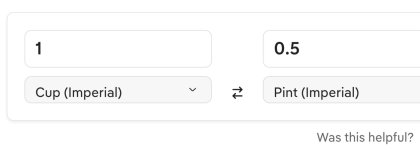
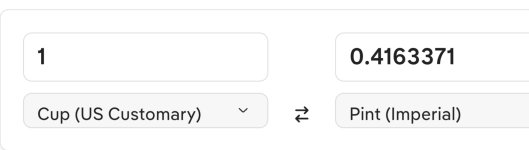
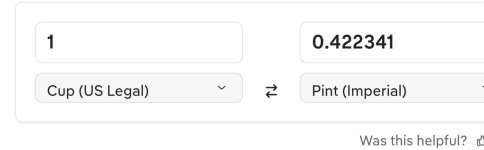
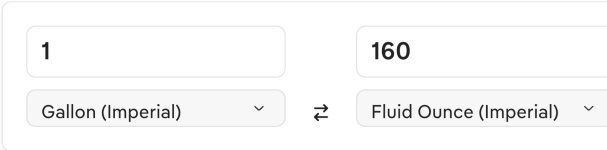
There's 16 ounces in a pound, but there's 160 ounces in a gallon 🤔??

So how big is a metric🍺?

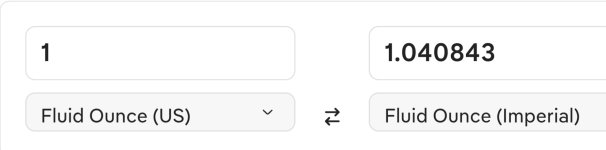
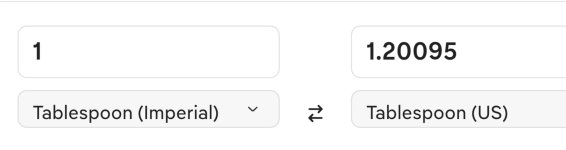
Even cooking 🍺 is different cuz tablespoons are different in Merika,..
 

Attachments

  • Screenshot_20260819_182721_DuckDuckGo.jpg
    Screenshot_20260819_182721_DuckDuckGo.jpg
    65.9 KB · Views: 2
  • Screenshot_20260819_182751_DuckDuckGo.jpg
    Screenshot_20260819_182751_DuckDuckGo.jpg
    58 KB · Views: 2
  • Screenshot_20260819_182812_DuckDuckGo.jpg
    Screenshot_20260819_182812_DuckDuckGo.jpg
    75.2 KB · Views: 2
  • Screenshot_20260819_183205_DuckDuckGo.jpg
    Screenshot_20260819_183205_DuckDuckGo.jpg
    66.9 KB · Views: 2
  • Screenshot_20260819_183243_DuckDuckGo.jpg
    Screenshot_20260819_183243_DuckDuckGo.jpg
    62.5 KB · Views: 2
  • Screenshot_20260819_183344_DuckDuckGo.jpg
    Screenshot_20260819_183344_DuckDuckGo.jpg
    65.5 KB · Views: 2
Because Volts are Joules/charge and Amperes are charge/second
Not really. Volt is defined as the electromotive force that dissipates 1 Watt of power at a current of 1 Ampere. So the V is defined by the well defined W = J/s and A (which is an arbitrary value).

One of the other things about dimensionality that I always found weird was that while kilograms and meters were relatively physically large units, a Joule is tiny. There are 3.6 million Joules in a kilowatt-hour. In the centimeter-gram system, an erg is also extremely tiny.
Think of Pascals Pa. 1 atm = 101325 Pa.
 
Is that Fluid Ounces or are you talking about how much your Coke weighs ??

How many fluid ounces are there in an ounce of 🌽 syrup🤔

There's 16 ounces in a pound, but there's 160 ounces in a gallon 🤔??

So how big is a metric🍺?

Even cooking 🍺 is different cuz tablespoons are different in Merika,..
Hey, I didn't make this s*it up.
 
Not really. Volt is defined as the electromotive force that dissipates 1 Watt of power at a current of 1 Ampere. So the V is defined by the well defined W = J/s and A (which is an arbitrary value).
Amperes are defined as one coulomb of charge per second. A coulomb is about 6.24e+18 electron charges. So the coulombs cancel out and you end up with watts.

 
Back