Signs of Spring

One more hummingbird shot:

20250509_125547.jpg
 
It looks simply amazing, I would love to wander among such flowers!
If you're sensitive to color like I am, being immersed in it to that extent is quite an experience.

20250409_092333.jpg

20250518_165016.jpg

Armada Drive runs right along the upper edge of the Flower Fields. One of my favorite places to ride laps — especially in spring — and it's only 12 minutes from home by bike!
 
Some white oaks are turning brown, gold, and red. But new green shoots of wildflowers are already a half-inch tall. In Nor. Cal. we have Summer and three stages of Spring. That has already started with the greening.
 
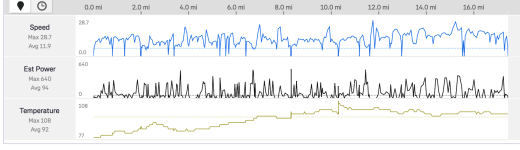
I will not be able to ride much tomorrow because of a big storm, so I just did ten miles today. What is interesting is that with this storm will arrive the steelhead trout from the sea. They are a trout that is about three feet long and unlike salmon they spawn and return the sea for several years. The don't just spawn and die. The population was decimated but now it is bouncing back.
1762990870759.jpeg
 
Time to wake up this thread for 2026. For our more northern members, there's hope!

Between our unseasonably wet November and December and our unseasonably warm January through present, the flowers here in coastal San Diego County are off to a strong start a week ahead of astronomical spring.

20260314_133734.jpg

No shortage of color and greenery now on neighborhood rides. Golden yellow treasure flower on left, intensely red hibiscus behind.

20260314_134102.jpg

Love geraniums, especially the red ones.

20260314_184400.jpg

You can't make this stuff up.

20260312_122147.jpg

As inviting as it is green, but no bikes allowed on the greenbelt.

20260313_143140.jpg

Meanwhile, on a bluff-top open space above nearby Batiquitos Lagoon, the yellow crown daisy is poised for its usual spring explosion. An exceptionally low tide has drained much of the outer lagoon.

20260313_143111.jpg

Like most other open spaces right on the coast, this one will soon be awash in crown-daisy yellow, the green barely visible.

20260315_132232.jpg

Down on the north shore at lagoon level, pale purple and white radish rules.

20260315_140108.jpg

But the crown daisies aren't giving up without a fight.

20260315_140451.jpg

Alas, this lagoon trail's another place I can only ride past.
 
Last edited:
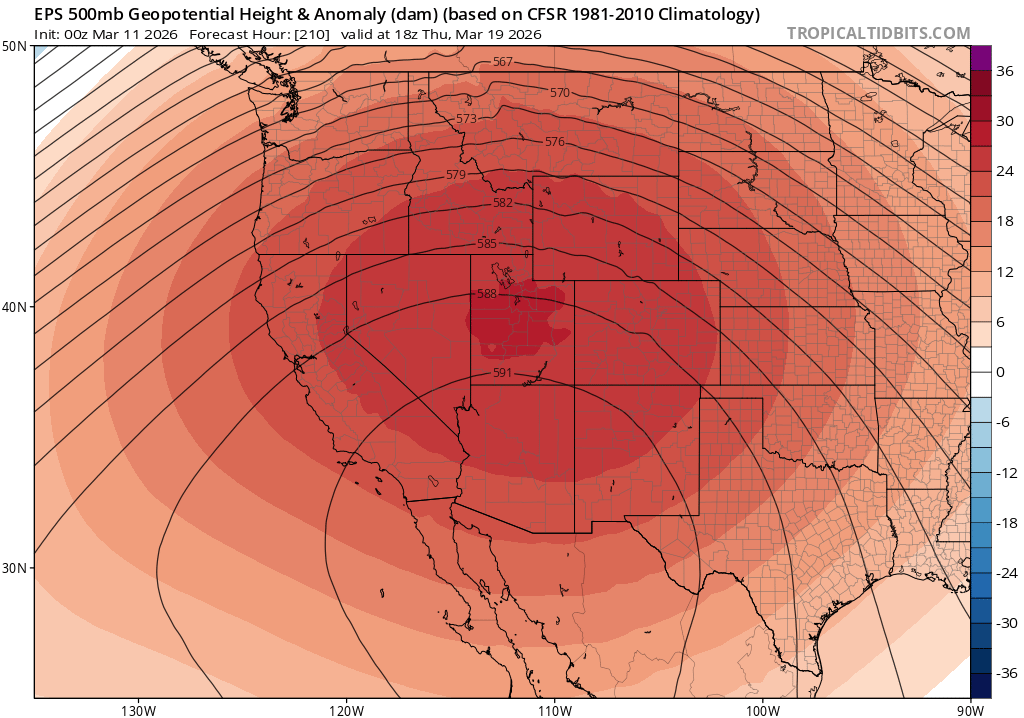
Across all of North America today are extreme weather events.
View attachment 207351View attachment 207352

I see that SoCal is all red, and that's reflected in the coastal 7-day forecast below.

Screenshot_20260316_100534_Weather.jpg

Those upper 70s and 80s are unseasonably warm even by late summer standards, so NOT a sign of spring here.

Screenshot_20260316_100712_Windyapp.jpg

Looking at the regional pressure and air flow patterns in the Windy app, no idea where all this warm air is coming from. Certainly not a typical Santa Ana setup.
 
I am absolutely afraid of bees. But I'm also mesmerized by their behavior.
Where are you located?
NC/SC line on the Piedmont.

The most conspicuous sign of activity is hovering males, identified around here by their white faces. They're bluffing when they attack because they can't sting. Then you look for sawdust from tunneling females, who can sting but are docile. As a tunnel lengthens over the years, one may lay 10 eggs. On my property, they like northern facia boards, where the sun won't make the wood too hot or dry for the larvae. She'll put in a supply of pollen for each egg, then seal the entrance, and far more may greet you the next spring.

Where there's an infestation, your Clarabelle horn is in danger. A mischievous bee sill surely crawl up the tube, lay a couple of eggs, put in a stockpile of pollen, and seal it off. You won't know it until the next time you sneak up behind a pedestrian and squeeze the bulb.

For years I used ladders, mirrors, and a stethoscope to locate holes and squirt insecticide. It was a losing battle. In 2021 I discovered diatomacious earth. For $9, I bought 4 pounds, which I hope will last me 500 years. To most things, it's harmless clay, but it will wipe off the coating that keeps an insect from drying out. A syringe would put a puff into a hole. The white powder would show me I'd treated it, and as long as the hole lasted, any insect that crawled in or out would dry up and pass away. In 2022 there was almost no activity. I located and puffed the holes I'd missed or that had been begun since 2021. I haven't seen any activity in 4 years. Mine may be the only yard around here without an infestation.
 
Last edited:
Didn't understand this week's record heat in SoCal. Clearly not a typical Santa Ana event, and it's all over the US southwest!

Now I see that it's a highly anomalous heat dome fueled in part by an atmospheric river at its northern edge. You can't make this stuff up.


Imagine how much worse it'd be if we had climate change!
;^}
 
Back