Turbo Vado 2 4.0 or 5.0 or 6.0?

here’s the one that’s most handy, it’s actually closer than i thought ! i should find the xls. the gold is the ratio between rider power and motor power, at four different assist levels with max set to 100% to avoid hitting the limiter, so to speak. at the time we believed that it was always supposed to be 2x the support factor, and that the measured value was electrical power, and the motor was 80% efficient at these optimal cadences. you can also see how spiky the data is (the thinner gold line) which is pretty typical of any power measurements on a bike, no matter how smoothly and consistently you try and pedal. spec’s algorithms probably have all kinds of smoothing.

if you track the red and blue (rider and motor power) and unsmoothed gold, there are often spikes in the support factor when rider power increases, and then sometimes it drops back down. might be related to the responsiveness of their algorithms and controllers scaling up or down.

View attachment 205271
How did you get this data? I’m envisioning myself audio recording myself reading motor and rider power of the display while I ride. It looks like you were able to capture much more granular data.
 
How did you get this data? I’m envisioning myself audio recording myself reading motor and rider power of the display while I ride. It looks like you were able to capture much more granular data.
it’s been a while. everything but motor power is in the data file you get from mission control (or whatever it’s called now lol) that can be parsed with anything that reads XML, which is basically anything. i probably used excel. there are also lots of free converters for FIT files and the other associated formats.

the motor power is more annoying, specialized obviously saves it because you can see the stats in their cloud, but if i remember i made a screen recording and used a video to text tool to grab the motor power field and export it as a CSV.

today you could just upload the screen recording to gemini and ask it to make a spreadsheet with the fields you want at one second intervals. i did this a while ago and it worked perfectly on the first try :eek:
 
today you could just upload the screen recording to gemini and ask it to make a spreadsheet with the fields you want at one second intervals. i did this a while ago and it worked perfectly on the first try
Miraculous!

The good news: First thing I want to know is if mechanical motor power Pm really is linear in rider power Pr at constant E and cadence before saturation. If the TCU's "power ratio" (Pm/Pr) field stays constant under those conditions, linearity is confirmed!

Suppose you ride through Prs, the saturation point, with ever-increasing Pr at constant E and cadence. After constancy up a linear ramp, Pm/Pr should fall continuously as soon as you cross Prs.

This might even be a way to get some rough empirical Prs values for my SL 1. My Pm model predicts constant Prs = 133W any time E = M.

Easy enough to check all that in a few flattish neighborhood laps, just by keeping an eye on the right TCU page.
 
Last edited:
Miraculous!

The good news: First thing I want to know is if mechanical motor power Pm really is linear in rider power Pr at constant E and cadence before saturation. If the TCU's "power ratio" (Pm/Pr) field stays constant under those conditions, linearity is confirmed!

Suppose you ride through Prs, the saturation point, with ever-increasing Pr at constant E and cadence. After constancy up a linear ramp, Pm/Pr should fall continuously as soon as you cross Prs.

This might even be a way to get some rough empirical Prs values for my SL 1. My Pm model predicts constant Prs = 133W any time E = M.

Easy enough to check all that in a few flattish neighborhood laps, just by keeping an eye on the right TCU page.

that isn’t quite as easy to verify as it sounds, since at a given cadence, speed, drag, and slope, there is only one possible amount of rider power Pr for a constant E. at the same cadence, on level ground, you could ride in several different gears to achieve different speeds with different Pr at the same cadence, and since this is a mid drive it should give you the same Pm.

sticking to one gear and allowing speed to vary, and with it cadence from, say, 70 to 90RPM, would be interesting since peak torque is dropping off in that range, but power is not. for a given E less than 70 or so I bet you’d find a fairly constant Pm/Pr ratio, and I bet it would be close to the predicted 2.0xE.

a gradually increasing incline would be another interesting way to do it, same gear, same cadence, but increasing Pr to maintain the same speed. very tough to find such a road, but you could certainly get a few data points on a flat, at 3%, at 6%. I still believe that outside the extremes you’ll be pretty close to the 2.0xE.
 
I was mostly interested in Vado SL 1 performance during my first days of the ownership...

An analysis made on the third day into the ownership:
1769759495424.png


At that time, I only rode in E=M modes.

Only on the fourth day of the ownership, I made the first Vado SL Metric Century:
1769759814453.png


There were the days when I was using BLEvo proactively with TCU 1. Was downloading CSV files and analysing the e-bike performance in Excel. We had numerous discussions with @mschwett what the electrical vs mechanical power was and we could never agree on 1.8x vs 2.0x :)

However, I cannot find the results of those analyses on EBR related to the B; it was 4 1/2 years ago! :)
 
that isn’t quite as easy to verify as it sounds...
Unfortunately, found exactly that yesterday, when I did 15 mi of mostly flat neighborhood laps watching the power ratio S on my SL 1's display:

20260129_204343.jpg

S is the top field here. In principle, it should have been pretty constant for constant E at Pr values along the pre-saturation ramp in the plot of mechanical motor power Pm vs Pr. Provided the ramp's actually a straight line.

Manipulated assist ease E via the SL 1's E = M MicroTune. (In principle, the varying M should have had no effect on S.) Tried to keep Pr below any reasonable saturation value Prs.

Screenshot_20260129_232102_Sheets.jpg

Kept cadence at 70-100 rpm, a range where Px (max motor power available at M = 100) and motor efficiency are reasonably flat in cadence. Official SL 1.1 motor data here.

The only findings I'm prepared to share at this time:

1. Not clear how to interpret much of the variation seen in S. So yes, maybe not as valuable a tool as I'd hoped.

2. Sometimes S was constant over a range of Pr values likely to be under Prs, sometimes not. Will try again.

3. S is very nonlinear in E — in fact, roughly quadratic, meaning that doubling E generally quadrupled S! The S vs. E curve from the official SL 2 Prs data is more exponential than quadratic. No idea what's going on here.

since at a given cadence, speed, drag, and slope, there is only one possible amount of rider power Pr for a constant E. at the same cadence, on level ground, you could ride in several different gears to achieve different speeds with different Pr at the same cadence, and since this is a mid drive it should give you the same Pm.
Cadence only enters the picture via Px and efficiency. Keeping cadence at 70-100 rpm as I did pretty much eliminates that confounding factor. In which case, cadence and the gear you're in become irrelevant.

Power is power, and on the SL 1, rider power Pr is a measured quantity.
 
Last edited:
Unfortunately, found exactly that yesterday, when I did 15 mi of mostly flat neighborhood laps watching the power ratio S on my SL 1's display:

View attachment 205346
S is the top field here. In principle, it should have been pretty constant for constant E at Pr values along the pre-saturation ramp in the plot of mechanical motor power Pm vs Pr. Provided the ramp's actually a straight line.

Manipulated assist ease E via the SL 1's E = M MicroTune. (In principle, the varying M should have had no effect on S.) Tried to keep Pr below any reasonable saturation value Prs.

View attachment 205347
Kept cadence at 70-100 rpm, a range where Px (max motor power available at M = 100) and motor efficiency are reasonably flat. Official data here.

The only findings I'm prepared to share at this time:

1. Not clear how to interpret much of the variation seen in S. So yes, maybe not as valuable a tool as I'd hoped.

2. Sometimes S was constant over a range of Pr values likely to be under Prs, sometimes not. Will try again.

3. S is very nonlinear in E — in fact, roughly quadratic, meaning that doubling E generally quadrupled S! The S vs. E curve from the official SL 2 Prs data is more exponential than quadratic. No idea what's going on here.


Cadence only enters the picture via Px and efficiency. Keeping cadence at 70-100 rpm as I did pretty much eliminates that confounding factor. In which case, cadence and the gear you're in become irrelevant.

Power is power, and on the SL 1, rider power Pr is a measured quantity.

Can you extract the exact data from the .fit file download from the Specialized app?
 
Cadence only enters the picture via Px and efficiency. Keeping cadence at 70-100 rpm as I did pretty much eliminates that confounding factor. In which case, cadence and the gear you're in become irrelevant.

Power is power, and on the SL 1, rider power Pr is a measured quantity.

not so sure about that except at a steady state. agreed of course that power is power, and the SL 1.1 can output 250w mech power from 60 to 100rpm.

but at 60rpm you have 35nm of torque, and at 100rpm you have 21. big difference. does the controller respond to a change in cadence (which influences power) the same way as it responds to a change in torque (which also influences power)? i feel like my experiment showed that rapidly increasing rider power caused the controller to overshoot the target power in some cases and undershot in others. the question is ... why ! nowhere near max power in either case, but i would bet it's the difference between the rider increasing cadence - speeding up on a flat - vs going up a hill, and decreasing cadence but increasing torque! or it could be the difference between 10% and 30% ease...

support.jpg
 
Not without an app. Looked at the Android options a while back and decided against all of them.

i used this one in the past, other related tools on the same site are useful as well. it makes a csv with lots of interesting columns that you can look at, including rider and motor power.


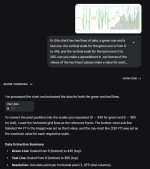
the graphs on the specialized rider hub are also detailed enough for a very short ride to figure this out! if you feel like being shocked at what ai can do, ask gemini to make a csv from this :

cloud.jpg

and in a few seconds you'll have this : (i added the chart, but with a consistent vertical axis unlike the one on spec site

whoa.jpg


anyone whose job involves mucking about with data is SCREWED.

omfg.jpg
 
Last edited:
not so sure about that except at a steady state. agreed of course that power is power, and the SL 1.1 can output 250w mech power from 60 to 100rpm.
Totally agree on the need for steady-state conditions in tests like these. Did reasonably well at that last time, but next time will be better controlled.

...but at 60rpm you have 35nm of torque, and at 100rpm you have 21. big difference. does the controller respond to a change in cadence (which influences power) the same way as it responds to a change in torque (which also influences power)?
At steady ground speed on the flat in still air, power at the rear wheel is all that matters. In principle, torque is irrelevant in the absence of accelerations, no?

i feel like my experiment showed that rapidly increasing rider power caused the controller to overshoot the target power in some cases and undershot in others. the question is ... why !
Saw some crazy transients in the power ratio on my TCU! Some seemed to occur around changes in rider power, some around E changes. But I couldn't really make out a pattern. Will take a closer look.

Some of the big spikes were more than double the motor's published boost factor B = 1.8. Unthinkable in the simple Pm model I've been using till now.

nowhere near max power in either case, but i would bet it's the difference between the rider increasing cadence - speeding up on a flat - vs going up a hill, and decreasing cadence but increasing torque! or it could be the difference between 10% and 30% ease...

View attachment 205348
Need to digest this.
 
Last edited:
i used this one in the past, other related tools on the same site are useful as well. it makes a csv with lots of interesting columns that you can look at, including rider and motor power.


the graphs on the specialized rider hub are also detailed enough for a very short ride to figure this out! if you feel like being shocked at what ai can do, ask gemini to make a csv from this :

View attachment 205349
and in a few seconds you'll have this : (i added the chart, but with a consistent vertical axis unlike the one on spec site

View attachment 205350

anyone whose job involves mucking about with data is SCREWED.

View attachment 205351
You aptly named the image "whoa.jpg". Interesting stuff.
 
...At steady ground speed on the flat in still air, power at the rear wheel is all that matters. In principle, torque is irrelevant in the absence of accelerations, no?

in terms of moving the bike forward, yes! but remember that the system measures the torque at the crank, or rather in the motor, and combines that with the reading from the cadence sensor to determine power. we don't really know what specialized's algorithms are responding to, and whether they first combine torque and cadence to get power, and then use that value only, or do they factor them separately. i think the "natural" feeling you get during assist probably at least considers cadence separately from power. the motor can spin the chainring without the pedals moving, and i have to imagine there would be circumstances where right as you started grinding along slowly at very high torque but very low cadence you would not want full power even if the math suggested it?

just speculating. i bet it's more complicated than we think and also has something to do with how the motor and pedals are "connected"
 
Back