Using Two Trailers to Transport Timber

S.Giles

Member
Region
Other
I build wooden furniture for a hobby and getting timber delivered to my village is always an ordeal.

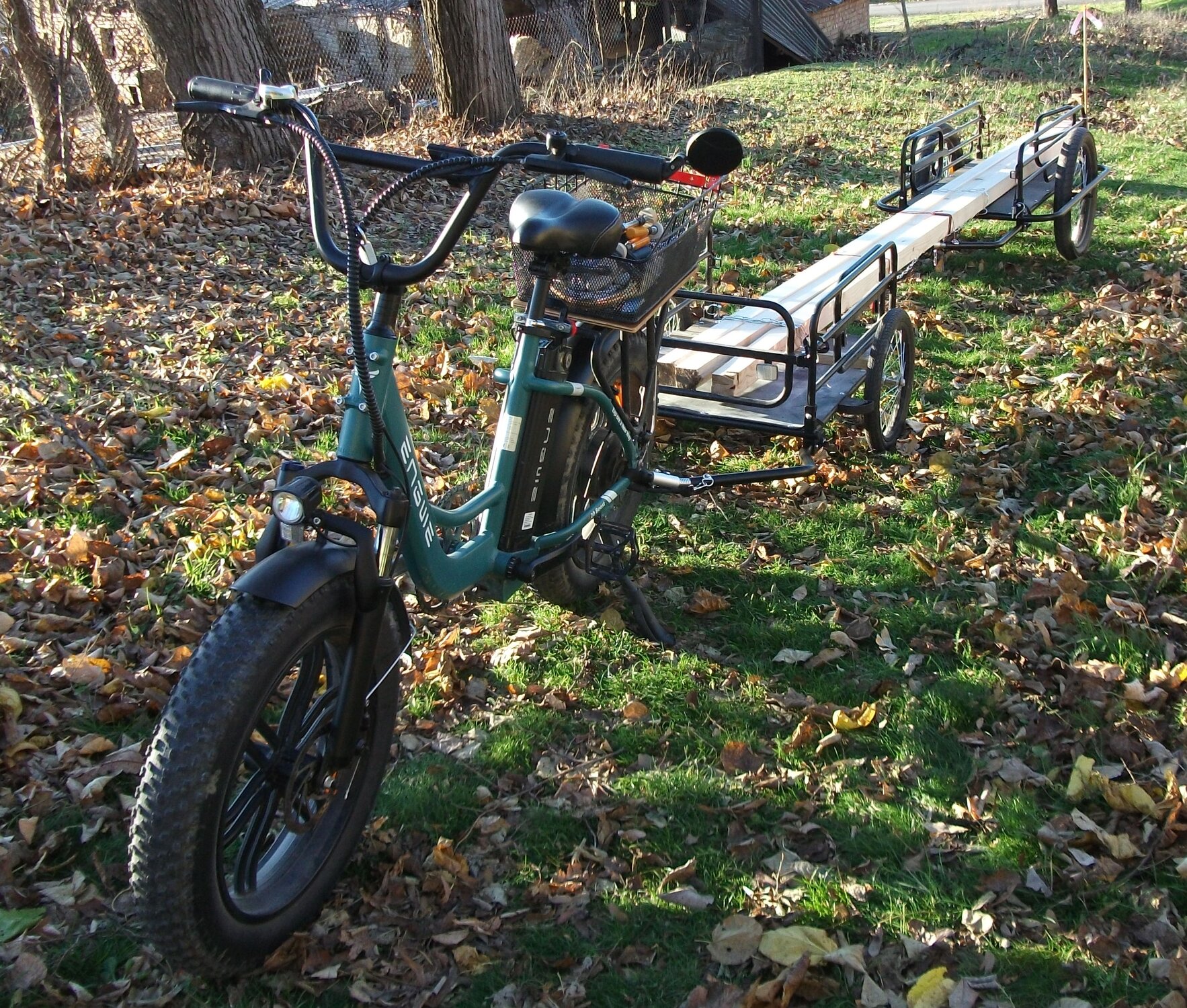
Here's my solution. Using two trailers to transport four metre lengths of timber. I had to make small modifications to the trailers, but I tried it today for the first time and it worked really well.

Has anyone else tried something like this, and if so, how did it work out?

Cheers,

Steve
DSCF4059.JPG
 
Haven't tried this two trailer approach but have been thinking about it. I have some questions and comments.

The 2nd (rear) trailer appears to be a heavier type, was this on purpose? I'm guessing yes, and it makes sense with the possibility of more of the cargo weight on the rear trailer helping to keep more weight off of the hitch. Does this affect the tracking?

Are you tying down the load beyond the use of the chain? (letting the cargo's weight help to keep it in place) If so are you concerned about the pivot point on the front trailer? I guess the idea is the difference between a more rigid setup (that could potentially track straighter) and one that pivots a bit easier. The other concern is having the cargo better attached to the front to prevent it from sliding forward and potentially into the rear wheel during heaving stopping action.

Thinking about making the front "pressure point" of the cargo sitting on the front trailer so it can pivot easier I guess it might also make sense to add some anti slip material (for example the stuff intended to keep carpets in place) to the rear trailer to further prevent the cargo from slipping/shifting ... and here's where some elastic type tie downs would help keep a lighter load from shifting (increased pressure against the anti slip material).

Also what about transporting the rig empty (to the store)? How do you attach the rear trailer, or do you simply tip it up and place into the front trailer for the trip?
 
Last edited:
Thank you for the reply, mclewis.

You're asking all the same questions I asked myself before I tried this for real! I'll try to answer them all.

  • The trailers are different because I just happened to have them available and used what I had at hand.
  • As you mentioned, the rear trailer takes more of the weight, so it makes sense to use the sturdier one in that position. Tracking is not a problem.
  • I use two chains, one on each trailer. They are set quite loosely, so as to allow for articulation. Their purpose is to keep the load broadly centralised.
  • I used a piece of wood (about 2'' by 1'' in cross section) on the first trailer, laid approximately in line with the wheels' axle and screwed in place on the trailer's bed. This concentrates the load over the wheels and prevents any upwards or downwards force on the bike's trailer hitch.
  • The trailer's front rail prevents the load sliding forward into the bike's rear wheel. (also, see next point)
  • I used woodworker's G-clamps (not shown in the photo's) clamped to the load (not the trailer) to prevent the load slipping relative to the trailers, and to prevent the rear trailer sliding forward under braking due to momentum. A pair of clamps, one fixed to the load just in front of the rear trailer and the other fixed to the load just behind the front trailer were sufficient (leave a small gap [2'' or so] to aid articulation). This obviates the need for anti-slip material.
  • For transporting the empty rig to the woodyard, I added a trailer hitch to the rear of the front trailer. The rear trailer is attached to this on the way to the yard and it is then detached for the journey back. (It's not visible in the photo's, but a length of chain is attached between the two trailers to pull the rear trailer along, rather than relying on bed/load friction alone.)
The whole setup is remarkably well balanced under load. I'd go so far to say that it feels more stable than when using a single trailer, probably because the load is properly balanced almost exactly over the front trailer's wheels.

I hope I answered all your questions, but if not, please don't hesitate to ask.

Steve
 
Back