Seeking that extra range

BigT

New Member
Region
USA
Hello to all , My friends call me "T" and this i my intro here.
Now I will never claim to be an expert in ebikes by any stretch of the imagination but I would like to share my first ride. My rear motor is the factory geared unit 750 watts with a half twist ,
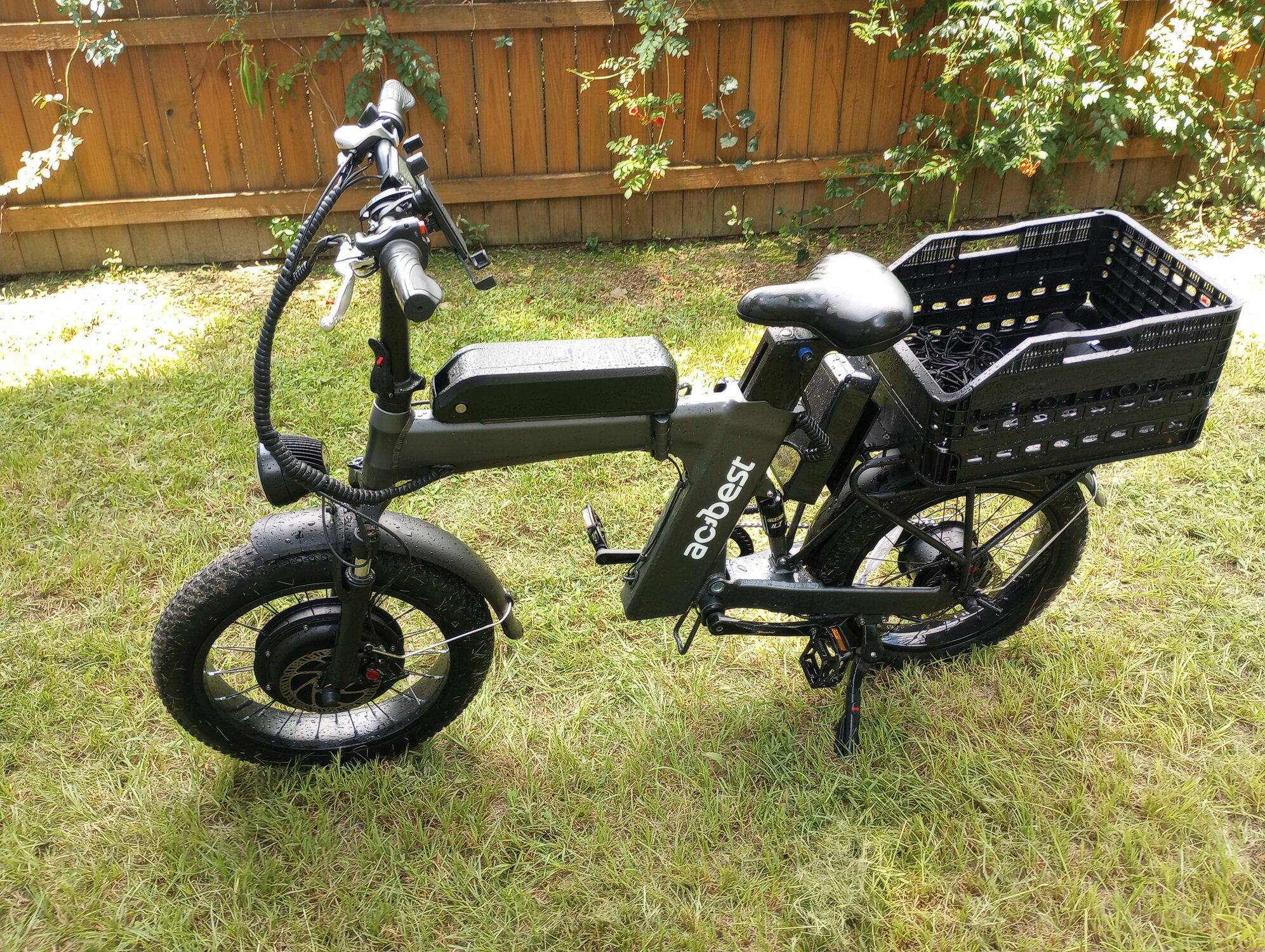
IMG_20240804_113042982.jpg
and the front is a 1000 watt inexpensive direct drive in which I wired in a thumb throttle which resides on the left.
I have to say that having two separate systems is really easy to control off road. Now my factory battery is actually the seat post and the front battery is a 52 volt 10 amp unit . I'm considering adding another battery in parallel for the rear motor.
Any suggestions ?

 
looks good,what about the weight? you could get a "brick battery and customize(have used a good many) it this type of battery usually is cheaper.
Thanks man , do you recommend a battery blender ? I think that a brick could fit into an ammo box which I could secure in the rear basket keeping it out of the elements.
 
Because you can essentially never say for sure what level of quality control went into any battery blender, and the risks of a bad parallel connection can literally be catastrophic, a blender is a pretty dangerous risk. The one exception to this are the DateX blenders, but they cost quite a bit. With dealers charging hideous markups and buying direct still being pretty pricey.

I always Parallel'd two batteries together directly for my dual-motor bikes, but to make it a reasonably safe choice you have to do a lot of homework, matching cells and pack configs, and charge cycles among other things. And you can never truly not be worried about it when, for instance, charging. Eventually I went to buying a big custom battery with a BMS powerful enough to handle both motors' draw at the same time.

Bicycle Motorworks sells off-the-shelf packs with really big-output BMS' and thats where I'd go to see if I could find a single pack to run both motors. When he was doing custom packs he is the vendor I used to make them for me.

If you go to two batteries, don't try and blend them. You already have two independent systems. Just charge with two chargers and skip all the risks. The amount of effort you will expend (and risk you will create) running two systems on two parallel'd batteries is not really worth it. You have to parallel the packs together... and then split the output back up again to two destinations. If you are new at this you're better off doing it the safe way.
 
Last edited:
Hello Big T, In 2025 Mike Vee here: Positive , Informative and possibly beautiful on this platform -> NON negative low voltage Pole SEE above<-
Consider carrying in your basket a small 52 Volt additional compatible battery pack ( or two ) that you can use if or when it is required under load or distance conditions. I don't see a requirement to hard wire these into the eBike. A Backup Battery.
 
Hello Big T, In 2025 Mike Vee here: Positive , Informative and possibly beautiful on this platform -> NON negative low voltage Pole SEE above<-
Consider carrying in your basket a small 52 Volt additional compatible battery pack ( or two ) that you can use if or when it is required under load or distance conditions. I don't see a requirement to hard wire these into the eBike. A Backup Battery.
Thank you Mike , maybe a 14 gauge split from my original battery via blender run up to the basket with an XT60 on the end to connect and disconnect ? I think you're into something...
 
Thank you Mike , maybe a 14 gauge split from my original battery via blender run up to the basket with an XT60 on the end to connect and disconnect ? I think you're into something...
On to something...lol
 
and there is a 10 ah hailong in a pouch basically you just about hang anywhere,tried the 36 and 48 flavor-they both worked well.
Thanks , I do see those online but I'm wondering if saving a few bucks by buying them through Alibaba would be any different than buying from a warehouse in the US. They probably come from a Chinese plant anyway. Right ?
 
I regularly install factory battery blenders on things such a Revv1 DRTs. But I agree that for DYI it would be better to carry a spare battery only when needed for an extra long ride. Do not wire it or have a switch. Just remove one battery and replace it with the other that fits the same holding tray.

1735775173293.png
 
Last edited:
I regularly install factory battery blenders on things such a Revv1 DRTs. But I agree that for DYI it would be better to carry a spare battery only when needed for an extra long ride. Do not wire it or have a switch. Just remove one battery and replace it with the other that fits the same holding tray.

View attachment 188034
How do you carry the spare battery comfortably
 
I regularly install factory battery blenders on things such a Revv1 DRTs. But I agree that for DYI it would be better to carry a spare battery only when needed for an extra long ride. Do not wire it or have a switch. Just remove one battery and replace it with the other that fits the same holding tray.

View attachment 188034
agree,your sure are a practical person,very safe advice.
 
How do you carry the spare battery comfortably
agree,your sure are a practical person,very safe advice.
If you have a rack and pannier, put it in the bottom of the pannier, low. The second one can be smaller than the first, just as long as it fits in the same tray or holder. I can swap batteries based on that day's ride needs. Normally smaller is better, 60 mile rides are very rare for me. Most are less than 7 round trip.
 
If you have a rack and pannier, put it in the bottom of the pannier, low. The second one can be smaller than the first, just as long as it fits in the same tray or holder. I can swap batteries based on that day's ride needs. Normally smaller is better, 60 mile rides are very rare for me. Most are less than 7 round trip.
On a long trip I would recommend on the first part of the trip a small battery,when its exhausted install larger battery and return home.This reminds of how to correctly use a 4 WD vehicle,run in 2wd till stuck,engage 4wd and return home.( as one 4wd critic sez,4wd allows one to get stuck in more inaccessible places.
 
On a long trip I would recommend on the first part of the trip a small battery,when its exhausted install larger battery and return home.This reminds of how to correctly use a 4 WD vehicle,run in 2wd till stuck,engage 4wd and return home.( as one 4wd critic sez,4wd allows one to get stuck in more inaccessible places.
I get your point, in my area they have rideouts that are usually about 15 miles and give or take maybe another 7 miles to get to a rideout 30 miles and another 14 miles carrying a 15 pound weight around your person would be daunting. I think a switch solution is probably a good idea. Just like my AWD has a switch from 2wd to 4wd.
 
I get your point, in my area they have rideouts that are usually about 15 miles and give or take maybe another 7 miles to get to a rideout 30 miles and another 14 miles carrying a 15 pound weight around your person would be daunting. I think a switch solution is probably a good idea. Just like my AWD has a switch from 2wd to 4wd.
a good heavy DPDT switch should do the trick.
 
a good heavy DPDT switch should do the trick.
Yes, a good heavy switch rated for 48V, >15A DC. Switches rated for these specs are usually large & bulky. You can get around this by using lesser rated switches and never switching under load.

I've had good luck with these:

1765462217603.png


I like the center off position so I can kill the power from both batteries.

For safety reasons, I have the switch located where it can't be accessed while riding.
 
Back