@bob armani
HR 727 defines an "low speed electric bike" as same as a bike. There is a federal supremacy clause in the bill that prevents the states from writing a more stringent regulation for ebikes that can be legally sold and ridden just like traditional bikes.
No is the short answer to your question. HR 727 is a consumer law legalizing ebikes to be sold as bicycles and not motorized vehicles in the US. For the purpose you want (if necessary?), you would want state and local laws. That's what determines if your ebike is legal and that you're allowed to ride where you are riding.
You are using an out of date browser. It may not display this or other websites correctly.
You should upgrade or use an alternative browser.
You should upgrade or use an alternative browser.
People for Bikes: Progress on Ebike Laws in the US
- Thread starter Admin
- Start date


Somewhat accurate but the definition of compliance was intended to be HR727 and states were supposed to retain "use" regulations of compliant "low speed electric bicycles" as same as traditional bikes. There was one "class" that allowed full power to 20mph and limited assist beyond that speed - i.e. it stated max motor alone speed was 20mph with 170lb rider on level ground (a bit confusing but not if your the PhD electrical engineer that worked for years to pull legal purview of ebikes from the NHTSA and more it to the CPSC which benefited all ebike riders.The entire ebike definition system is about establishing cutoffs that let ebikes be treated as bikes and use infrastructure that was designed for non-powered vehicles.
No matter how many times I mention it, nobody ever reads HR727 which is the federal definition for what is a compliant "low speed electric bicycle" that can be sold in all 50 states. It does not define a cut-off at 20mph....it states that motor alone speed is limited to 20mph on level surface with 170lb rider. That defines the power limit that is allowed beyond 20mph (around 300w) to avoid having a cut-off which many consider a safety concern. People for Bikes did not understand HR727 when they defined assist limits at 20mph because they were too focused on something harmonized with the EU so that same ebikes sold there could be sold here but that was true before the 3 class legislation.The entire ebike definition system is about establishing cutoffs



Chargeride
Well-Known Member
Tbh, that seems perfectly ressonable to me ..so go figure.

Biplaneguy
Active Member
- Region
- USA
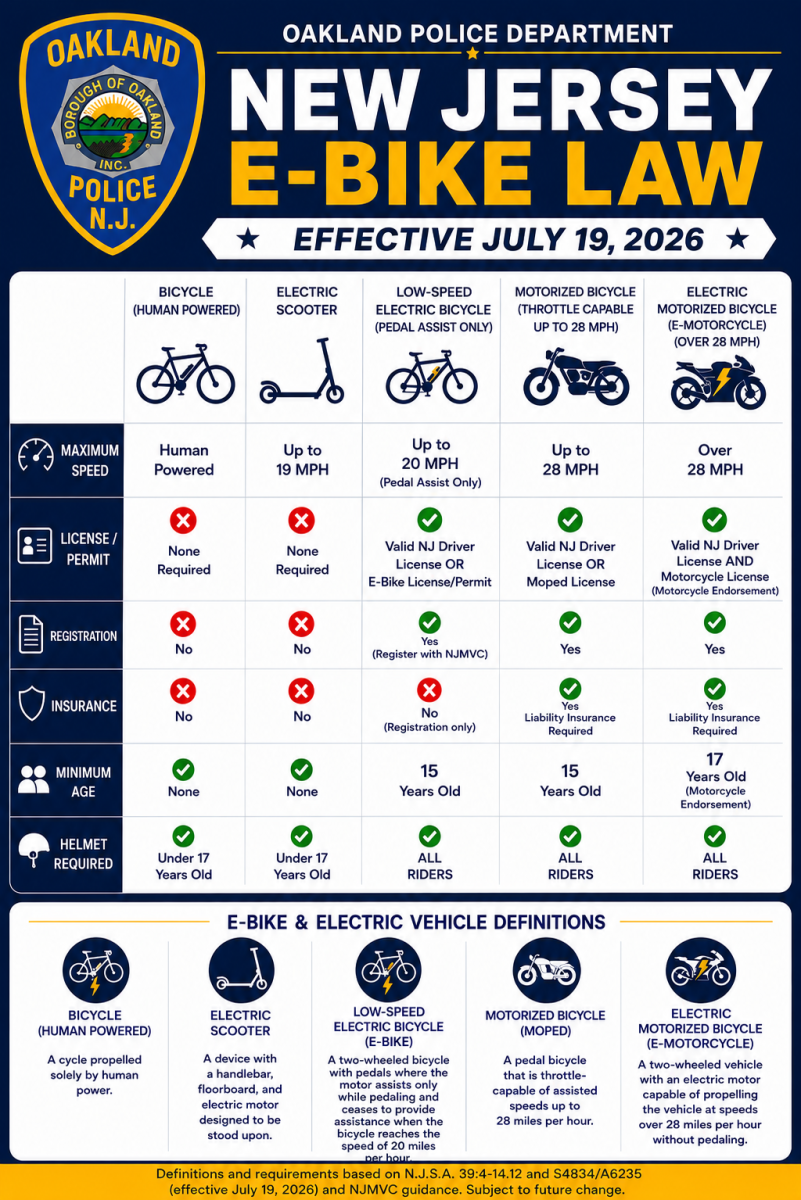
The NJ law effectively bans out of state visitors from bringing their ebikes to NJ and riding them there, as many RVers do.


stompandgo
Well-Known Member
- Region
- USA
The key words appear to be "throttle-capable". My Class 3 bikes don't have them and are not capable of them, but maybe that moniker is meant to cover them generically.
Note the complete lack of Class designations.
Note the complete lack of Class designations.

6zfshdb
Well-Known Member
- Region
- USA
- City
- Northeast Pennsylvania
Lots of flaws, and situations that were not thought through with that NJ law.
I live across the border in PA and often ride trails in NJ. Not anymore.
My brother, who lives in NJ, replaced his motorcycle with an e-bike. He uses it for running errands and to get around the heavy traffic where he lives. He's selling it rather than go through the hassle and expense of registering it. That's why he sold the motorcycle in the first place.
I met a couple on Monday while riding the PA D&L trail on the opposite side of the Delaware. They had crossed over the Bulls Island foot bridge with their e-bikes into NJ and were asked to leave by a Bulls Island park ranger.
The NJ bike shop where I bought my 3 e-bikes is going out of business. I wonder how much revenue NJ is going to loose as a result of this ridiculous law.
I live across the border in PA and often ride trails in NJ. Not anymore.
My brother, who lives in NJ, replaced his motorcycle with an e-bike. He uses it for running errands and to get around the heavy traffic where he lives. He's selling it rather than go through the hassle and expense of registering it. That's why he sold the motorcycle in the first place.
I met a couple on Monday while riding the PA D&L trail on the opposite side of the Delaware. They had crossed over the Bulls Island foot bridge with their e-bikes into NJ and were asked to leave by a Bulls Island park ranger.
The NJ bike shop where I bought my 3 e-bikes is going out of business. I wonder how much revenue NJ is going to loose as a result of this ridiculous law.
stompandgo
Well-Known Member
- Region
- USA
There are pros and cons with this legislation.
Pros:
Analog bicycles, electric scooters, and electric motorcycles are recognized and defined. I have not seen this anywhere else.
Electric motorcycles have registration, insurance, and operator licensing requirements. This is a loophole that must be closed.
Cons:
No definitions for electric skateboards, trikes, unicycles, hoverboards, or other non-bicycle products that have equal road impact.
No definition of an electric scooter that can exceed 19mph. There are plenty of them on the market and on the roads.
A Class 1 e-bike requires a license and registration, but no insurance. Makes no sense.
Class 2 and Class 3 bikes are lumped together and require license, registration, and insurance. NJ has effectively banned out of state e-bikes from the roads.
Have the major insurance companies caught up with the market and created e-bike insurance policies? My agent says no. I have an umbrella liability policy.
What about e-bikes that have pedals that can exceed 28mph? There are plenty of them on the market and on the roads.
I'm pretty sure that NJ requires a title in order to register and insure a vehicle. I have yet to see any e-bike come with a title. What about the millions that are already out there without titles? How do you register them in NJ?
I am against helmet laws of any kind for any age rider.
The current situation with e-bikes on public roads is unsustainable. It has already grown out of control, and gets worse every day. However, what NJ did was take a framework that served as a starting point and made it into law. While I am in favor of leaving the laws up to the states, the definitions should be universal. This is going to start a mishmash of stupid laws across the country that are going to severely affect the e-bike market and those that ride them.
Pros:
Analog bicycles, electric scooters, and electric motorcycles are recognized and defined. I have not seen this anywhere else.
Electric motorcycles have registration, insurance, and operator licensing requirements. This is a loophole that must be closed.
Cons:
No definitions for electric skateboards, trikes, unicycles, hoverboards, or other non-bicycle products that have equal road impact.
No definition of an electric scooter that can exceed 19mph. There are plenty of them on the market and on the roads.
A Class 1 e-bike requires a license and registration, but no insurance. Makes no sense.
Class 2 and Class 3 bikes are lumped together and require license, registration, and insurance. NJ has effectively banned out of state e-bikes from the roads.
Have the major insurance companies caught up with the market and created e-bike insurance policies? My agent says no. I have an umbrella liability policy.
What about e-bikes that have pedals that can exceed 28mph? There are plenty of them on the market and on the roads.
I'm pretty sure that NJ requires a title in order to register and insure a vehicle. I have yet to see any e-bike come with a title. What about the millions that are already out there without titles? How do you register them in NJ?
I am against helmet laws of any kind for any age rider.
The current situation with e-bikes on public roads is unsustainable. It has already grown out of control, and gets worse every day. However, what NJ did was take a framework that served as a starting point and made it into law. While I am in favor of leaving the laws up to the states, the definitions should be universal. This is going to start a mishmash of stupid laws across the country that are going to severely affect the e-bike market and those that ride them.
Last edited:

stompandgo
Well-Known Member
- Region
- USA
I missed that that one.i’m curious why a 19mph scooter doesn’t require a license or registration but a 20mph ebike does….
It appears to be restrictive but not necessarily unreasonable. I'd prefer the Washington state approach which is summarized in a Bellingham police department public information graphic (unfortunately uses the word "and" instead of "or" under vehicle regulations) based on legislation https://lawfilesext.leg.wa.gov/Biennium/2025-26/Htm/Bill Reports/Senate/6110-S.E SBR FBR 26.htm which clearly defines what is not a compliant ebikeTbh, that seems perfectly ressonable to me ..so go figure.
(Summary:
An e-bike is further defined as excluding:
- any vehicle capable of exceeding 20mph solely on its electric motor; and
- any vehicle designed, manufactured, or intended by the manufacturer or seller to be easily configured to not meet the requirements of an e-bike, whether by a mechanical switch or button, by changing a setting in software controlling the drive system, by use of an online application, or through other means intended by the manufacturer or seller.)
In addition, the statute mandates a workgroup to make further recommendations/draft legislation presenting an interim report by Dec. 15 2026 and a final report by October 31, 2027.

Jeremy McCreary
Bought it anyway
- Region
- USA
- City
- Carlsbad, CA
The best hope is that other states looking to tighten their ebike/emoto/scooter laws will learn something from NJ's mistakes here. Maybe they'll even have a licensing and registration apparatus in place before those requirements go into effect.
OK, OK, I didn't say much of a hope. But CA can't be the only state looking to curb emotos and e-scooters while supporting legal ebiking in general.
OK, OK, I didn't say much of a hope. But CA can't be the only state looking to curb emotos and e-scooters while supporting legal ebiking in general.
stompandgo
Well-Known Member
- Region
- USA
WA seems to have e-bike laws almost right. I'm not a fan of a 750W limit, and there's no mention of any other e-mobility devices. Still, it's a lot better than NJ.
What impresses me is the work group mandate with reasonably short interim and final reports which allows for refining/clarifying/modifying/expanding of the current law. So something impactful is done now with potential for improvement. Maybe just by chance or due to fears of parental legal responsibility but my observation of kids (one clearly less than 8 years old) as well as adults zooming around with non-compliant bikes on roads and sidewalks has recently gone from frequent to zero. A win for everyone including the riders.WA seems to have e-bike laws almost right. I'm not a fan of a 750W limit, and there's no mention of any other e-mobility devices. Still, it's a lot better than NJ.
Jeremy McCreary
Bought it anyway
- Region
- USA
- City
- Carlsbad, CA
That could be part of the motivation behind the most draconian law recently proposed in CA. But I don't think it has much support in the legislature.All it will take in any state is to have a politician looking to make a name for him or herself. They will take advantage of an e-bike related death and jump on the anti e-bike bandwagon just like they did in NJ..
All CA ebike bills recently passed have kept to the vision that a legal ebike, as defined by statute, can use public infrastructure without state license and registration and without insurance. Among other things, "legal" here means an ebike with operable pedals, no more than 750W of motor power, and compliant with the CA 3-class system. What kind of watts still needs refinement, but it's a start.
Similar threads
- Replies
- 14
- Views
- 9K


- Replies
- 2
- Views
- 3K

- Replies
- 0
- Views
- 3K


