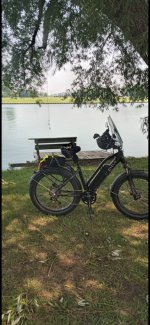
Gravel Vs. Trail Bikes

6zfshdb

Well-Known Member
Region
USA
City
Northeast Pennsylvania
What are the differences and how are bikes equipped for each type of surface? Pictures welcome.

I'm basically a trail rider who avoids roads as much as possible. The trails I ride here in the east have mostly mixed surfaces, including pavement, packed limestone & decomposed granite, dirt, grass, sand and some loose gravel. Slopes range from zero to 15 degrees. Perhaps it's the part of the country where I ride, but I've never come across a mostly gravel riding environment. The closest would be beaches with varying sizes of stone mixed with sand. Are there places across the country that cater specifically to gravel bikes?

Over the years, I've equipped my bikes to handle these varying surfaces by adding semi knobby tires, front suspension forks, anti vibration handlebar shocks, a quality suspension seatpost, wide range 10T-52T 11 speed cassette and a comfortable saddle. I would dearly love to have full rear suspension, which most gravel bikes I've seen have, but haven't found a bike thus equipped that fits my upright riding style.

What am I missing? Just what is a gravel bike and how are they equipped?

 
Are there places across the country that cater specifically to gravel bikes?
Kansas :)

But honestly. There are two flavours of gravel bikes:
  • Racing geometry, extremely lighweight, totally unequipped (just for racing)
  • Relaxed geometry, heavier (could be even steel), with multiple equipment bosses: for several water bottles, tools, fenders; frame, handlebar and saddle bags and even fork bags could be installed as well as detachable lighting. These are for bike-packing.
The very specific feature of a gravel bike is it is very fast on paved surfaces and pretty fast off-road. However, a gravel bike is not the thing for a technical singletrack.
Trail bikes are for technical singletracks and that's it. These are excellent climbers especially on rough surfaces and are pretty safe for bombing gnarly descents. Trail bikes are not applicable where the speed matters (except downhill). Riding a trail bike on a paved surface is usually a painful and slow experience.
 
Are we talking e-bikes here? The other question is drop bar or flat bar?

What are your priorities? There are a variety of options.

Weight
Suspension
Power
 
Just what is a gravel bike and how are they equipped?

Perhaps I should have explained that first. A gravel bike is:
  • A specially designed version of a road racing bike for fast riding asphalt, gravel and off-road
  • Usually, a gravel bike is designed for drop handlebars although flat handlebar gravel bikes exist, too (see Marin DSX 3)
  • A gravel bike has no other suspension than its own tyres. Some gravel bikes have a sort of suspension for the stem and/or seat-post
  • The tyre width is usually 38 to 55 mm on 700c wheels. The most typical size nowadays is 700x45c
  • A gravel bike often comes with a dropper seat-post
  • The frame is designed for pretty wide tyres
  • The bike geometry is relaxed, allowing the rider spending many hours in the saddle without getting much tired
  • The drivetrain is a hybrid between a road and MTB type. It supports drop-bars but the gearing is more of the MTB type: more rugged, and it is geared a way lower than for a road racing bike
  • Although the 2x drivetrain is still popular, you will meet a 1x drivetrain on a gravel bike more often than on a road bike
  • Gravel bikes need to be really lightweight. The rider has to be able to carry the bike over an obstacle as bunny-hopping is rather not done by gravel cyclists
  • Often, the gravel bike frame is made with multiple bosses for the equipment needed on very long rides.
1766499106426.png

A typical modern gravel bike.

1766499185588.png

A typical modern flat handlebar gravel bike. The fork for such a type is usually made of carbon fibre.
 
Last edited:
Full suspension was originally intended for downhill mountain bikes. It was adapted to e mountain bikes because they can reach the same high speeds of downhill bikes on all kinds of terrain. Kind of like a motorcycle. If you are going too fast to avoid or absorb a bump or pothole with your knees or riding technique, you need a bike with a good suspension. However, full suspension bikes are very inefficient for pedaling.
 
I wanted to add that, while full suspension is more useful than fat tires, I think it belongs in the same category. It is a feature that makes pedaling the bike more difficult in trade for being more comfortable to ride and is really only practical with a motor on the bike (or used for downhill as originally intended). That's why you don't see this kind of suspension on performance bikes like gravel and road bikes.
 
So..... It seems from all the info provided, a gravel bike is more like a road bike, except with fatter tires.
 
The geometry and gearing are different from a road bike as pointed out above. There is gravel bike racing that these bikes were originally designed for. A lot of people in California use them on fire roads and other rough terrain. They are not specifically for roads with gravel on them.
gravel_bikes.jpg
 
Full suspension was originally intended for downhill mountain bikes. It was adapted to e mountain bikes because they can reach the same high speeds of downhill bikes on all kinds of terrain. Kind of like a motorcycle. If you are going too fast to avoid or absorb a bump or pothole with your knees or riding technique, you need a bike with a good suspension. However, full suspension bikes are very inefficient for pedaling.
Very true, but lightweight (~25 pounds) analog mountain bikes are raced from the local to UCI World Cup level for XC, Enduro, and other non-downhill classes. Downhill MTB's look more like unpowered motorcycles these days.
 
So..... It seems from all the info provided, a gravel bike is more like a road bike, except with fatter tires.
It is the most simple definition, yes. The devil is in the details, though. For instance, gravel bikes are usually equipped with "flared" drop-bars. That is, the drop is wider than the hood area. It is for greater stability in rough terrain. Gravel bikes are more rugged than respective road bikes.

1766534953028.png

That's why a gravel bike needs to be lightweight :)

1766535041562.png

Nothing should stop a gravel cyclist :)


1766534776991.png

It is not only the bikes, it is about the culture. For instance, gravel cyclists hate their bikes being flashy. It is often very difficult to even read the make on a gravel bike.

1766535216536.png

The group riding is the essence of gravel cycling. Long distance, high speed. Road cycling is all about the peloton. Gravel cycling is about a group, which doesn't use the benefit of techniques such as drafting. However, there is a great sense of camaradarie. Unless it is a race, people help one another in a case of a breakdown. ("Self-sufficiency" is the word on the gravel race. There even is a Solo category where you must ride alone and never be helped by others!)

1766535369402.png

Fancy a heavy e-MTB there :)

1766535463506.png

And then the reward comes at the finish line :)

1766535592013.png

The industry has coined the name of "adventure cycling" :)


Someone has invented a cute definition: "Gravel cyclists are the roadies who ride across the road" :D It is because they emerge from the woods, cross the asphalt road, and get into the forest again :)
 
Last edited:
Back