
spokewrench
Well-Known Member
- Region
- USA






You would need a motor with a faster winding. For the same winding on a motor a higher voltage will top out at a faster speed than a lower voltage.I figure to go faster than 20 or so with a 36 volt battery, maybe you'd need a different motor besides a different controller.


The Aventon 48 volt battery is 678 watt hours, while the 36 volt battery is 720 watt hours. It looks like the 36-volt battery would cost a little more.
I was thinking of back emf. A PM motor is a generator. The faster it turns, the more voltage it produces against the battery. If you hooked it to a 48 volt battery with no load on the motor, it could spin up to where the back emf was 48 volts. I wonder if 48 volt batteries came in for Class 3: 28 mph. At 36 volts, the same motor would be good for 21 mph, which in the US is just over the limit for Classes 1 and 2.
I figure to go faster than 20 or so with a 36 volt battery, maybe you'd need a different motor besides a different controller.


More power is typical in the world. I can't even use all the bosch power on the 4 gen motor. Even a 20% grade I only have to put out 450 watts or even less if I go up slowly. Now after riding a acustic bike, it's way more than I need. Speed is addicting.Interesting that Giant seems to be starting down the 48v path after years running 36v.

I see no reason an ebike has to emulate a conventional one closely. I enjoy the extra power and speed of my ebike though I typically ride in a very similar speed range. Speed is addictive but torque/acceleration is a glowing crack pipe!More power is typical in the world. I can't even use all the bosch power on the 4 gen motor. Even a 20% grade I only have to put out 450 watts or even less if I go up slowly. Now after riding a acustic bike, it's way more than I need. Speed is addicting.

I know I can't I tried riding my Trek to get the same workout on my acoustic, and it is almost impossible even in the lowest assist level. I am not trying to work hard on the acoustic either.I see no reason an ebike has to emulate a conventional one closely. I enjoy the extra power and speed of my ebike though I typically ride in a very similar speed range. Speed is addictive but torque/acceleration is a glowing crack pipe!
That said higher voltages will typically yield better performance and efficiency, while a lower voltage battery of the same cell count will have a more stable output with a greater current capacity. Both have their advantages and it depends on your needs/wants.
I have my Zen PAS 1 set so low, it feathers in 25 - 100w. You can definitely get a workout if you want one. I have the first 4 PAS set to be very subtle and each increase is just enough to make a small difference and keep you pushing.I know I can't I tried riding my Trek to get the same workout on my acoustic, and it is almost impossible even in the lowest assist level. I am not trying to work hard on the acoustic either.

i get a workout but its not as much as I get on the acoustic without power. it just feels too easy. I am now so much faster on the tandem now too.I have my Zen PAS 1 set so low, it feathers in 25 - 100w. You can definitely get a workout if you want one. I have the first 4 PAS set to be very subtle and each increase is just enough to make a small difference and keep you pushing.
PAS 5 - 9 and now we're talkin' crack pipe power.
Of 4 e-bikes I've had, only the first had a geared motor. I think the advantage to gears is lightness because you can get torque with fewer poles. Geared or direct drive, if a motor is set up for a back emf of 48 at a little over 28 mph, a 36 volt battery won't let it spin much over 21 mph regardless of the controller.almost all ebike motors are geared tho, so the relationship between the motor speed and the wheel speed is whatever the motor manufacturer wants it to be. at a lower voltage you could just gear it down less and up the current for more torque at the lower speed. i am not really sure what the pros and cons would be. 10s7p at 14a vs 13s6p at 10.5a... would it really matter?
Of 4 e-bikes I've had, only the first had a geared motor. I think the advantage to gears is lightness because you can get torque with fewer poles. Geared or direct drive, if a motor is set up for a back emf of 48 at a little over 28 mph, a 36 volt battery won't let it spin much over 21 mph regardless of the controller.
That said, I see the Aventon has a hub-drive model that can be used as class 3 on a 36-volt battery. Hmmm... I wonder what that motor would do on 48 volts...
My 2020 Radrunner had 20 poles and 5:1 gearing. I believe the Rover and the Mini used the same motor. To program a KT controller, one multiplied the poles by the gearing and said it had 100 poles. Using a motor with 100 poles would have the same effect as gearing a 20-pole motor: 5 times the torque with 1/5 the rpms.hmmmm. i think pretty much every mainstream bike from aventon, gazelle, specialized, trek, giant, vanmoof, etc is a geared motor. even rad switched to geared like 5 years ago, i think.
in addition to more torque geared motors are smaller and more efficient at low speeds, because the motor isn't trying to move you along at 40rpm or something bonkers, they usually have internal clutches for reduced drag, etc. the only downsides are the whine and lack of regen.

?? How does that work?freewheeling direct drive
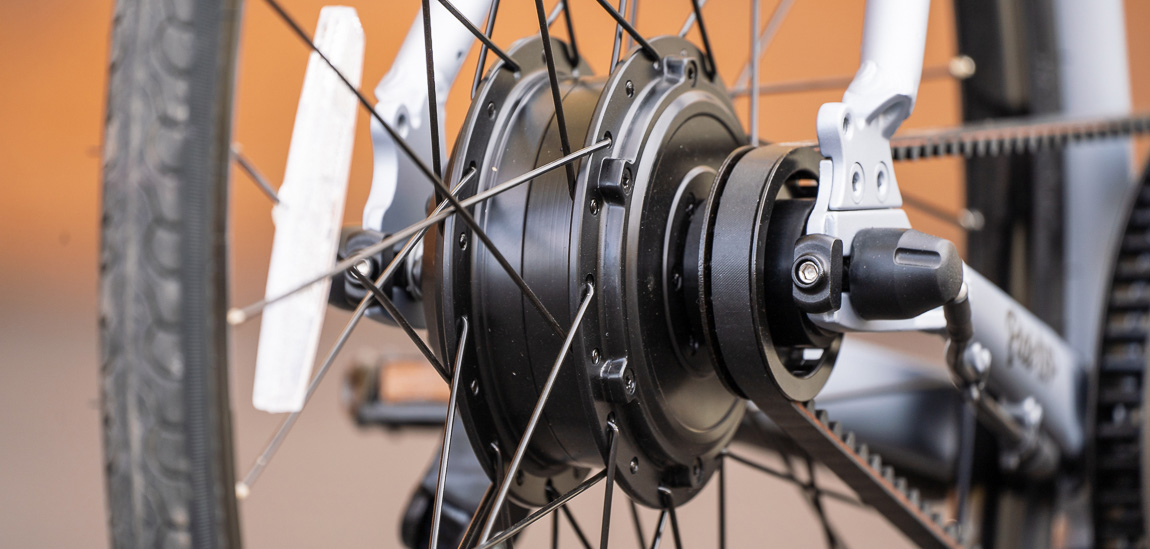
 electricbikereport.com

I think a direct drive motor would make a superior cargo bike if done right. You would need to throw enough amps into the motor, and have good gearing for pedaling. It's the most reliable motor, albeit bigger and heavier. But it's a cargo bike and the extra weight of the motor and battery wouldn't be an issue. Torque sensing PAS, throttle, and regenerative braking would be sweet in any cargo bike..... I don't think a cargo eBike would make much sense with a direct drive hub.


