You are using an out of date browser. It may not display this or other websites correctly.
You should upgrade or use an alternative browser.
You should upgrade or use an alternative browser.
Another new TQ motor: hpr40
- Thread starter Calcoaster
- Start date



stompandgo
Well-Known Member
- Region
- USA
That's great, but it's not from TQ.

apctjb
Active Member
- Region
- USA
I wish! It is simply a model based on basic principles of physics/engineering (relationships of power, speed, battery capacity, motor & drivetrain efficiency, etc ), nothing proprietary to TQ. Not intended to be a highly accurate (to many variables to model) but close enough to illustrate the impact of assist and power level on range.
Last edited:
stompandgo
Well-Known Member
- Region
- USA
The problem is that it is posted in a public forum that is scraped by search engines and AI, and someone is going to declare it as gospel. It's just like the idiotic USAC Category-FTP chart that went stupidly viral on Slowtwitch. Your post presents it as fact. I'm sure that was not your intention, but that's what happens to stuff like this.


apctjb
Active Member
- Region
- USA
Point taken, thanks. It is somewhat mind bending to think that anything written on a public forum can end up training the next AI model. Hopefully that results in a higher level of care (but I doubt it). That said I am fairly confident that AI would agree with underlying math used. Its just basic math.

mschwett
Well-Known Member
- Region
- USA
Point taken, thanks. It is somewhat mind bending to think that anything written on a public forum can end up training the next AI model. Hopefully that results in a higher level of care (but I doubt it). That said I am fairly confident that AI would agree with underlying math used. It’s ts just basic math.
it’s very cool. and the amount of data that goes into a foundation model for an AI is such that you need not be concerned about your data influencing it. the fact that it’s on the internet means that any AI (whether trained on your model or not) will be able to locate it and reference it, which is fine since such citations are typically correctly cited and linked.
has anyone verified that the mechanical power out from the TQ motors corresponds as neatly to the predictions as the table suggests? on other bikes (mahle, specialized SL) we’ve seen that it’s not nearly so consistent! it takes a bit of effort - a known grade, known weight of the bike, and power pedals to measure actual rider input - but it’s a fun experiment.
stompandgo
Well-Known Member
- Region
- USA
I know that the rider power input measurement on the HPR50 reads low, based on riders that I know that also have a left side crank power meter or Garmin Rally power pedals on their bike. It's in the range of 10%-30% low. This, of course, affects the motor's real power output at any given moment because the assistance is coupled to rider power. The other big factor is that the TQ motor keeps itself together by derating the output based on internal temperature. The guys on the Trek Fuels that are blowing them up are riding at full output for extended periods under high load. The software can only do so much to limit power and save the motor. I can feel this derating on my HPR50 bike when riding in a group at high speed and high cadence for extended periods. I have my Eco set at 100w max, and I have not felt it derate power at that setting. However, I have Mid set at 200w max, and I can only ride in that mode for so long before I feel the motor back off. Both of these factors affect the linearity of the power output of the motor.
I have looked into adding a Tempo power meter to my bike, but that is on the back burner for now.
I have looked into adding a Tempo power meter to my bike, but that is on the back burner for now.
Captainslow
New Member
- Region
- United Kingdom
As in my previous posts I’m shortly going to take delivery of a Canyon Endurace Onfly (exciting!). I haven’t yet seen anything about servicing the TQ HPR40. Does anyone here have any experience with this? My interest is in if there is any regular in-use attention needed and if it needs an annual service, if so what’s involved? Also any advice from those with experience of breakdowns or defects and how they were dealt with. I live in the NE of Scotland so not many TQ dealers anywhere close by.
apctjb
Active Member
- Region
- USA
Congratulations! Looking forward to hearing your impressions. Based on what I am experiencing with the TQ50 on my BMC, the TQ40 seems like a good choice for a lightweight e road bike. I have not had any issue with the TQ50 so far so nothing to offer in terms of dealing with service issues.As in my previous posts I’m shortly going to take delivery of a Canyon Endurace Onfly (exciting!).
stompandgo
Well-Known Member
- Region
- USA
There is no preventative maintenance on the HPR40 or any other modern TQ drive unit. They are self contained and are serviced by replacement through a TQ dealer. Canyon is DTC so you should be able to go to any dealer that sells TQ based bikes. You will want to have the firmware kept up to date. Right now, that must be done by a shop that has the TQ service dongle and software. There was one major HPR40 update a few months ago. Soon, you will be able to do updates over the air, but not now.As in my previous posts I’m shortly going to take delivery of a Canyon Endurace Onfly (exciting!). I haven’t yet seen anything about servicing the TQ HPR40. Does anyone here have any experience with this? My interest is in if there is any regular in-use attention needed and if it needs an annual service, if so what’s involved? Also any advice from those with experience of breakdowns or defects and how they were dealt with. I live in the NE of Scotland so not many TQ dealers anywhere close by.
Enjoy.
apctjb
Active Member
- Region
- USA
I have been testing an App I built to estimate battery range to help in ride/route planning. So far its been providing reasonably accurate results for rides I have done on my BMC. Would love to get feedback from others regarding app accuracy and improvements. Note this is not a TQ sanctioned app and calculates range based on user inputs and basic physics -the accuracy of results will vary on factors outside of the scope physics model. Below is a link to a working version of the app for those that are interested. I appreciate the feedback.
https://sites.google.com/view/tq-hpr-ebike-range-estimator
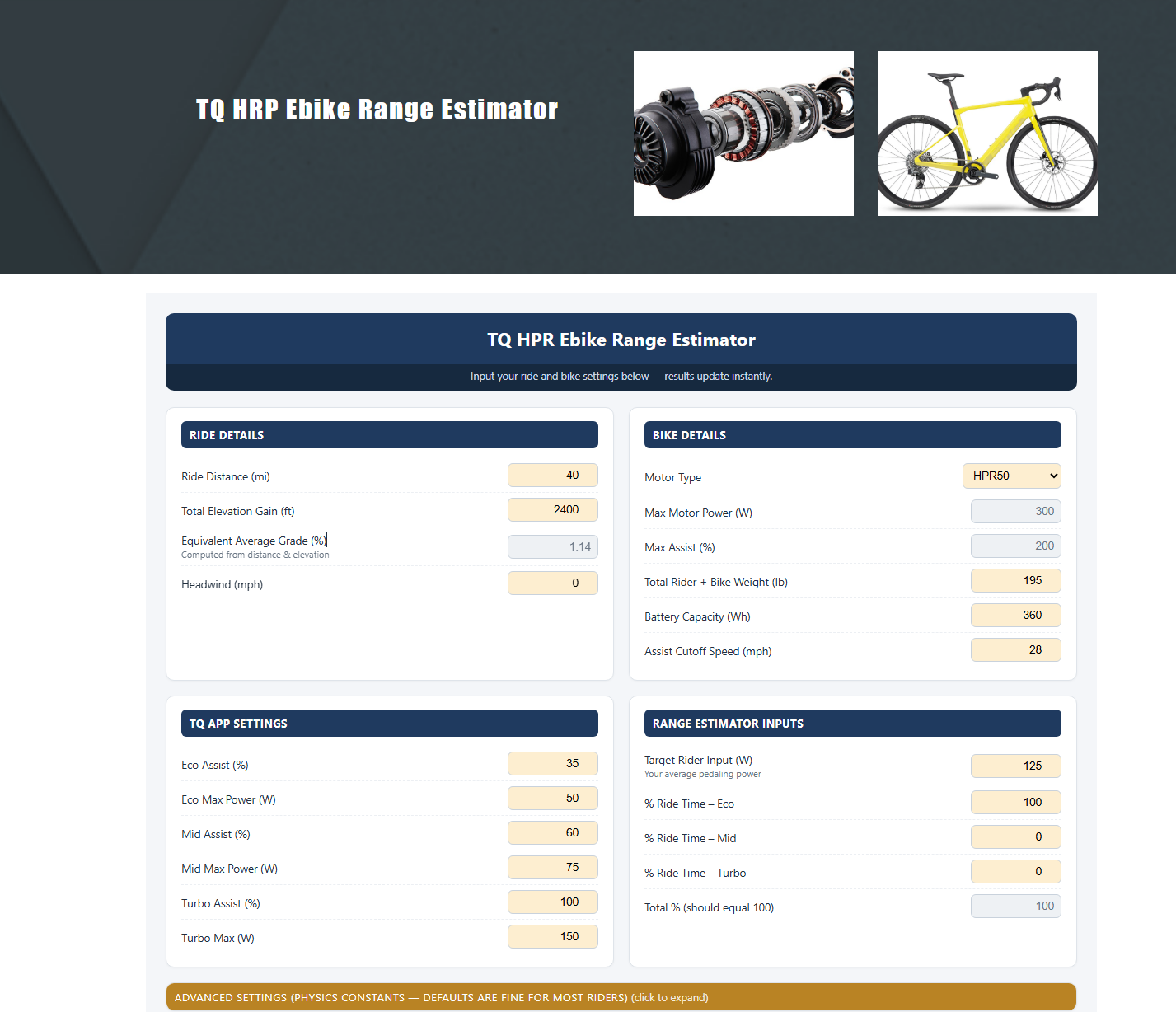
https://sites.google.com/view/tq-hpr-ebike-range-estimator
mschwett
Well-Known Member
- Region
- USA
this is cool! i love exercises like this. it's always cool how close the real world matches the physics, in most cases.
i think for this to be accurate for the kind of riding i do you'd need a way to break the ride into a few chunks or "types" of riding. the key factor is how often you're going any given speed since the power required doesn't vary linearly with speed. using the standard formula, here's a really modest and simple example.
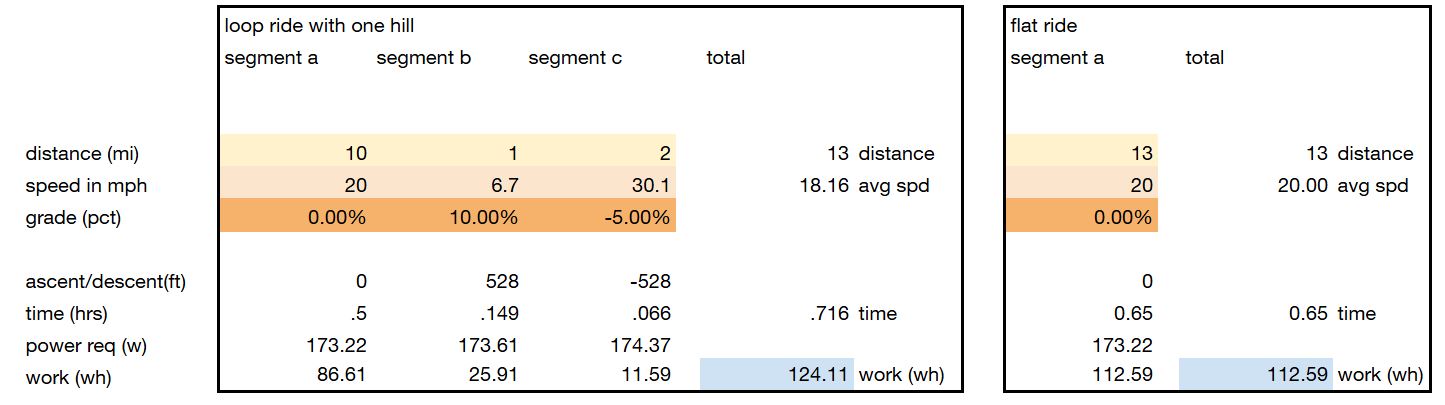
the "ride with one hill" is a 13 mile ride with a single 528 foot tall hill at 10% up, and 5% down. we pedal with the same power (or same total motor+rider power) for the entire ride, resulting in one speed on the flat, a different speed going up, and a different speed going down.
the ride with the hill takes longer because the air resistance scales exponentially going down the hill. since we're inputting the same power, for more time, we do more work - in this case about 10 percent more, from just one hill! the orange cells are input here
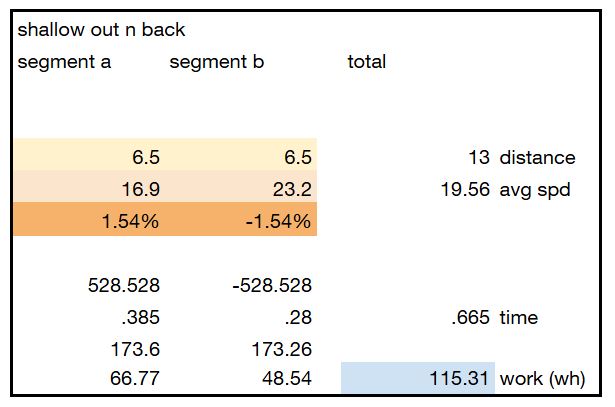
but.... what if it's just a really shallow out and back with the same amount of climbing? now the penalty is negligible because we're not going much faster on the downhill.
in a truly brutal ride, with steep ascents and descents, what probably happens is that we don't pedal on the descents. here's an example :
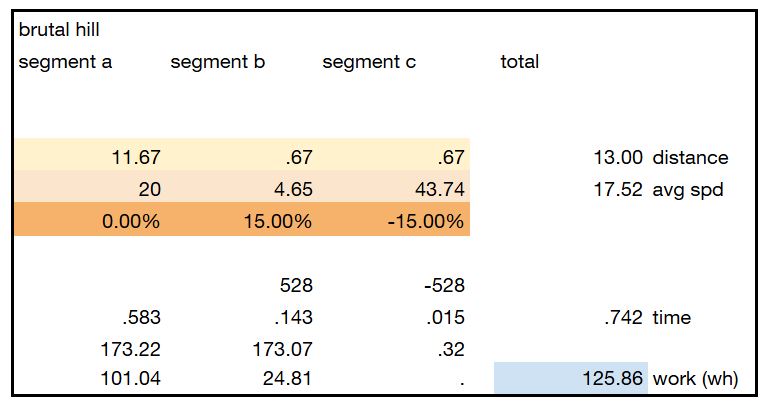
now, even without wasting our power downhill where it hardly makes a difference, we still did as much work as the first hill, but our average speed dropped even further!
one approach to this would be to have the user select a "ride profile" - flat, small hills, shallow gradient, big hills, or something, and either apply some factors or do some proportional modeling. personally, i think these 5-20% potential differences in work are worth taking into account. my examples above are also for a pretty racy setup, an aero road bike with the rider in a decent position. change it to flat bars and sitting upright and those differences are going to skyrocket.
i think for this to be accurate for the kind of riding i do you'd need a way to break the ride into a few chunks or "types" of riding. the key factor is how often you're going any given speed since the power required doesn't vary linearly with speed. using the standard formula, here's a really modest and simple example.
the "ride with one hill" is a 13 mile ride with a single 528 foot tall hill at 10% up, and 5% down. we pedal with the same power (or same total motor+rider power) for the entire ride, resulting in one speed on the flat, a different speed going up, and a different speed going down.
the ride with the hill takes longer because the air resistance scales exponentially going down the hill. since we're inputting the same power, for more time, we do more work - in this case about 10 percent more, from just one hill! the orange cells are input here
but.... what if it's just a really shallow out and back with the same amount of climbing? now the penalty is negligible because we're not going much faster on the downhill.
in a truly brutal ride, with steep ascents and descents, what probably happens is that we don't pedal on the descents. here's an example :
now, even without wasting our power downhill where it hardly makes a difference, we still did as much work as the first hill, but our average speed dropped even further!
one approach to this would be to have the user select a "ride profile" - flat, small hills, shallow gradient, big hills, or something, and either apply some factors or do some proportional modeling. personally, i think these 5-20% potential differences in work are worth taking into account. my examples above are also for a pretty racy setup, an aero road bike with the rider in a decent position. change it to flat bars and sitting upright and those differences are going to skyrocket.
apctjb
Active Member
- Region
- USA
one approach to this would be to have the user select a "ride profile" - flat, small hills, shallow gradient, big hills, or something, and either apply some factors or do some proportional modeling. personally, i think these 5-20% potential differences in work are worth taking into account. my examples above are also for a pretty racy setup, an aero road bike with the rider in a decent position. change it to flat bars and sitting upright and those differences are going to skyrocket.
Agree , a ride profile would be a nice improvement. Or better yet, input the route GPX file and the app breaks the ride into 100m segments and calculates grade of each little segment. That said there is a point of diminishing returns for lots of added computational modeling which might only add small amounts of accuracy.
stompandgo
Well-Known Member
- Region
- USA
Can I run it on my phone in my jersey pocket? Can I start it at the beginning of the ride and stop it at the end, with no intervention during the ride, no matter how many stops and starts I make? If so, I'll be happy to test it out for you. I can bring a power block if it's a battery eater.
Can it handle a range extender? Would I just change the capacity number, or is there a separate field for it?
Did you post this app on Facebook? Something like this crossed my timeline a few days ago.
Can it handle a range extender? Would I just change the capacity number, or is there a separate field for it?
Did you post this app on Facebook? Something like this crossed my timeline a few days ago.
apctjb
Active Member
- Region
- USA
Thanks for the offer. This is a pre ride range estimator for route planning. It helps answer questions like-- can I make the ride on my main battery or is a range extender needed, and what motor settings should I use to increase the range of a route I am considering. It is not an app you need to bring with you once on the ride.Can I run it on my phone in my jersey pocket? Can I start it at the beginning of the ride and stop it at the end, with no intervention during the ride, no matter how many stops and starts I make? If so, I'll be happy to test it out for you. I can bring a power block if it's a battery eater.
Where I live there are lots of longer rides up in the mountains, where I don't want to run out of battery and rely on my legs alone to get home. This helps me estimate battery range and what motor settings to use to increase the range for a specific route.

Stefan Mikes
Gravel e-biker
- Region
- Europe
- City
- Mazovia, PL
Not making any comparisons but...
The latest Bosch e-bikes can calculate the ride distance and elevation gain by the route plan and take you there on the battery charge (by automatically adjusting the assistance).
Specialized has had Smart Control since I think 2019: enter the ride distance and elevation gain and the e-bike will take you there on the battery (a concept similar to Bosch but no map).
The latest Bosch e-bikes can calculate the ride distance and elevation gain by the route plan and take you there on the battery charge (by automatically adjusting the assistance).
Specialized has had Smart Control since I think 2019: enter the ride distance and elevation gain and the e-bike will take you there on the battery (a concept similar to Bosch but no map).
apctjb
Active Member
- Region
- USA
That's brilliant! No need for range estimator with that functionality. Unfortunately no such feature on TQ bikes...The latest Bosch e-bikes can calculate the ride distance and elevation gain by the route plan and take you there on the battery charge (by automatically adjusting the assistance).
Specialized has had Smart Control since I think 2019: enter the ride distance and elevation gain and the e-bike will take you there on the battery (a concept similar to Bosch but no map).
Stefan Mikes
Gravel e-biker
- Region
- Europe
- City
- Mazovia, PL
Just you make you aware: none of these systems (as an automated solution) is perfect. For instance, the Spesh system is very conservative during the early ride phase (providing too little assistance just to make sure) while it is often the full assistance during the last phase (to meet the criterion of using the battery charge up to the specification). Fancy you ride a terrain with many short steep hills. You do not get the boost when you need it most! (Yes, you can override the system to TURBO for 30 seconds by a button push).
Nothing replaces the experience, so the tool you mentioned would give more awareness and contribute to the experience gain.
Nothing replaces the experience, so the tool you mentioned would give more awareness and contribute to the experience gain.
apctjb
Active Member
- Region
- USA
For instance, the Spesh system is very conservative during the early ride phase (providing too little assistance just to make sure) while it is often the full assistance during the last phase (to meet the criterion of using the battery charge up to the specification).
Exactly what I found myself doing! Being overly conservative early on because I was concerned about range only to complete the ride with more than enough gas in the tank! (the bike, not me...) That is why I wanted a way to plan for the ride in advance...

Jeremy McCreary
Bought it anyway
- Region
- USA
- City
- Carlsbad, CA
Exactly what I found myself doing! Being overly conservative early on because I was concerned about range only to complete the ride with more than enough gas in the tank! (the bike, not me...) That is why I wanted a way to plan for the ride in advance...
Guess I'm kind of a control freak when it comes to my bike. For one thing, after 20+ years of retirement and 42 years of marriage, it's one of the few things I'm still in charge of!
;^}
So, much prefer your approach to that of Specialized's Smart Control — which I have on my Vado SL 1 but have yet to try. Looking forward to hearing how your app progresses.
Similar threads


- Replies
- 3
- Views
- 31K

- Replies
- 9
- Views
- 112K