Brake Bleed Blues

PedalUma

Well-Known Member
Region
USA
City
Petaluma, CA
I have recently had to do brake bleeds on things such as gigantic cargo bikes and eTrikes. It is such a pain. This is where you can share your pain and pick up useful real world tips from others. One eTrike took two hours to get all the bubbles out.
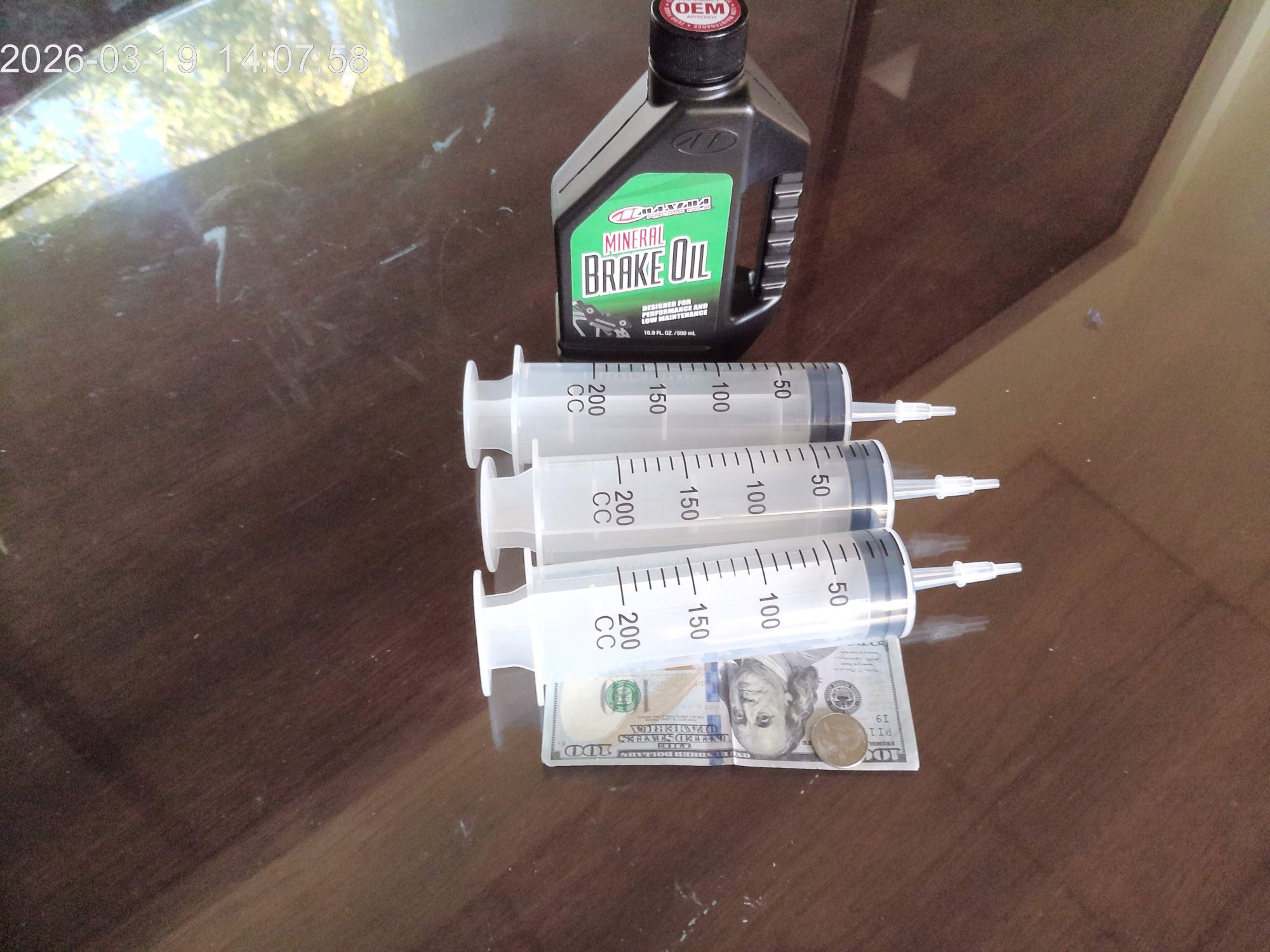
I just purchased these large 200 ml syringes to help. I do not care if I waste a little fluid. I want all the bubbles out fast.

1790038486139.jpeg

Here is a starting place video from Park Tool.
 
Last edited:
Yes, the caliper comes off with the pads off, and the caliper is on or over cardboard away from the rotor. Pull the old dark junk oil down until you hit fresh oil from the top dispenser added reservoir or syringe. Dispose of the burnt junk. Then go the other way with fresh oil so no bubbles appear at the top. I am making it sound easier than it is. For the rear drop the callipers and put the front wheel up on a milk crate, so the bubbles want to migrate up. It is not taking the caliper off, it is lowering it down while still attached to the hose. This way there are no S-curves like under a kitchen sink that can trap air. When the fresh oil has no bubbles up top cap the top, like a pipette with the plug, install the bottom plug and clean everything before installing the pads. A block is required to prevent the pistons from popping out.
 
Last edited:
Bleeding a bike can be such a mess. Get cardboard under it. @Aushiker, It was about 14 years-ago-working a 9 to 5 selling wine;
when I was at a picnic table eating a tuna sandwich from home with two ladies from work at lunch, I explained that I could not work on things with rubber gloves, I had to really feel what I was doing. They laughed and laughed, even more at me. They were thinking about condoms. Mineral oil on the hands is nasty. I would still rather feel what I was doing. Who wants a raincoat in the shower? In the west of one island I love you can be in the rainbow mist and ride the waves in and out with your toes sticking up. The waves and air at 82 degrees as you view the rainbow and gliders an and an observatory on a mountain. Iti is exactly between a baja like desert an a jungle.
 
I just sold my analog cargo bike but before doing so stripped off the Avid Mechanicals and installed new Magura hydros. Good riddance.

The electrified cargo I'm building now was the donor of those Maguras, and I'm treating it to a set of Paul mechanicals.

I don't "hate" hate hydros, but I much prefer the simplicity of cable pull. I hadn't even thought about trying to get a long, heavy cargo bike at the correct angle for a proper bleed! Yeesh.
 
I prefer doing a dual syringe bleed over a lever bleed with a cup. I've found that once the majority of the easy air is removed, using one syringe to pull and the other to push helps get the last of the air out.
 
I prefer doing a dual syringe bleed over a lever bleed with a cup. I've found that once the majority of the easy air is removed, using one syringe to pull and the other to push helps get the last of the air out.
Any chance that you could post a step by step tutorial on this method?
 
I prefer doing a dual syringe bleed over a lever bleed with a cup.
Me too. Having both pressure and suction really works to force it through.
I fantasize about using DOT 5. It is used in race cars and is super stable. I just don't know how it will impact seals. It is supposed to inert.
I'm treating it to a set of Paul mechanicals.
Really good mechanicals are really good. Just tighten the inside pad after a big ride until it touches and then back off a quarter turn.
 
Really good mechanicals are really good. Just tighten the inside pad after a big ride until it touches and then back off a quarter turn.
I don't know if they fit the accolade "really good," but I've been true to Avid's BBDB / BB7s since inception, run'em on the tandem and on the bike-towing cargo bike, and on the mountain bikes. I hear these Paul Klampers fall into the "really good" category so figured they're worth trying for a cargo bike with horsepower.
 
I don't know if they fit the accolade "really good," but I've been true to Avid's BBDB / BB7s since inception, run'em on the tandem and on the bike-towing cargo bike, and on the mountain bikes. I hear these Paul Klampers fall into the "really good" category so figured they're worth trying for a cargo bike with horsepower.
The Hase mechanical brakes are like jewelry and very strong and with great action. If coupled with highly polished stainless cables with pure silicone oil inside the housings, you have a simple system that will never need a bleed or form a vapor lock. Those Avids in my opinion with the little round pads are not all that great. There is a badly corroded set of those on a gigantic rickshaw I am working on this week. It lives in a hilly area. I am installing these hydro quads in the front. $43.

1790090397497.png
 

Attachments

  • Hydro Quads.jpg
    Hydro Quads.jpg
    440.7 KB · Views: 3
Any chance that you could post a step by step tutorial on this method?
I'm no expert, but this is what I do.

1. If your lever has a reservoir, remove the cover and top it off.
2. Attach hoses to two clean syringes. Fill each syringe half way and burp the air out of the hoses.
3. Attach the hoses to each end of the brake hose, i.e. lever and caliper.
4. If either end uses zerk fitttings or a bleed screw, open them.
5. Affix one syringe to the bike so that it is vertical, forcing air out of the fluid. I usually use the caliper end.
6. Push the caliper syringe while pulling on the lever syringe. It takes practice, but it's not hard. Push about half the fluid. No syringe should be more than 3/4 full or less than 1/4 full.
7. Hold the lever syringe vertically to burp the air. Push the lever syringe while pulling the caliper syringe. You can also do what @PedalUma suggests, and pull on the syringe with less fluid first to create a "vacuum", then push the fluid through with the other syringe. If this method works, increase the push force to drive out trapped bubbles.
8. Always make sure that bottom of both syringes are vertical before moving fluid.
9. Repeat 5-10 times.
10. After moving fluid, flick the lever lightly, which can force sticky air bubbles out of the lever.
11. Test the lever for travel and firmness. When it's acceptable, disconnect both syringes and close both bleed screws or attach the covers.

All this assumes that the fluid is good. Changing fluid is similar, but I just use one syringe at the lever end, and put a hose onto the caliper, and put it into a jar. Keep refilling the syringe until the fluid runs clean, then bleed.
 
Those Avids in my opinion with the little round pads are not all that great. There is a badly corroded set of those on a gigantic rickshaw I am working on...
Hmmm, not familiar with round pads for Avids, mine have always have the rectangular pads.

The original Avid BBDBs had the pistons with magnets for pad retention and the magnets on mine rusted out. They later dropped the magnets and began providing pads with spring clips for retraction / retention, and I've had zero issues with those over years of service.

Supposedly the difference with these Paul Klampers is they are machined out of a single block of aluminum, so are supposed to be extra stiff compared to a bolted-together 2-piece caliper. But like I said, I never had a complaint about the Avids, even for tandem and cargo duty, so remains to be seen if I just wasted my money for an imperceivable improvement. (well... their anodized color selection got me, too -- I won't pretend like this was a purely practical purchase decision!)
 
round pads for Avids
Mine are the banjo shape. And you are correct in my opinion about mechanical brakes made from a solid block. I hear that bike packers out in the middle of nowhere like Peru or Kenya, prefer quality mechanical brakes.

To bleed I also like push-pull. I pull out the old burnt oil down until I see the fresh oil. I then dispose of the old, putting fresh into the lower syringe. Then I push that up while pulling up top. I do it outside and it helps to have a buddy because I don't have a way to hang a syringe unless I do it next to a fence. I go back and forth several times. When it becomes really stiff to move the fluid you know that all the air is out. It is amazing to me how much air can be in a system.

 
Back