6 states currently allow 1000 watt ebikes. Most others are 750. What's the issue? You should just relax and enjoy the bike. It's legal.Enjoy your ride, or I hope you enjoyed your ride. This is the first time you've dropped the "1000 watts" peak from your claim of what the law is. I totally agree with you now.
Don't worry about those "extra watts." 1000 watts continuous is tied to the federal benchmark of 1 h.p., that is, mechanical watts, because, depending on motor efficiency, an electric motor needs 900-1000 watts of electrical power to the motor to output ~750 watts mechanical at the shaft. Your bike is highly likely to be seen as federally compliant at this stage of low-level enforcement. God forbid they roll out the dynamometers, but they probably won;t. They'll be trained in brand recognition and the like. The rest of what I have said will sink in over time. Glad I could help you out.
You are using an out of date browser. It may not display this or other websites correctly.
You should upgrade or use an alternative browser.
You should upgrade or use an alternative browser.
Are 750 watt ebikes actually legal?
- Thread starter Frostybikes
- Start date



RunForTheHills
Well-Known Member
- Region
- USA
You selected a hub motor again. The RPM of the motor is shown in the table below the graph on the left, but is not represented in the graph. The motor you selected is a direct drive motor and the first motor shown, the GMAC, is a geared hub motor. A direct drive motor will spin at the speed of the wheel it is laced into. A geared hub motor has a planetary gear system built into it so that the motor can spin faster than the wheel at a more efficient RPM for the motor. Grin is not being deceptive and never has been.It can mean pedaling cadence but if human power is not involved then a torque calculation is in RPMs (cadence). I've been looking the simulator over, here's my screenshot from just a couple of minutes ago. I don't see an input for RPMs, either, now that we have terminology straight. This is the formula according to Grin, and I agree with for motor shaft torque: Power in Watts = Torque * RPM * 2Pi/60 ~ Torque * RPM * 0.104. (Well, shoot, I cut off the snippet too high and there are further parameters below. None of them were for cadence or RPM, though, and they are present on yours if yours is also recent. I can go make another screenshot if you like. I'm strongly thinking RPM/Cadence is a constant here that they didn't appear to tell us about. This is very interesting in the article:
"This is one reason why rated motor powers can be all over the map. It is ultimately the torque and not power that causes a motor to overheat. To convert a maximum torque spec into a power rating you need to also specify the RPM at which you decided this rating. However, permanent magnet electric motors in isolation don't intrinsically have an RPM at which they spin at, they'll have an RPM/V winding constant. It's the combination of this winding constant and your battery voltage that determines how fast a motor will be able to spin in a given setup." RPM/V winding constant is fascinating but not really our question. A motor without a load will spin faster or slower according to voltage supplied is one of the key concepts involved with that.
But yeah, I still don't see that variable input.
And a search for the word cadence had no hits in the article. I suppose it is a whole lot more honest than other companies would have us believe, and it is a complicated subject. I'm not mad at Grin, but it is an industry that teaches us not to trust it.
View attachment 212964
David42000
Member
You have outdated information. I know for a fact without checking that Kansas used to be a 1000 watt state but is now 3 class.Six states explicitly allow e-bikes with up to 1000W of power on public roadways: Georgia, Kansas, Minnesota, Oklahoma, Oregon, and Virginia. Additionally, Florida and Mississippi have no maximum power limits for bicycles, meaning 1000W models are perfectly legal there, provided they can still be pedaled. In most other states, the legal limit is capped at 750W. [1, 2, 3]
View attachment 212950
View attachment 212952
View attachment 212953
View attachment 212949
View attachment 212951
View attachment 212954Six states explicitly allow e-bikes with up to 1000W of power on public roadways: Georgia, Kansas, Minnesota, Oklahoma, Oregon, and Virginia. Additionally, Florida and Mississippi have no maximum power limits for bicycles, meaning 1000W models are perfectly legal there, provided they can still be pedaled. In most other states, the legal limit is capped at 750W.If you are planning to ride your e-bike, tell me:What state or specific city will you be riding in?Are you planning to ride on paved roads, bike lanes, or off-road trails?I can give you more specific details on local path restrictions and speed limits.What Legal Considerations Apply to 1000W City E-Bikes in Urban ...Jan 16, 2026 — State-by-State Legal Matrix for 1000W City E-Bikes State laws create patchwork compliance challenges for 1000W city e-bikes riders. Six states explicitly permit...TST EbikeClass 3 eBike Laws, US Electric Bike Regulations | Quietkat USAIn which states are 1000W Ebikes legal? Six states specifically allow eBikes to have a max power of 1000W; these are Georgia, Kansas, Minnesota, Oklahoma, Orego...quietkat usaComplete State-by-State E-Bike Regulations Guide 2025May 26, 2025 — Higher Power Allowances. Higher Limit States: Six states specifically allow eBikes to have a max power of 1000W; these are Georgia, Kansas, Minnesota, Oklahoma,Movcan
Movcan
Six states explicitly allow e-bikes with up to 1000W of power on public roadways: Georgia, Kansas, Minnesota, Oklahoma, Oregon, and Virginia. Additionally, Florida and Mississippi have no maximum power limits for bicycles, meaning 1000W models are perfectly legal there, provided they can still be pedaled. In most other states, the legal limit is capped at 750W. [1, 2, 3]
If you are planning to ride your e-bike, tell me:
I can give you more specific details on local path restrictions and speed limits.
- What state or specific city will you be riding in?
- Are you planning to ride on paved roads, bike lanes, or off-road trails?
What Legal Considerations Apply to 1000W City E-Bikes in Urban ...
Jan 16, 2026 — State-by-State Legal Matrix for 1000W City E-Bikes State laws create patchwork compliance challenges for 1000W city e-bikes riders. Six states explicitly permit...
View attachment 212955
View attachment 212956
TST Ebike
Class 3 eBike Laws, US Electric Bike Regulations | Quietkat USA
In which states are 1000W Ebikes legal? Six states specifically allow eBikes to have a max power of 1000W; these are Georgia, Kansas, Minnesota, Oklahoma, Orego...
View attachment 212960
View attachment 212957
Six states specifically allow eBikes to have a max power of 1000W; these are Georgia, Kansas, Minnesota, Oklahoma. Two states, Florida and Loisiana have no limits on ebike output.
View attachment 212959
View attachment 212958
Allow me to be more helpful. Here is information I compiled just a few days ago, painstakingly and manually, looking at each and every statute personally. I even got Hawaii right and their new law just went into effect July 1 2026.
You'll note that online "State-by-state-eBike-law" guides never give you the watts information for 3 class states. That's why I compiled the list. It's up-to-speed and accurate. I dunno if your internets are borken or mines are, but when I search for Kansas — K.S.A. § 8-1489 and click on the Kansas Revisor link, I see: "8-1489. "Electric-assisted bicycle" defined; classes of electric-assisted bicycles. "Electric-assisted bicycle" means a bicycle with two or three wheels, a saddle, fully operative pedals for human propulsion, and an electric motor of less than 750 watts that meets the requirements of one of the following three classes:"
That's what I see. Your information is old and outdated.
| Grouping | Description | States |
| Group 1: "Less Than" (Blind) | Adopted "less than" PFB language verbatim; 750W sticker is prima facie non-compliant. | AL, AZ, AR, CT, FL, ID, IL, IA, KS, LA, ME, MD, MS, MO, NH, NJ, NM, NY, ND, OH, SD, TN, TX, VT, VA, WV, WI, WY |
| Group 2: "No More Than" | Inclusive ceiling; "no more than" 750W. | CA, CO, DE, GA, HI, MA, MI, MN, NV, NC, OK, PA, SC, UT, WA |
| Group 3: "Averaging" | Even vaguer "average 750 watts" | IN, NE |
| Group 4: Outliers | Rely on legacy/mechanical definitions; some are the most compliant of all the states in this group. AK and KY have no special e-bike law at all. | AK, KY, MT, OR, RI |
Group 1: The Strict "Less Than 750 Watts" States
These states adopted the rigid wording of PeopleForBikes model templates verbatim into their traffic codes. In these states, a motor rating of exactly 750W sits outside the literal text of the law. None of them clarify what “watts” means. These states blindly adopted PFB model language with no variation of the definition of an e-bike.
- Alabama — Ala. Code § 32-1-1.1
- Arizona — Ariz. Rev. Stat. § 28-101
- Arkansas — Ark. Code § 27-51-1702
- Connecticut — Conn. Gen. Stat. § 14-1
- Florida — Fla. Stat. § 316.003
- Idaho — Idaho Code § 49-106
- Illinois — 625 ILCS 5/1-140.10
- Iowa — Iowa Code § 321.1
- Kansas — K.S.A. § 8-1489
- Louisiana — La. Rev. Stat. § 32:1
- Maine — 29-A M.R.S. § 101(22-B)
- Maryland — Md. Code, Transp. § 11-117.1
- Mississippi — Miss. Code Ann. § 63-3-103
- Missouri — Mo. Rev. Stat. § 301.010
- New Hampshire — N.H. Rev. Stat. § 259:27-a
- New Jersey — N.J. Stat. § 39:1-1
- New Mexico — N.M. Stat. Ann. § 66-1-4.11
- New York — N.Y. Veh. & Traf. Law § 102-c
- North Dakota — N.D. Cent. Code § 39-01-01
- Ohio — Ohio Rev. Code § 4511.01
- South Dakota — S.D. Codified Laws § 32-20B-9
- Tennessee — Tenn. Code Ann. § 55-8-301
- Texas — Tex. Transp. Code § 664.001.
- Vermont — 23 V.S.A. § 4
- Virginia — Va. Code § 46.2-100
- West Virginia — W. Va. Code § 17C-1-70
- Wisconsin — Wis. Stat. § 340.01
- Wyoming — Wyo. Stat. Ann. § 31-1-101
Group 2: The "No More Than / Does Not Exceed" States
These states explicitly chose or amended the PFB model language to establish an inclusive ceiling. By using terms like "does not exceed" or "no more than," they allow a factory motor rated at exactly 750 watts. They still do not clarify what kind of watts. These states seemed to have been paying more attention and saw no reason to outlaw the very popular 750 (continuous) watt continuous motors sold by brands like Bafang over a de minimis one watt. As opposed to the blind states, these states, at the very least, paid attention to the facts about what consumers want. These states had one eye open, at least, and were not totally “asleep at the handlebars.”
- California — Cal. Veh. Code § 312.5 ("does not exceed")
- Colorado — Colo. Rev. Stat. § 42-1-102 (does not exceed)
- Delaware — Del. Code tit. 21, § 101 ("does not exceed-less than or equal to")
- Georgia — Ga. Code Ann. § 40-1-1 (“not more than”)
- Hawaii — § 291C-1 (“no more than”)
- Massachusetts — Mass. Gen. Laws ch. 90, § 1 (750 watts or less).
- Michigan — Mich. Comp. Laws § 257.13e (not greater than)
- Minnesota — Minn. Stat. § 169.011 ("does not exceed")
- Nevada — Nev. Rev. Stat. § 484B.017 (“not more than”)
- North Carolina — N.C. Gen. Stat. § 20-4.01 ("does not exceed")
- Oklahoma — 47 O.S. § 1-104 (“not more than”)
- Pennsylvania — 75 Pa. C.S. § 102 ("does not exceed") (not 3 class system)
- South Carolina — S.C. Code Ann. § 56-1-10 ("no more than")
- Utah — Utah Code § 41-6a-102 (“not more than”)
- Washington — Wash. Rev. Code § 46.04.169 ("no more than")
Whatever this means, there is yet less clarity regarding what “watts” means, but they didn’t fall for the verbatim “less than 750 watts” 3 class system, like group 1.
- Indiana — Ind. Code § 9-13-2-49.3 (averaging 750 watts)
- Nebraska — Neb. Rev. Stat. § 60-618.02 (averaging 750 watts)
Group 4: The Outliers
These states all took different approaches, ranging from referring to federal law directly or relying on it to a substantial extent, to not classifying e-bikes at all. Those that set the limit at 1000 watts seem to reflect federal mechanical watts, because 1000 watts is a good nominal electrical figure for assuring 750 mechanical watts can be delivered. Still no designation for what kind of watts. Having achieved their vague ~750 watt limit in 45 states, it would seem logical that PFB is now complaining of these five states wherein they failed, labeling them non-complaint, when in fact they are the most compliant of all the states. PFB does not explain, however, if it means just these states or if it might also be referring to the 17 states that refused “less than 750 watts” language, too. These states seem to be fully aware, both eyes open. Perhaps not Alaska and Kentucky, they might just be ignoring the issue; but the point is they are not doing anything that is unconstitutional and preempted by federal consumer product law.
Remember Rhode Island when PeopleForBikes tells you that anything more powerful than their 3 class system is an illegal “e-moto.” Hardly. Depending on the variable of wasted electrical energy, a 1500 mechanical watt bike may very well have over 2000 continuous watts electric and be legal for the road in Rhode Island as the e-bike Rhode Island says it is. Rhode Island is master of the streets of Rhode Island, not PeopleForBikes.
- Alaska — § 28.90.990. (relies on broader DMV vehicle and "motor-driven cycle" designations).
- Kentucky — (No State law. Municipalities regulate e-bikes, mostly under the 3 class system).
- Montana — Mont. Code Ann. § 61-8-102 (an electric motor capable of propelling the vehicle and a rider who weighs 170 pounds no faster than 20 miles an hour on a paved, level surface, but drops “less than 750 watts 1 h.p.” language from federal law).
- Oregon — Or. Rev. Stat. § 801.258 (Explicitly permits motor configurations up to 1,000 watts).
- Rhode Island — R.I. Gen. Laws § 31-1-3 (Uses an inclusive ceiling capped at 2 S.A.E. horsepower, [about 1500 mechanical watts]).
Last edited:
David42000
Member
Ok, all cleared up. The worst I can say about Grin is that they did not include that information in their written instructions about how to use the simulator. That's no reason to be suspicious of Grin, just a matter of overlooking a detail in how to use it, no biggie. Maybe it's in the video, I didn't watch it. Thank you for your effort in helping me understand what I was missing. I appreciate it.You selected a hub motor again. The RPM of the motor is shown in the table below the graph on the left, but is not represented in the graph. The motor you selected is a direct drive motor and the first motor shown, the GMAC, is a geared hub motor. A direct drive motor will spin at the speed of the wheel it is laced into. A geared hub motor has a planetary gear system built into it so that the motor can spin faster than the wheel at a more efficient RPM for the motor. Grin is not being deceptive and never has been.


David42000
Member
Ah, you've run to AI slop. but you can't put a statute number into google to check and want to argue for days over it. "AI can make mistakes."If you are planning to ride your e-bike, tell me:
I can give you more specific details on local path restrictions and speed limits.
- What state or specific city will you be riding in?
- Are you planning to ride on paved roads, bike lanes, or off-road trails?
View attachment 212958
(erroneous infographic statement edited)
Last edited:
RunForTheHills
Well-Known Member
- Region
- USA
Because they have an excellent write up on another article on their site:Ok, all cleared up. The worst I can say about Grin is that they did not include that information in their written instructions about how to use the simulator. That's no reason to be suspicious of Grin, just a matter of overlooking a detail in how to use it, no biggie. Maybe it's in the video, I didn't watch it. Thank you for your effort in helping me understand what I was missing. I appreciate it.
Ebike Parts Explained - Getting Started - Resources
Here we give a brief summary of the key components that make up an ebike conversion and the role that they play. Some things like motors and batteries are probably familiar to everyone, while motor controllers, PAS sensors, etc. are less familiar but important to know about.
 ebikes.ca
You have outdated information. I know for a fact without checking that Kansas used to be a 1000 watt state but is now 3 class.
Allow me to be more helpful. Here is information I compiled just a few days ago, painstakingly and manually, looking at each and every statute personally. I even got Hawaii right and their new law just went into effect July 1 2026.
You'll note that online "State-by-state-eBike-law" guides never give you the watts information for 3 class states. That's why I compiled the list. It's up-to-speed and accurate. I dunno if your internets are borken or mines are, but when I search for Kansas — K.S.A. § 8-1489 and click on the Kansas Revisor link, I see: "8-1489. "Electric-assisted bicycle" defined; classes of electric-assisted bicycles. "Electric-assisted bicycle" means a bicycle with two or three wheels, a saddle, fully operative pedals for human propulsion, and an electric motor of less than 750 watts that meets the requirements of one of the following three classes:"
That's what I see. Your information is old and outdated.
Grouping Description States Group 1: "Less Than" (Blind) Adopted "less than" PFB language verbatim; 750W sticker is prima facie non-compliant. AL, AZ, AR, CT, FL, ID, IL, IA, KS, LA, ME, MD, MS, MO, NH, NJ, NM, NY, ND, OH, SD, TN, TX, VT, VA, WV, WI, WY Group 2: "No More Than" Inclusive ceiling; "no more than" 750W. CA, CO, DE, GA, HI, MA, MI, MN, NV, NC, OK, PA, SC, UT, WA Group 3: "Averaging" Even vaguer "average 750 watts" IN, NE Group 4: Outliers Rely on legacy/mechanical definitions; some are the most compliant of all the states in this group. AK and KY have no special e-bike law at all. AK, KY, MT, OR, RI
Group 1: The Strict "Less Than 750 Watts" States
These states adopted the rigid wording of PeopleForBikes model templates verbatim into their traffic codes. In these states, a motor rating of exactly 750W sits outside the literal text of the law. None of them clarify what “watts” means. These states blindly adopted PFB model language with no variation of the definition of an e-bike.
- Alabama — Ala. Code § 32-1-1.1
- Arizona — Ariz. Rev. Stat. § 28-101
- Arkansas — Ark. Code § 27-51-1702
- Connecticut — Conn. Gen. Stat. § 14-1
- Florida — Fla. Stat. § 316.003
- Idaho — Idaho Code § 49-106
- Illinois — 625 ILCS 5/1-140.10
- Iowa — Iowa Code § 321.1
- Kansas — K.S.A. § 8-1489
- Louisiana — La. Rev. Stat. § 32:1
- Maine — 29-A M.R.S. § 101(22-B)
- Maryland — Md. Code, Transp. § 11-117.1
- Mississippi — Miss. Code Ann. § 63-3-103
- Missouri — Mo. Rev. Stat. § 301.010
- New Hampshire — N.H. Rev. Stat. § 259:27-a
- New Jersey — N.J. Stat. § 39:1-1
- New Mexico — N.M. Stat. Ann. § 66-1-4.11
- New York — N.Y. Veh. & Traf. Law § 102-c
- North Dakota — N.D. Cent. Code § 39-01-01
- Ohio — Ohio Rev. Code § 4511.01
- South Dakota — S.D. Codified Laws § 32-20B-9
- Tennessee — Tenn. Code Ann. § 55-8-301
- Texas — Tex. Transp. Code § 664.001.
- Vermont — 23 V.S.A. § 4
- Virginia — Va. Code § 46.2-100
- West Virginia — W. Va. Code § 17C-1-70
- Wisconsin — Wis. Stat. § 340.01
- Wyoming — Wyo. Stat. Ann. § 31-1-101
Group 2: The "No More Than / Does Not Exceed" States
These states explicitly chose or amended the PFB model language to establish an inclusive ceiling. By using terms like "does not exceed" or "no more than," they allow a factory motor rated at exactly 750 watts. They still do not clarify what kind of watts. These states seemed to have been paying more attention and saw no reason to outlaw the very popular 750 (continuous) watt continuous motors sold by brands like Bafang over a de minimis one watt. As opposed to the blind states, these states, at the very least, paid attention to the facts about what consumers want. These states had one eye open, at least, and were not totally “asleep at the handlebars.”
Group 3: The “Average 750 watts” States.
- California — Cal. Veh. Code § 312.5 ("does not exceed")
- Colorado — Colo. Rev. Stat. § 42-1-102 (does not exceed)
- Delaware — Del. Code tit. 21, § 101 ("does not exceed-less than or equal to")
- Georgia — Ga. Code Ann. § 40-1-1 (“not more than”)
- Hawaii — § 291C-1 (“no more than”)
- Massachusetts — Mass. Gen. Laws ch. 90, § 1 (750 watts or less).
- Michigan — Mich. Comp. Laws § 257.13e (not greater than)
- Minnesota — Minn. Stat. § 169.011 ("does not exceed")
- Nevada — Nev. Rev. Stat. § 484B.017 (“not more than”)
- North Carolina — N.C. Gen. Stat. § 20-4.01 ("does not exceed")
- Oklahoma — 47 O.S. § 1-104 (“not more than”)
- Pennsylvania — 75 Pa. C.S. § 102 ("does not exceed") (not 3 class system)
- South Carolina — S.C. Code Ann. § 56-1-10 ("no more than")
- Utah — Utah Code § 41-6a-102 (“not more than”)
- Washington — Wash. Rev. Code § 46.04.169 ("no more than")
Whatever this means, there is yet less clarity regarding what “watts” means, but they didn’t fall for the verbatim “less than 750 watts” 3 class system, like group 1.
- Indiana — Ind. Code § 9-13-2-49.3 (averaging 750 watts)
- Nebraska — Neb. Rev. Stat. § 60-618.02 (averaging 750 watts)
Group 4: The Outliers
These states all took different approaches, ranging from referring to federal law directly or relying on it to a substantial extent, to not classifying e-bikes at all. Those that set the limit at 1000 watts seem to reflect federal mechanical watts, because 1000 watts is a good nominal electrical figure for assuring 750 mechanical watts can be delivered. Still no designation for what kind of watts. Having achieved their vague ~750 watt limit in 45 states, it would seem logical that PFB is now complaining of these five states wherein they failed, labeling them non-complaint, when in fact they are the most compliant of all the states. PFB does not explain, however, if it means just these states or if it might also be referring to the 17 states that refused “less than 750 watts” language, too. These states seem to be fully aware, both eyes open. Perhaps not Alaska and Kentucky, they might just be ignoring the issue; but the point is they are not doing anything that is unconstitutional and preempted by federal consumer product law.
Remember Rhode Island when PeopleForBikes tells you that anything more powerful than their 3 class system is an illegal “e-moto.” Hardly. Depending on the variable of wasted electrical energy, a 1500 mechanical watt bike may very well have over 2000 continuous watts electric and be legal for the road in Rhode Island as the e-bike Rhode Island says it is. Rhode Island is master of the streets of Rhode Island, not PeopleForBikes.
- Alaska — § 28.90.990. (relies on broader DMV vehicle and "motor-driven cycle" designations).
- Kentucky — (No State law. Municipalities regulate e-bikes, mostly under the 3 class system).
- Montana — Mont. Code Ann. § 61-8-102 (an electric motor capable of propelling the vehicle and a rider who weighs 170 pounds no faster than 20 miles an hour on a paved, level surface, but drops “less than 750 watts 1 h.p.” language from federal law).
- Oregon — Or. Rev. Stat. § 801.258 (Explicitly permits motor configurations up to 1,000 watts).
- Rhode Island — R.I. Gen. Laws § 31-1-3 (Uses an inclusive ceiling capped at 2 S.A.E. horsepower, [about 1500 mechanical watts]).
Well, I live in a group 2 state so even under some new law that came out 3 whole weeks ago, I'm legal with 750 watts power. You can nit-pick this to death but it still comes down to just riding carefully and slowing down on the trails. If you cause an accident, and it's your fault, it makes no difference what you have for power. If the bike is sold as having 750 watts, then the rider is not breaking the law as far as power goes, in my state. But negligence is a whole other matter. My last ebike was 1000 watts and I rode it for 6 years with no problem. If you worry about breaking the law, stick with a little 350 watt and have fun on the hills. I live in the NW. We have real hills that take power.Ah, you've run to AI slop. Infographics, emojis and now this, but you can't put a statute number into google to check and want to argue for days over it. "AI can make mistakes."
David42000
Member
Are you aware this thread is about whether 750 watt motors are legal and you're saying I'm nitpicking because you have expressed confusion throughout the thread?Well, I live in a group 2 state so even under some new law that came out 3 whole weeks ago, I'm legal with 750 watts power. You can nit-pick this to death but it still comes down to just riding carefully and slowing down on the trails. If you cause an accident, and it's your fault, it makes no difference what you have for power. If the bike is sold as having 750 watts, then the rider is not breaking the law as far as power goes, in my state. But negligence is a whole other matter. My last ebike was 1000 watts and I rode it for 6 years with no problem. If you worry about breaking the law, stick with a little 350 watt and have fun on the hills. I live in the NW. We have real hills that take power.
You began this by claiming I was wasting words after providing information you can get nowhere else, state by state information concerning whether or not your state had some kind of 750 watt limit. And then you utterly refused to check your state laws. You wouldn;t check your states laws, and then you mistakenly said:What a lot of wasted words. The op's answer is simple. Check with your state laws on the max power you can have. Where I live it's 750 watts. Above that it needs a license and can't be on bike trails.
And your state doesn't have a "1000 watt peak" law. I checked that, THEN you gave us AI slop falsely claiming six, or was it eight states allow 1000 watts which is not true. You filled the thread up with misinformation SOLELY because you were too proud to get the statute number I provided in my post and check your own state and say thank you fro helping me out. And now I am nit-picking by trying to keep the information in the thread accurate. Wow.The best you can do to protect yourself from a lawsuit is to simply stay within your states ebike power laws. My state says no more than 750 watts or 1000 peak. That's what I have. I'm legal under the law. Seems pretty simple. If the law changes, go with it or don't.
David42000
Member
Thanks.Because they have an excellent write up on another article on their site:
Ebike Parts Explained - Getting Started - Resources
Here we give a brief summary of the key components that make up an ebike conversion and the role that they play. Some things like motors and batteries are probably familiar to everyone, while motor controllers, PAS sensors, etc. are less familiar but important to know about.
Your an idiot looking to mislead or scare people with this "new laws" bs. Everybody can check their own state laws, like I have, for the last 6 years, as my ebikes are at the top wattage to be legal. Why you keep trying to say otherwise is a mystery. The power ebike laws are not federal but made state by state. Most say 750 and under are legal ebikes. Some are 1000. That law has not changed in most states. You have not added any new information to this. Your looking for some thank you's + attaboys for doing the same research that most anyone else with an ebike already knows or has already researched on their own. You add nothing new. Let it go bro. You have beaten this horse to death.Are you aware this thread is about whether 750 watt motors are legal and you're saying I'm nitpicking because you have expressed confusion throughout the thread?
You began this by claiming I was wasting words after providing information you can get nowhere else, state by state information concerning whether or not your state had some kind of 750 watt limit. And then you utterly refused to check your state laws. You wouldn;t check your states laws, and then you mistakenly said:
And your state doesn't have a "1000 watt peak" law. I checked that, THEN you gave us AI slop falsely claiming six, or was it eight states allow 1000 watts which is not true. You filled the thread up with misinformation SOLELY because you were too proud to get the statute number I provided in my post and check your own state and say thank you fro helping me out. And now I am nit-picking by trying to keep the information in the thread accurate. Wow.
My curiosity was peaked, so I checked my bike spec.
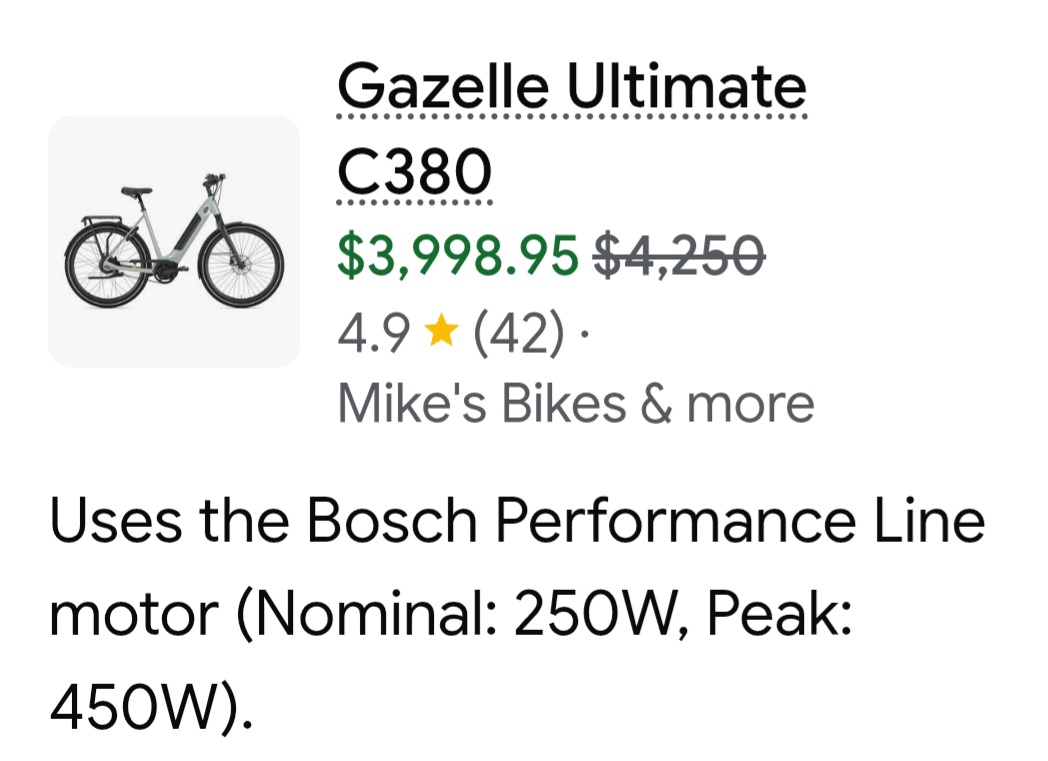
What's with all these bikes that are 750 or higher? Do you tow auto transport trailers? Or are these primarily Class 2s?
Full disclosure: although I don't do it often, 20 mph is no big deal for the C380. Don't spend much time on "steeper" hills, but tried it and 20 is no big deal. Wouldn't be able to do it for very long because 20 + steep hill really eats battery.
What's with all these bikes that are 750 or higher? Do you tow auto transport trailers? Or are these primarily Class 2s?
Full disclosure: although I don't do it often, 20 mph is no big deal for the C380. Don't spend much time on "steeper" hills, but tried it and 20 is no big deal. Wouldn't be able to do it for very long because 20 + steep hill really eats battery.
I use 750 and 1000 watt bikes because I live in the Pacific North West where hills are everywhere. It's not about speed, which is 30 mph max. but for the extra power climbing steep streets. If I lived in flatlands I'd have a bike with less power. I've seen many people out here spend thousands on an ebike just to find it underpowered on the hills. They struggle to make it up. More power is best imo.

David42000
Member
ONE State is a 1000 watt state. ONE. And you utterly refused to check your own state. You tried to misinform me about my own state. You keep riding the dead horse. Find something constructive to do besides expressing hatred for people who know more or are willing to find out more.Your an idiot looking to mislead or scare people with this "new laws" bs. Everybody can check their own state laws, like I have, for the last 6 years, as my ebikes are at the top wattage to be legal. Why you keep trying to say otherwise is a mystery. The power ebike laws are not federal but made state by state. Most say 750 and under are legal ebikes. Some are 1000. That law has not changed in most states. You have not added any new information to this. Your looking for some thank you's + attaboys for doing the same research that most anyone else with an ebike already knows or has already researched on their own. You add nothing new. Let it go bro. You have beaten this horse to death.
David42000
Member
Not quite auto transport trailers, but I did landscaping and other real work with a trailer. I'd haul a couple hundred pounds around, say, several cubic yards of gardening soil, or stone. And then there's groceries and other stuff. I'm pretty serious about replacing a motor vehicle. No way even a deceptively rated 250 watt would do.My curiosity was peaked, so I checked my bike spec.
View attachment 213008
What's with all these bikes that are 750 or higher? Do you tow auto transport trailers? Or are these primarily Class 2s?
Full disclosure: although I don't do it often, 20 mph is no big deal for the C380. Don't spend much time on "steeper" hills, but tried it and 20 is no big deal. Wouldn't be able to do it for very long because 20 + steep hill really eats battery.
David42000
Member
I'm suspecting there is about to be a wave of strict enforcement and that watts, even just that de minimis one watt difference, will soon matter a lot, especially in the "less than 750 watts" states. I have yet to see a "less than" 750 watts sticker. The times, they are a' changin.'I have a couple of 750w bikes that are fed up to1500w. Outside of selling an ebike, it's not about watts but maximum powered speed.
Similar threads
- Replies
- 69
- Views
- 14K
- Replies
- 11
- Views
- 2K

- Replies
- 20
- Views
- 2K

- Replies
- 27
- Views
- 4K
