Mine peaks at 1000 watts but I get passed by roadies on race bikes with no motor as well as people on escooters doing 50mph. What's the law say there?Another plan: wait for guys with the GREAT BIG motors (say 1000w+) to start getting tickets/enforcement actions, THEN worry about the 749 vs. 750 concern. Until then, the difference is pretty much a non event?
My plan is to continue enjoying 1000w+ motors, ridden in a sane manner, as long as I can.
Kinda like dealing with my wife...... you pick your battles carefully
You are using an out of date browser. It may not display this or other websites correctly.
You should upgrade or use an alternative browser.
You should upgrade or use an alternative browser.
Are 750 watt ebikes actually legal?
- Thread starter Frostybikes
- Start date


David42000
Member
The Safe Speeds Act is in congress and threatens to do exactly that. You don't have to care. I have no problems with states having use laws like speed limits (as long as they are equal) helmets, age restrictions. If your bike has something like 1000 watts continuous, then your shaft output may very well be about 1 h.p. or more--1 h.p. is the federal standard. I understand just riding safely and not drawing attention to yourself. But consider if you get hit and are badly hurt--If Safe Speeds passes, a cop might see your 750 sticker and suddenly the accident was your fault, you don't get your medical expenses paid. Safe riding is a hope, but you can;t guarantee it. Like I said, it's fine if you don;t care. I'm just trying to help people understand the risk they are in.If that ever happened on a Federal level, which it won't, then people have to choose between breaking the law or buying a bike with less power. Like speed limits, drivers age requirements, and helmet laws, these are left up to the states to decide. My ebike is 750 watt but 1000 peak. So, is it legal? Who knows? I just ride carefully and don't worry about it.

stompandgo
Well-Known Member
- Region
- USA
Amflow?If that ever happened on a Federal level, which it won't, then people have to choose between breaking the law or buying a bike with less power. Like speed limits, drivers age requirements, and helmet laws, these are left up to the states to decide. My ebike is 750 watt but 1000 peak. So, is it legal? Who knows? I just ride carefully and don't worry about it.
Chargeride
Well-Known Member
The laws are there to protect legislators from litigation.


David42000
Member
Through the e-bike lens, this is not "wrong" per se, but it is highly confused. Everybody talks this way becasue manufacturers advertise this wayAlthough it hits 1,000W at peak, the continuous motor rating of 750W means it qualifies as a Class 1, 2, or 3 e-bike.
It's misleading in your favor as far as power delivered. This is to get around regulations that are too stringent, especially in Europe. The truth is you're not looking at motor ratings when you talk about 1000W and 750W. This is about system power, what the controller will deliver. The term "peak power" here is very specialized to the e-bike industry. Normally a motor manufacturer not trying an endrun around regulations that don't work will rate a motor as continuous and will be honest--this means the maximum sustained current the motor can handle without overheating. It is not a power output rating; mechanical watts, horsepower, and torque describe power output.
"Peak" power in e-bike terms can mean two different things. Peak torque means a very momentary increase in torque as the motor attempts to overcome a suddenly increased load. The motor will either overcome the load or stall. This only lasts for milliseconds. It does not mean additional power you can use for a few minutes to get up a hill. Peak power can also mean that the controller is simply delivering more current. When it means that, all the manufacturer is really saying is that their continuous "motor" rating was false, and not the maximum power the motor can handle without thermal meltdown for indefinite periods; or it caould also mean that you are destroying your motor's performance by weakening the magnets and if you do it long enough the windings will burn out too. That's fine for the manufacturer, they want you to need to buy another motor. If you can use "peak" 1000 watts for an extended time either the 750 continuous rating was false or you're damaging your motor at 1000 watts.
Outside the e-bike lens, peak refers to surge or inrush current at startup to overcome inertia. This can be drastically higher than continuous wattage. It can also be a reference to waveform, the highest point of the wave.
The industry plays games with the terms. But when it comes to the law, it will use standardized terms. You can calculate the maximum power your system can deliver. Multiply volts x amperage and you have continuous watts (or else the system was designed to fail) This is a hardline. 48 volts x 20 amps = 960 continuous watts. To find out actual horsepower at the shaft, multiply continuous watts x efficiency variable and that gets you mechanical watts. ~746 mechanical watts equals 1 h.p.
One of the most overpowered bikes available sold as an e-bike boasts 60 volts and 27 amps and is advertised at 2000 watts for two hub motors that "peak" at 5000 watts. If you do the math that system is capable of handling over 16,000 continuous watts, or else is designed for planned obsolesence. Most would scream that's illegal! that's not an e-bike; but for OPDMD pruposes it is perfectly legal and still an e-bike because the Americans With Disabilities act and other OPDMD laws never specify a ceiling for wattage power and specifically include "electric bicycles."
I hope this helps you understand.
David42000
Member
I guess so. It's a funny thing...I'm good at writing jokes and even complexly layered ones but sometimes even simple stuff goes over my head.You missed the joke Dave
David42000
Member
Ummm...Legislators have immunity. Manufacturers and/or consumers are the ones the law protects.The laws are there to protect legislators from litigation.
Chargeride
Well-Known Member
I just guessed that word as some kind of american thing
The best you can do to protect yourself from a lawsuit is to simply stay within your states ebike power laws. My state says no more than 750 watts or 1000 peak. That's what I have. I'm legal under the law. Seems pretty simple. If the law changes, go with it or don't.
David42000
Member
It wasn't but a few days ago I compiled that state list. What state are you in? If I missed something, I'd like to correct it.The best you can do to protect yourself from a lawsuit is to simply stay within your states ebike power laws. My state says no more than 750 watts or 1000 peak. That's what I have. I'm legal under the law. Seems pretty simple. If the law changes, go with it or don't.
David42000
Member
It's pretty clear that your state does not have a "1000 watt peak, 750 watts" law as none do and I made no mistake.The best you can do to protect yourself from a lawsuit is to simply stay within your states ebike power laws. My state says no more than 750 watts or 1000 peak. That's what I have. I'm legal under the law. Seems pretty simple. If the law changes, go with it or don't.
David42000
Member
Ken, while I agree with the Grin link about the futility of rating continuous electrical input to a motor (but only as a regulatory benchmark), there is no futility in rating output power in horsepower. I confess I am utterly confused at their simulator charts--they seem to claim that at 1200 continuous watts (of course for their specirfic setup of motor, controller and battery), 100% efficiency is achieved? That is NEVER true. And there is no way to account for the variable of cadence necessary to convert continuous power supplied into mechanical watts and then into torque, because torque calculations absolutely depend on the cadence variable. The chart doesn't express that variable in any way that I can perceive. I'm neither mathematician nor engineer, but I did grow up in an engineering household and understand a lot of the formulas and math going on, at least enough to be in doubt about all of the information at this link. Dunning Kruger can rear its head even amongst the most careful of us, so I have low confidence in my "engineering" reasoning skills. I might not even know what it is I don't know but need to. The truth of some of it draws you in, but most don't understand the absence of information and, since it looks authoritative, they accept it.You are technically correct but few people understand "less than." In reality the ebikes rated at 750W could be reported to the CPSC as non-compliant. Someone wanting to cause some problems for these companies will eventually do that so they should just change their rating to 749.99W to be technically compliant.
In reality a motor rating as stated in in the federal and 3-class system is nebulous but no one takes the time to understand this. Here's the best explanation I have found (there are reasons why the PhD electrical Engineer that wrote the federal specification intended it to be a motor rating - mainly because the NHTSA was more focused on motor alone speed to 20mph).
Why Ebike Motor Watt Ratings Are Meaningless
Ebike motor watt ratings are almost meaningless: the same hub motor is sold as 250W, 500W, and 1000W, with no standard way to rate motor power. Here's what really determines a motor's power, and why torque and heat matter more than the number on the label.ebikes.ca
Maybe I am missing something, but I'm suspicious for now. I have an engineer friend I can put this to, though. You like discussing technical details, and few here seem tolerant of it as if exposing them to information is like a vampire exposed to sunlight. I like the detailed sort of information that inspires confidence because I can check it out. I always want to educate myself as best as I can. If you understand how I have made a mistake about the Grin link, I'd love to hear what you have to say. Where exactly do I see the cadence variable in that simulator chart?
Remember:
Grin is an e-bike company.
We know misinformation is prevalent in the industry with many deceptive claims and analysis frameworks being thrown about, most of them obviously silly from a STEM viewpoint.
Last edited:
For the last time, my state law say's any motorized bike must not exceed 750 watts. Above that it's considered a scooter and must be licensed as such. My bike is 750 watts. It's legal. They don't state peak output in the law, just continous output, which is 750. Now, are we clear? Good. I'm going riding.It's pretty clear that your state does not have a "1000 watt peak, 750 watts" law as none do and I made no mistake.

RunForTheHills
Well-Known Member
- Region
- USA
They do not make that claim. If you put their GMAC motor into their motor simulator, peak efficiency is just below 95% at just under 700 watts. The green line is efficiency and the red line is watts.Ken, while I agree with the Grin link about the futility of rating continuous electrical input to a motor (but only as a regulatory benchmark), there is no futility in rating output power in horsepower. I confess I am utterly confused at their simulator charts--they seem to claim that at 1200 continuous watts (of course for their specirfic setup of motor, controller and battery), 100% efficiency is achieved?
Motor Simulator - Web Tools - Resources
Our ebike motor simulator allows you to easily simulate the different performance characteristics of different ebike setups - with a wide selection of hub motors modeled, and the ability to add custom batteries and controllers and set a wide variety of vehicle parameters you'll be able to see...
 ebikes.ca
David42000
Member
Thanks for setting me straight on that. I see it now and I erred. However, you seem to have no opinion on the cadence variable which disturbs me a great deal more than the double duty in the right column I missed. It was thinking about that that probably caused me not to focus on the "no motor is ever 100% efficient" idea. I should have focused on one thing at a time and I didn't. NOWHERE in this chart is their a cadence variable introducable. Probably they hold it at a fixed constant, even so, they do not explain that or tell us what that constant is.
RunForTheHills
Well-Known Member
- Region
- USA
Do you mean pedaling cadence? The GMAC is a hub motor. You can see that they do have an input variable for rider power in watts. You can set that to zero if you just want to see the motor power.Thanks for setting me straight on that. I see it now and I erred. However, you seem to have no opinion on the cadence variable which disturbs me a great deal more than the double duty in the right column I missed. It was thinking about that that probably caused me not to focus on the "no motor is ever 100% efficient" idea. I should have focused on one thing at a time and I didn't. NOWHERE in this chart is their a cadence variable introducable. Probably they hold it at a fixed constant, even so, they do not explain that or tell us what that constant is.
RunForTheHills
Well-Known Member
- Region
- USA
If you choose "Show More" in the motor selection, it will let you choose a mid-drive motor like the BBS02 (they don't sell mid-drive motors, only hub motors) and the motor simulator will let you input information about the gearing on the bike.
https://ebikes.ca/resources/web-tools/simulator.html?motor=GMAC10T&batt=B5220_GA&cont=PR&axis=mph
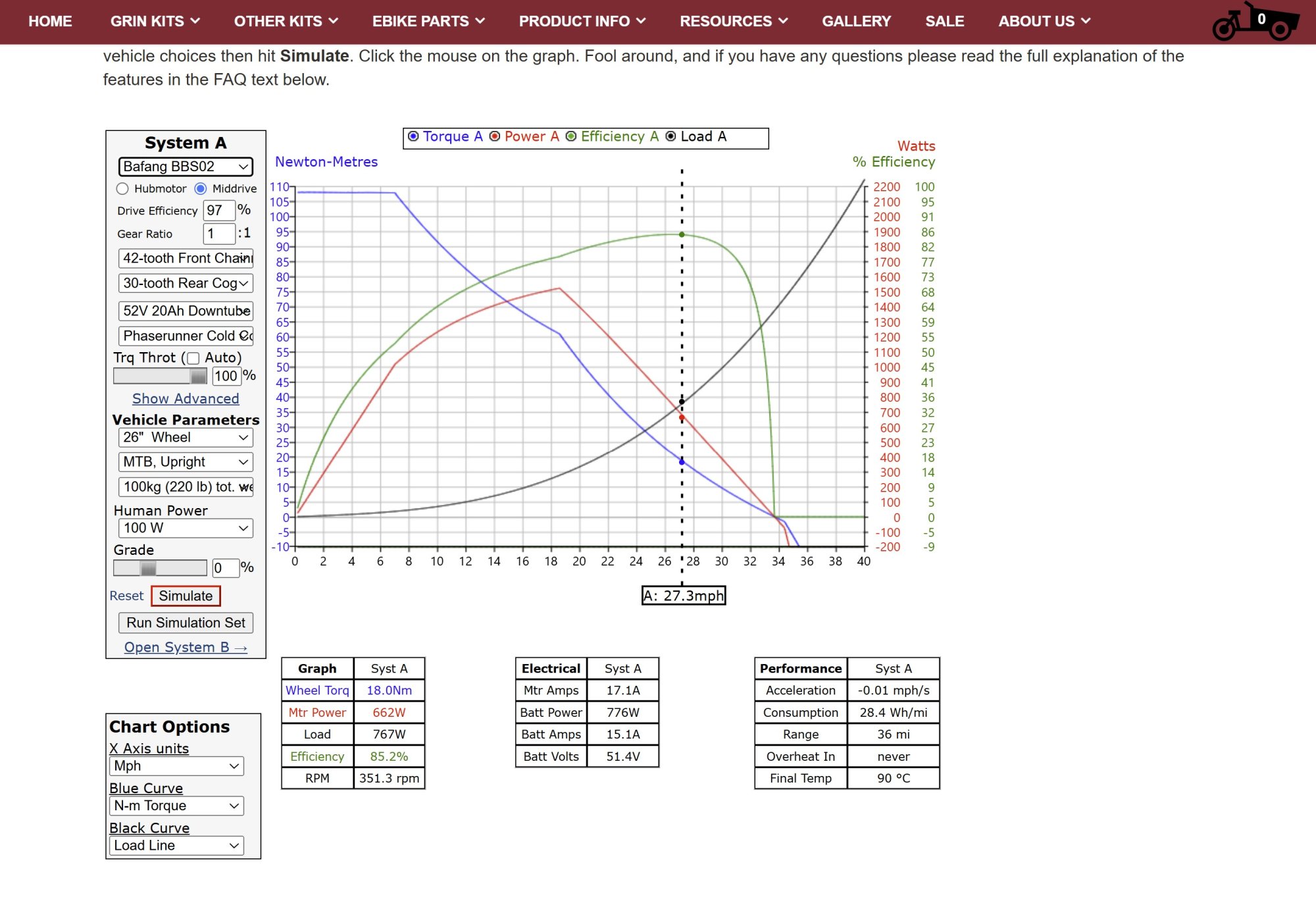
https://ebikes.ca/resources/web-tools/simulator.html?motor=GMAC10T&batt=B5220_GA&cont=PR&axis=mph
Six states explicitly allow e-bikes with up to 1000W of power on public roadways: Georgia, Kansas, Minnesota, Oklahoma, Oregon, and Virginia. Additionally, Florida and Mississippi have no maximum power limits for bicycles, meaning 1000W models are perfectly legal there, provided they can still be pedaled. In most other states, the legal limit is capped at 750W. [1, 2, 3]





 Six states explicitly allow e-bikes with up to 1000W of power on public roadways: Georgia, Kansas, Minnesota, Oklahoma, Oregon, and Virginia. Additionally, Florida and Mississippi have no maximum power limits for bicycles, meaning 1000W models are perfectly legal there, provided they can still be pedaled. In most other states, the legal limit is capped at 750W.If you are planning to ride your e-bike, tell me:What state or specific city will you be riding in?Are you planning to ride on paved roads, bike lanes, or off-road trails?I can give you more specific details on local path restrictions and speed limits.What Legal Considerations Apply to 1000W City E-Bikes in Urban ...Jan 16, 2026 — State-by-State Legal Matrix for 1000W City E-Bikes State laws create patchwork compliance challenges for 1000W city e-bikes riders. Six states explicitly permit...TST EbikeClass 3 eBike Laws, US Electric Bike Regulations | Quietkat USAIn which states are 1000W Ebikes legal? Six states specifically allow eBikes to have a max power of 1000W; these are Georgia, Kansas, Minnesota, Oklahoma, Orego...quietkat usaComplete State-by-State E-Bike Regulations Guide 2025May 26, 2025 — Higher Power Allowances. Higher Limit States: Six states specifically allow eBikes to have a max power of 1000W; these are Georgia, Kansas, Minnesota, Oklahoma,Movcan
Movcan
If you are planning to ride your e-bike, tell me:
What Legal Considerations Apply to 1000W City E-Bikes in Urban ...
Jan 16, 2026 — State-by-State Legal Matrix for 1000W City E-Bikes State laws create patchwork compliance challenges for 1000W city e-bikes riders. Six states explicitly permit...


TST Ebike
Class 3 eBike Laws, US Electric Bike Regulations | Quietkat USA
In which states are 1000W Ebikes legal? Six states specifically allow eBikes to have a max power of 1000W; these are Georgia, Kansas, Minnesota, Oklahoma, Orego...


Six states specifically allow eBikes to have a max power of 1000W; these are Georgia, Kansas, Minnesota, Oklahoma. Two states, Florida and Loisiana have no limits on ebike output.


Movcan
Six states explicitly allow e-bikes with up to 1000W of power on public roadways: Georgia, Kansas, Minnesota, Oklahoma, Oregon, and Virginia. Additionally, Florida and Mississippi have no maximum power limits for bicycles, meaning 1000W models are perfectly legal there, provided they can still be pedaled. In most other states, the legal limit is capped at 750W. [1, 2, 3]For the last time, my state law say's any motorized bike must not exceed 750 watts. Above that it's considered a scooter and must be licensed as such. My bike is 750 watts. It's legal. They don't state peak output in the law, just continous output, which is 750. Now, are we clear? Good. I'm going riding.
If you are planning to ride your e-bike, tell me:
- What state or specific city will you be riding in?
- Are you planning to ride on paved roads, bike lanes, or off-road trails?
What Legal Considerations Apply to 1000W City E-Bikes in Urban ...
Jan 16, 2026 — State-by-State Legal Matrix for 1000W City E-Bikes State laws create patchwork compliance challenges for 1000W city e-bikes riders. Six states explicitly permit...
TST Ebike
Class 3 eBike Laws, US Electric Bike Regulations | Quietkat USA
In which states are 1000W Ebikes legal? Six states specifically allow eBikes to have a max power of 1000W; these are Georgia, Kansas, Minnesota, Oklahoma, Orego...
Six states specifically allow eBikes to have a max power of 1000W; these are Georgia, Kansas, Minnesota, Oklahoma. Two states, Florida and Loisiana have no limits on ebike output.
David42000
Member
Enjoy your ride, or I hope you enjoyed your ride. This is the first time you've dropped the "1000 watts" peak from your claim of what the law is. I totally agree with you now.For the last time, my state law say's any motorized bike must not exceed 750 watts. Above that it's considered a scooter and must be licensed as such. My bike is 750 watts. It's legal. They don't state peak output in the law, just continous output, which is 750. Now, are we clear? Good. I'm going riding.
Don't worry about those "extra watts." 1000 watts continuous is tied to the federal benchmark of 1 h.p., that is, mechanical watts, because, depending on motor efficiency, an electric motor needs 900-1000 watts of electrical power to the motor to output ~750 watts mechanical at the shaft. Your bike is highly likely to be seen as federally compliant at this stage of low-level enforcement. God forbid they roll out the dynamometers, but they probably won;t. They'll be trained in brand recognition and the like. The rest of what I have said will sink in over time. Glad I could help you out.
David42000
Member
It can mean pedaling cadence but if human power is not involved then a torque calculation is in RPMs (cadence). I've been looking the simulator over, here's my screenshot from just a couple of minutes ago. I don't see an input for RPMs, either, now that we have terminology straight. This is the formula according to Grin, and I agree with for motor shaft torque: Power in Watts = Torque * RPM * 2Pi/60 ~ Torque * RPM * 0.104. (Well, shoot, I cut off the snippet too high and there are further parameters below. None of them were for cadence or RPM, though, and they are present on yours if yours is also recent. I can go make another screenshot if you like. I'm strongly thinking RPM/Cadence is a constant here that they didn't appear to tell us about. This is very interesting in the article:Do you mean pedaling cadence? The GMAC is a hub motor. You can see that they do have an input variable for rider power in watts. You can set that to zero if you just want to see the motor power.
"This is one reason why rated motor powers can be all over the map. It is ultimately the torque and not power that causes a motor to overheat. To convert a maximum torque spec into a power rating you need to also specify the RPM at which you decided this rating. However, permanent magnet electric motors in isolation don't intrinsically have an RPM at which they spin at, they'll have an RPM/V winding constant. It's the combination of this winding constant and your battery voltage that determines how fast a motor will be able to spin in a given setup." RPM/V winding constant is fascinating but not really our question. A motor without a load will spin faster or slower according to voltage supplied is one of the key concepts involved with that.
But yeah, I still don't see that variable input.
And a search for the word cadence had no hits in the article. I suppose it is a whole lot more honest than other companies would have us believe, and it is a complicated subject. I'm not mad at Grin, but it is an industry that teaches us not to trust it.
Similar threads
- Replies
- 69
- Views
- 14K
- Replies
- 11
- Views
- 2K

- Replies
- 20
- Views
- 2K

- Replies
- 27
- Views
- 4K
