Switch hub? Weird sound

Electricmover

Member
Region
Europe
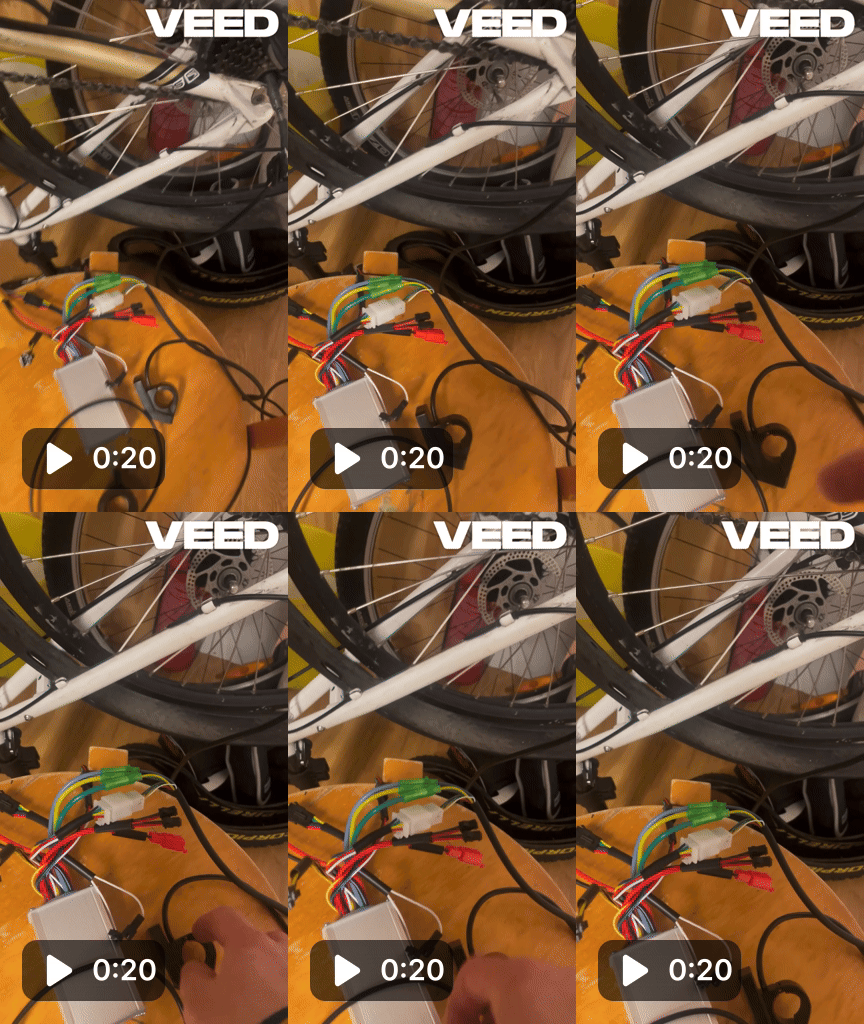
So I sort of fixed an old hub back-wheel, by wiring some cables to make it work. The idea is to have it as a back-wheel on my bike.

Now, it gives of a weird sound and does not seem to give continuos throttle when the throttle is pressed. Any idea if I better just get another back wheel entirely? Or could it be some small failure that is easy to fix? What do you think. See vid:
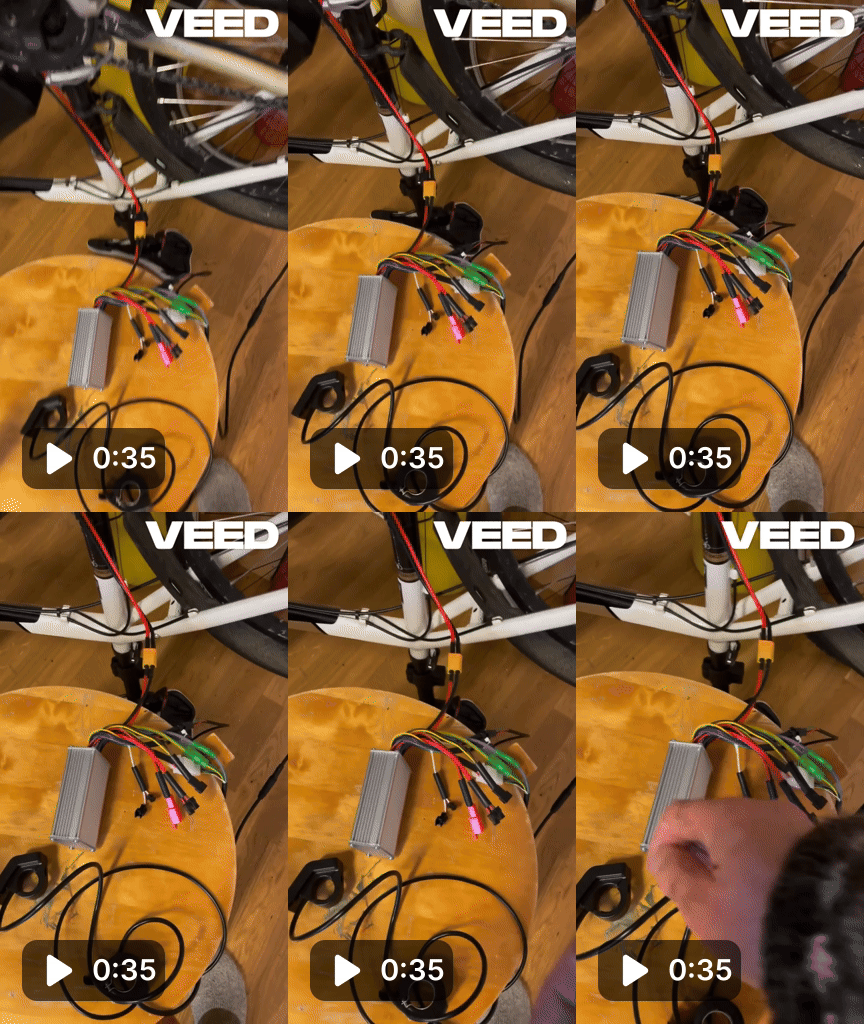

The wheel spins and gives of a short burst but then kind of stops again. It does not seem to be giving continuos power when throttle is pressed in.

Thanks

 
There is something wrong there. It looks like you have the separate three thick and five of six thin wires to the motor. Two or more are out of order. Did you follow the color scheme, matching colors on each wire thickness? While this has always worked for me, people talk about some motor makers using different colors.

There are 36 possible combinations of wires, but if you follow this chart, only two or three combinations need to be tested.

If you started with all the colors matching, you will move from the start position in the top center to the top right box. Rewire the three thick wires like it shows. It will either work or not, If it doesn't, you move down to the next box below it. Rewire the thick wires again. According to the chart, the motor has to work now.

One caution. Apply just enough throttle to test the wheel. If it is spinning noisy or clunky, you can burn out the controller with too much current,

GsugRE9.jpg


I have read on other forums that this flow chart works.

I have never needed to use it, but I did follow the instructions on the bottom right to reverse the direction of a motor, and that worked,
 
There is something wrong there. It looks like you have the separate three thick and five of six thin wires to the motor. Two or more are out of order. Did you follow the color scheme, matching colors on each wire thickness? While this has always worked for me, people talk about some motor makers using different colors.

There are 36 possible combinations of wires, but if you follow this chart, only two or three combinations need to be tested.

If you started with all the colors matching, you will move from the start position in the top center to the top right box. Rewire the three thick wires like it shows. It will either work or not, If it doesn't, you move down to the next box below it. Rewire the thick wires again. According to the chart, the motor has to work now.

One caution. Apply just enough throttle to test the wheel. If it is spinning noisy or clunky, you can burn out the controller with too much current,

View attachment 205589

I have read on other forums that this flow chart works.

I have never needed to use it, but I did follow the instructions on the bottom right to reverse the direction of a motor, and that worked,
Hmm maybe something is out of order. I Just used the color for color basically. Maybe best to just get hold of a better hub so this headache goes away.
 
Maybe best to just get hold of a better hub so this headache goes away.

There's nothing wrong with your hub, it's just wired differently.

The three thick phase wires are Almost Always paired with the same colored thin hal sensor wire.

Just swap two thick wires, along with their matching colored thin wires, and try again, if it doesn't work, swap two more pairs again.

My motor was making the exact same clunking sound and movement, and that is how I fixed it.
One swap got my motor going.

If you get it going, but it's running backwards, do what @harryS said, and that should get it going forward.

Screenshot_20260207_062502_DuckDuckGo.jpg


PS,.. in your video, it looks like your three thin wires are in a connector.
A lot of times, you can poke a needle into the backside of the connector to remove the individual wires from the connector.
There's a little spring tab that you push to unhook it from the connector.

You can reuse the connector without cutting any wires.
 
Last edited:
The three thick phase wires are Almost Always paired with the same colored thin hal sensor wire.
I have read on other forums that this flow chart works.

I just checked the flow chart, and it always shows the three thin hal sensor wires color matched?

It was @AHicks that told me about keeping the thick and thin wires paired, and swapping them as pairs got my motor working.

That flow chart suggests that I could probably have fixed my motor with only swapping the thick motor phase wires?
I dunno?


@Electricmover
Using the flow chart and trying all the combinations for the phase wires is really easy to do with your bullet plug connectors.

I would have tried it first if I knew about the chart.
 
Last edited:
There's nothing wrong with your hub, it's just wired differently.

The three thick phase wires are Almost Always paired with the same colored thin hal sensor wire.

Just swap two thick wires, along with their matching colored thin wires, and try again, if it doesn't work, swap two more pairs again.

My motor was making the exact same clunking sound and movement, and that is how I fixed it.
One swap got my motor going.

If you get it going, but it's running backwards, do what @harryS said, and that should get it going forward.

View attachment 205609

PS,.. in your video, it looks like your three thin wires are in a connector.
A lot of times, you can poke a needle into the backside of the connector to remove the individual wires from the connector.
There's a little spring tab that you push to unhook it from the connector.

You can reuse the connector without cutting any wires.
Even though I have a self learning line in my controller you think it might work better after rewiring? Should not the self-learning line solve this? Or maybe it only works for correctly wired hub motors?

Not sure where to start rewiring though. A bit confused about that part. If I switch one of the three thick wires(which ones? And one of them stays intact?). And then I switch the corresponding colors on the Hall side?

Yeah, I've used those pin connector-needles before so I know what you mean, I think. I am just confused about how to start the rewiring. What wold give me most chance of success? Which color goes where?

Thanks
 
There is something wrong there. It looks like you have the separate three thick and five of six thin wires to the motor. Two or more are out of order. Did you follow the color scheme, matching colors on each wire thickness? While this has always worked for me, people talk about some motor makers using different colors.

There are 36 possible combinations of wires, but if you follow this chart, only two or three combinations need to be tested.

If you started with all the colors matching, you will move from the start position in the top center to the top right box. Rewire the three thick wires like it shows. It will either work or not, If it doesn't, you move down to the next box below it. Rewire the thick wires again. According to the chart, the motor has to work now.

One caution. Apply just enough throttle to test the wheel. If it is spinning noisy or clunky, you can burn out the controller with too much current,

View attachment 205589

I have read on other forums that this flow chart works.

I have never needed to use it, but I did follow the instructions on the bottom right to reverse the direction of a motor, and that worked,
Basically I try to change the phase wires to start with? Not the halls correct? It looks like the halls stay intact on that chart.

thanks
 
Basically I try to change the phase wires to start with? Not the halls correct? It looks like the halls stay intact on that chart.

thanks

Yeah, start with the thick blue, yellow and green phase wires.

I'd describe what you've got as a noisy rotation, so do this,..

Screenshot_20260207_084321_DuckDuckGo.jpg


And go easy on the throttle like @harryS mentioned.

And let us know when (not if) you get it going.
 
Last edited:
Even though I have a self learning line in my controller you think it might work better after rewiring? Should not the self-learning line solve this? Or maybe it only works for correctly wired hub motors?

Not sure where to start rewiring though. A bit confused about that part. If I switch one of the three thick wires(which ones? And one of them stays intact?). And then I switch the corresponding colors on the Hall side?

Yeah, I've used those pin connector-needles before so I know what you mean, I think. I am just confused about how to start the rewiring. What wold give me most chance of success? Which color goes where?

Thanks

The chart is pretty simple. It shows the controller wire on left, motor wires on right. I figured you aligned all the wires by thickness and color to start, Note that they never have to change the thin phase wires, which would involve pulling the pins out of the 2x6 plastic connector, All you have to do is swap the thick phase wires, which use bullet connectors,

Now for the self-learning. That works by turning power off. Connect the two wires together. Turn on power. Controller senses the motor connections and does some computing in less than a second, The wheel will spin, either for a few revolutions or very slowly. Now you unplug the learning connections while the wheel spins. Power down, Wrap up the learning wires. The next time the controller powers up, it should work. Suppossed ly, a learning controller can run a motor with none of the thin wires connected. I dunno.
 
I have tried all phase wire-combinations in that chart now. But I still get the same result as seen in this video. Actually the sound is not too bad. The problem is that is stops spinning after a little while, even though the throttle is still pressed in fully.

This makes me think that A: Something is wrong within this motor-wheel.

Or

B: I should also switch the hall sensors somehow. But then how do I switch them? If from the motor side green goes to yellow, blue goes to green and then yellow goes to blue, then the same wiring goes for the halls? So from motor in the same order as the phase wires ?

Chat-GPT tells me I can try six different combinations for only the halls without touching the phase wires to begin with.
What do you guys think?
 
Last edited:
What do you guys think?

Well, being as your motor sounds and behaves EXACTLY like how my motor sounded when I had the "firing order reversed", try what I did and reverse the "firing order".

Start with all the wires colors matched, then swap two pairs of wires.

The problem is that the firing order is either A B C or C B A, so B has to stay in the middle.

I kinda forgot all the details but I got all carried away and reversed the firing order before even trying matching all the wire colors first.
That's when my motor sounded like yours.
Reversing my reversal and matching up the colors got my motor working.

Here's a link with pictures showing my confusion,..


I'm still thinking that the thin and fat wires are ALWAYS paired together, unless you have a proprietary motor and/or controller where they unpair the colors to keep their motors proprietary.

It turned out that my hub motor has the wires coming out the left side of the motor (instead of the more common right side) so the firing order needed to be reversed, but it was done inside the controller, so all the wire colors matched up like normal.
 
Well, being as your motor sounds and behaves EXACTLY like how my motor sounded when I had the "firing order reversed", try what I did and reverse the "firing order".

Start with all the wires colors matched, then swap two pairs of wires.

The problem is that the firing order is either A B C or C B A, so B has to stay in the middle.
You mean that I keep the phase wires intact going to their corresponding colors, and then try out different combinations for only the hall sensor-wires, correct?

Or do you mean that if the blue hall-wire from the motor goes to the green one on the controller side, then the blue phase-wire from the motor side also has to go to the green one from the controller side? Or do I just try out the different hall wire-combinations to start with? Without touching the phase wires?

Or what combination finally made your wheel work correctly?

thanks
 
Based on the "Rule" that I think I'm willing to believe, just Simply Keep The Thick & Thin Wire Colors Paired.

Chat-GPT tells me I can try six different combinations for only the halls without touching the phase wires to begin with.

You've tried that, and it didn't work.

So,.. try all 6 combinations again Keeping The Wire Colors Paired
When you swap the fat Green wire, swap the Green thin wire along with it.
Same with Blue And Yellow.

And Stop With The Full Throttle Crap !!!

It's like starting your car when it's already running.
It will either work or not work with just a tiny bit of throttle.

If you want to hear a clunking noise hit it with a hammer 🔨
Both the motor and controller can handle a 🔨 hit better than FULL Throttle with the wires hooked up wrong.


It's still worth your time and effort to try everything possible with your wire combinations, because if you give up and buy something new, you don't know whether you need a new motor or a new controller, so you might end up replacing both.

With that being said, if you do give up trying to fix something that can't be fixed, just hit the throttle and hold on Full until it blows up or dies.

I remember taking my laptop apart and fixing it a few times, then decided to modify it to make it more user friendly.

The flexible ribbon cable was cracking and losing connectivity, so I thought I'd drill a hole through the plastic top of the laptop to access the power button without opening the lid to extend the life of the ribbon cable.

It didn't work because I drilled into something more than just plastic.
To make sure that I wouldn't try and fix it again, I opened it up and broke it in half.

It was very cathartic it felt good knowing that I wasn't going to waste countless hours fixing broken garbage. 🙃
 
Last edited:
Ohh, BTW,..
Non of my controllers have a learning wire and I don't know what kind of difference that would make with what you've got going on?

It sounds like you have a fancy self learning controller that should be able to set itself up properly, and I don't know why it's not? but I don't think that you can blame the motor.

A hub motor is a hub motor is a hub motor.

They all the have the same wires (most have a speed sensor wire, and some have an extra temperature sensor wire)
 
Based on the "Rule" that I think I'm willing to believe, just Simply Keep The Thick & Thin Wire Colors Paired.


You've tried that, and it didn't work.

So,.. try all 6 combinations again Keeping The Wire Colors Paired
When you swap the fat Green wire, swap the Green thin wire along with it.
Same with Blue And Yellow.

And Stop With The Full Throttle Crap !!!

It's like starting your car when it's already running.
It will either work or not work with just a tiny bit of throttle.

If you want to hear a clunking noise hit it with a hammer 🔨
Both the motor and controller can handle a 🔨 hit better than FULL Throttle with the wires hooked up wrong.


It's still worth your time and effort to try everything possible with your wire combinations, because if you give up and buy something new, you don't know whether you need a new motor or a new controller, so you might end up replacing both.

With that being said, if you do give up trying to fix something that can't be fixed, just hit the throttle and hold on Full until it blows up or dies.

I remember taking my laptop apart and fixing it a few times, then decided to modify it to make it more user friendly.

The flexible ribbon cable was cracking and losing connectivity, so I thought I'd drill a hole through the plastic top of the laptop to access the power button without opening the lid to extend the life of the ribbon cable.

It didn't work because I drilled into something more than just plastic.
To make sure that I wouldn't try and fix it again, I opened it up and broke it in half.

It was very cathartic it felt good knowing that I wasn't going to waste countless hours fixing broken garbage. 🙃
I think it has got to be the motor. Or maybe the controller is incompatible with this particular motor.
Because I have tried all six combinations without changing the phase wires. And then I have tried all six combinations while changing the same colored phase wires.

Maybe there is some option/combination left that I do not know about? Or should I switch motor.
 
I'm not sure, but testing your controller on a different wheel should help diagnose the problem.

I suppose it's possible that the motor is FUBAR'ed but it sure looks like its trying?

A dead motor generally just doesn't do anything.

If that's a new controller, then a new (or different) motor is probably the best bet?
Just don't wreck your controller with full throttle, or you'll need a new controller as well.

There are other ways you can test a motor.
I've never done it but this video shows a simple way to test a hub motor,..

It's not a geared hub motor like yours, and you probably have a clutch in your motor which might affect the test?

 
but I don't think that you can blame the motor.

A hub motor is a hub motor is a hub motor.

I'm changing my mind on that.

A motor can run sensorless with only the 3 FAT phase wires connected (if the controller will support it)

One of those three wires could be shorted or open, inside the motor.

I suppose that could cause your motor to do what it's doing?

The bench test in the video link above should be able to identify a bad phase wire?
 
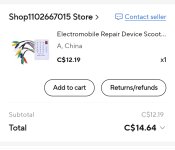
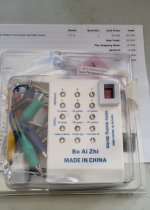
I've got one, but I've never used it.

@Electricmover you can have mine, but it would probably cost more to ship it to you than for you to buy your own?


You can do everything the tester does using a Multimeter but the tester is a lot easier to use.

Watching the lights flash is more reliable than waiting for the Multimeter to register a reading that keeps changing.
 

Attachments

  • Screenshot_20260208_102701_AliExpress.jpg
    Screenshot_20260208_102701_AliExpress.jpg
    110.6 KB · Views: 1
  • 20260208_102559.jpg
    20260208_102559.jpg
    258.5 KB · Views: 1
I've got one, but I've never used it.

I would have at least tested the tester, but all my connectors are waterproof, and I wasn't going to cut my cables to splice in, and I didn't want to try to hook up 9 "test pins" into my motor connector.

I have issues with breaking stuff that was never broken in the first place but I needed to find out how it works 😁
 
Back