Rear Wheel Removal Tip

All you need is a piece of chalk, a yardstick, and a sidewalk. Put the valve down. Mark that spot with chalk on the sidewalk. then roll forward until the valve is straight down again. Mark that spot. Measure between the marks. That is the circumference. This week I am taking a 700c rim and making it a 29'er by puting 50mm tires on it. Using a yardstick it will be 29 inches from the ground to the top of the tire. It will be 622-50 or 700c-2".
 
Great suggestion. Thanks. Maybe because it is cold out there this evening but with a fully charged battery an PAS level of 5 in 8th gear I was getting 28-30mph with not problem but this evening 25 was all I could do with PAS 5, 8th gear and slightly downhill (the garman and the bikes display are tracking now).
 
I do not understand how they all have a 29” diameter.

It's the height of the sidewalls that add to the overall diameter of the wheel.

And keep in mind that tire sizing is a bunch of nonsense. Lol
A 26" fat tire and wheel has a much smaller rim diameter than a normal 26" mountain bike.

Some controllers allow you to enter the actual tire size printed on the tire, but my three different controllers asked for the overall diameter of the wheel.
 
Thanks PCeBiker. That certainly clears things up a bit :)
Also, I only charged to 49 volt DC because it was getting dark and I wanted to test ride it. Probably should have waited unit full charge.
 
Thanks PCeBiker. That certainly clears things up a bit :)
Also, I only charged to 49 volt DC because it was getting dark and I wanted to test ride it. Probably should have waited unit full charge.

I deleted my post thinking that your battery was fully charged, but did you do a Garmin speedometer test on your old tires?

Perhaps they weren't calibrated properly which could also affect your speed reading of your new tires.
 
I understand diameter and circumference but sketchy on actual wheel diameter and outer tire diameter as to which one the are setting wheel size on the display for the wheel size. I do not understand using 26” as wheel size if the diameter of the tire is larger. That affects the speed just as it would by putting taller tires on a car. Come to think of it. This tire is not setting any closer to the front fender than the old one that I can tell.
Who knows what logic your controller is using, if any... Sounds like a dart board
Most of what I've seen you just enter the correct tire size
Screenshot_20251214_193901_Speeed.jpg
 
All you need is a piece of chalk, a yardstick, and a sidewalk. Put the valve down. Mark that spot with chalk on the sidewalk. then roll forward until the valve is straight down again. Mark that spot. Measure between the marks. That is the circumference. This week I am taking a 700c rim and making it a 29'er by puting 50mm tires on it. Using a yardstick it will be 29 inches from the ground to the top of the tire. It will be 622-50 or 700c-2".
That only works if the controller has that granular of a tire size input. I don't think that's the situation here.
 
I deleted my post thinking that your battery was fully charged, but did you do a Garmin speedometer test on your old tires?

Perhaps they weren't calibrated properly which could also affect your speed reading of your new tires.
Yes, it was right on with their setting of 29” wheel setting. Now I had to go to 27” wheel setting and now close to the Garmin. I am so tired I cannot rationalize the setting going lower with new tires as to why? Maybe tomorrow after I get some rest my brain with revert from it’s present Jelly like to normal 😁
 
That only works if the controller has that granular of a tire size input. I don't think that's the situation here.
My does it in .5 increments. (i .e. 27, 27.5, 28, 28.5 and the low value is 14“ and high value of 30”). I assume that is what you mean by granular but really granular would be in .1 increments.
 
Yes, it was right on with their setting of 29” wheel setting. Now I had to go to 27” wheel setting and now close to the Garmin.

Another thing that is going on is that your original tires were probably squashing down at least an inch where they contact the road, and that reduces the effective diameter of the tire.

The actual rubber circumference would be the same around the tire, but a large part of the tread gets squashed flat on the road and scrubs along the road.
(That's where tire efficiency and rolling resistance come into play.)

When you increased the air pressure in your original fat tires, you would have effectively increased the rolling diameter, and changed your speedometer reading.

Either way, it doesn't really matter, as long as your speedometer is reasonably accurate for the tires and air pressure that you're using.

I'm pretty sure that your new tires don't list the recommended tire pressure as something like 8-30 PSI like your old knobby tires.

My street treaded tires on my first ebike (CST Big Boat 26"X4") have "Inflate to 30 PSI" printed on the sidewall, with no pressure range recommended.

I'm pretty sure that's because airing a fat street tire down to 8 PSI would be dangerous.
It's bad enough with a knobby tire on pavement at 8 PSI and a street tread is even worse.

I deleted my post thinking that your battery was fully charged,

I'm reposting that post for reference,..

My new ebike will go 43 kph with a fully charged battery (54.6 V), but slows down to ~30 kph just before the controller cuts out at ~40 volts.

Maximum speed and battery voltage are directly related, especially with a hub motor.

It's the same with a mid-drive, but you can change gears to get the motor running at a more efficient RPM.
 
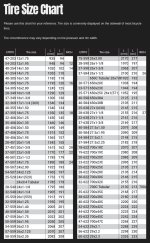
I just Google and posted the first chart that popped up.
But yeah... Fat tires are not on manufacturer radar much.... but the point was to show that granular means down to the mm
 
I just Google and posted the first chart that popped up.
But yeah... Fat tires are not on manufacturer radar much.... but the point was to show that granular means down to the mm

My KT controller on my first ebike has a granular adjustment ranging from 0 to 255, so I can adjust the speed readings by less than ½ kph.

My new ebike's display can be set with diameter in inches, and circumference in cm.

Screenshot_20251215_110629_Adobe Acrobat.jpg


My speedometer was close enough for me, so I didn't mess with that setting, or try to input the metric circumference.
 
With the knobby tires I had the pressure set to about 20psi. With the new Kenda’s 21psi. Why the difference? Mainly to insure they straightened out. I originally filled the rear to 25psi to correct any issues with tire deforming during shipping but dropped to 21psi before riding. Didn’t need to do this with the front tire. I sure enjoy these tires better. I put the knobby’s in the box my Kenda’s came in and traped box to store them in the event I ever needed them again.
 
With the knobby tires I had the pressure set to about 20psi.

I recently wrecked a pair of Schwalbe Super Moto-X tires by inflating them to the maximum pressure of 42 psi.

I figured that I would get the lowest rolling resistance and the best pinch flat protection by being at the maximum recommended pressure.
(A pinch flat is when you hit a curb or edge of some sort and the tire squashes down until it hits the rim and pinches a hole in the innertube.)

My reasoning was all wrong, and I swelled the tire until the rubber delaminated from the tire carcass.

It was then that I learned that bike tires are pretty much the same as car tires, and the proper air pressure is dependent mostly on the total weight on the tires.
And I also found out that the lowest rolling resistance isn't necessarily at the maximum recommended PSI either.

So,...
With your new tires, try finding out what Kenda recommends for their Cursor tire.

You're probably close to the "proper" pressure at 21 psi, and then there's your own personal preference based on riding style and terrain, but that's probably just a few psi one way or the other.

Normally, with increased pressure you get less rolling resistance and more range on a charge but less grip and handling performance as well as a rougher ride.

Being as you probably aren't going to run out of battery on any of your rides, you should aim for the best grip and performance that works best for you.

Thinking of your ebike more like a motorcycle than a bicycle is probably the best approach especially with your new street treaded tires.

I'm sure that you would NEVER have aired down your motorcycle tires to 8 psi.
 
All you need is a piece of chalk, a yardstick, and a sidewalk.

I wonder about that method, and how it applies to fat tires inflated to 8 psi?

A fat tire at 8 psi carrying a maximum payload will squash the tire at the contact patch on the sidewalk, effectively reducing the radius of the tire from the axle to the middle of the contact patch.

So I wonder how that would play out in the real world when trying to measure circumference?

The wheel would probably do one revolution in a shorter distance than if you removed the wheel from the ebike and rolled it down the sidewalk with no weight on it?

I'm confused now.
I'm gunna smoke a Vado and think about it to see if I can figure it out. 😁
 
Back