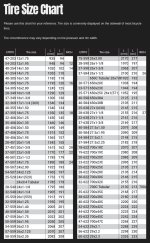
Yes, it was right on with their setting of 29” wheel setting. Now I had to go to 27” wheel setting and now close to the Garmin.
Another thing that is going on is that your original tires were probably squashing down at least an inch where they contact the road, and that reduces the effective diameter of the tire.
The actual rubber circumference would be the same around the tire, but a large part of the tread gets squashed flat on the road and scrubs along the road.
(That's where tire efficiency and rolling resistance come into play.)
When you increased the air pressure in your original fat tires, you would have effectively increased the rolling diameter, and changed your speedometer reading.
Either way, it doesn't really matter, as long as your speedometer is reasonably accurate for the tires and air pressure that you're using.
I'm pretty sure that your new tires don't list the recommended tire pressure as something like 8-30 PSI like your old knobby tires.
My street treaded tires on my first ebike (CST Big Boat 26"X4") have "Inflate to 30 PSI" printed on the sidewall, with no pressure range recommended.
I'm pretty sure that's because airing a fat street tire down to 8 PSI would be dangerous.
It's bad enough with a knobby tire on pavement at 8 PSI and a street tread is even worse.
I deleted my post thinking that your battery was fully charged,
I'm reposting that post for reference,..
My new ebike will go 43 kph with a fully charged battery (54.6 V), but slows down to ~30 kph just before the controller cuts out at ~40 volts.
Maximum speed and battery voltage are directly related, especially with a hub motor.
It's the same with a mid-drive, but you can change gears to get the motor running at a more efficient RPM.