Wire Organizing- What Do You Use?

Ken Shopken

Active Member
Region
USA
Hey all

I am tired of using zip ties and automotive split or spiral loom to organize and tidy up wiring.

Conversions look like crap with wiring coiled and crammed about.

What are you using?

Has anyone found a purchase link for Velcro closure type sleeves of different sizes?

Who is cutting excessive length from wiring harnesses? What are the products you are doing it with?

I have used soldered wiring ferrules with glue shrink tubing and wiring tubes.

 
Hey all

I am tired of using zip ties and automotive split or spiral loom to organize and tidy up wiring.

Conversions look like crap with wiring coiled and crammed about.

What are you using?

Has anyone found a purchase link for Velcro closure type sleeves of different sizes?

Who is cutting excessive length from wiring harnesses? What are the products you are doing it with?

I have used soldered wiring ferrules with glue shrink tubing and wiring tubes.

A key to tidy wiring is to find a place to hide the excess. Wiring is nowhere near as noticeable if its snug against the frame, or bundled to for example the brake or shifter wires. The problem is not the use of color coded zip ties or split loom casings. Its the 'coiled and crammed' part that makes things half-assed. I use small pouches on the handlebars to stuff my excess wire. Or a handlebar bag that does double duty for wallet, phone and keys. A molle pouch's loops can be used to wend cord inside of the loops, and even though it is external its invisible if you use a black pouch on black cabling.

Velcro closure sleeves look awful. The velcro on both sides makes the loom XL and extra-noticeable. Plus it doesn't last, especially at the outer edges.

If you use heat shrink that is color coded to your frame color (there is a rainbow of 2:1 non adhesive heat shrink available) it hides the cabling in plain sight. Do that to brake cables, too and cover the cabling only so far as it overlaps the frame - leaving it black as it loops outward to the bars - and the 'volume level' of the cabling is reduced without looking cheesy.

I did this one in 2017. Pic is overexposed which unfairly highlights the cabling, but still note everything is in plain sight and its still pretty low key. I wrapped excess wiring harness into a silicone-taped coil under and behind the motor. Its still fine like that now in 2024.

IMG_20180718_072213.jpg
 
A key to tidy wiring is to find a place to hide the excess. Wiring is nowhere near as noticeable if its snug against the frame, or bundled to for example the brake or shifter wires. The problem is not the use of color coded zip ties or split loom casings. Its the 'coiled and crammed' part that makes things half-assed. I use small pouches on the handlebars to stuff my excess wire. Or a handlebar bag that does double duty for wallet, phone and keys. A molle pouch's loops can be used to wend cord inside of the loops, and even though it is external its invisible if you use a black pouch on black cabling.

Velcro closure sleeves look awful. The velcro on both sides makes the loom XL and extra-noticeable. Plus it doesn't last, especially at the outer edges.

If you use heat shrink that is color coded to your frame color (there is a rainbow of 2:1 non adhesive heat shrink available) it hides the cabling in plain sight. Do that to brake cables, too and cover the cabling only so far as it overlaps the frame - leaving it black as it loops outward to the bars - and the 'volume level' of the cabling is reduced without looking cheesy.

I did this one in 2017. Pic is overexposed which unfairly highlights the cabling, but still note everything is in plain sight and its still pretty low key. I wrapped excess wiring harness into a silicone-taped coil under and behind the motor. Its still fine like that now in 2024.

View attachment 177712
Looks pretty nice. Great advice and know how. Thanks for sharing it.
 
Messy wiring inhibits theft. In 6 years nobody has even tried to cut my SS sling or master lock. Thieves have stolen a couple of lights, a tool box, and stabbed a couple of tires with a pick or knife. They have tried to remove the battery twice, backing off a couple of the wrong nuts. I use tie wraps to hold wire to the frame, except the big ball of wire under the controller (under the seat) I protects it from my left pants leg with a 2 liter bottle third tied to the frame twice with tie wraps. Green Mtn Dew bottle to match the frame color.
The last controller did not come with a ring terminal screw strip for the phase wires, so I made one out of MDPE sheet mounted under the seat. I have a 10-24 tap and some SS screws to match the ring terminals.
 
Last edited:
My bikes have the brake and shifter cables routed inside the down & cross tubes. The holes have grommets to protect the cables from chafing where they exit the tubes. They are located so as to not to affect the structural integrity of the frame. I used one of the cables as a "snake" to pull a wiring harness through the tubes. I push any cable slack back into the tube and use spiral wrap from the frame to the bars.

I realize this is a personal observation but, IMO, correctly installed spiral wrap does not spoil the look of the bike at all.

If you know what you're doing, and drill the holes in a safe location, the frame tubes can be used to route wiring.

On one bike, I installed small diameter, rigid tubing to the underside of the cross tube to route wiring. I painted the conduit to match the bike and it is hardly noticeable.
 
Hey all

I am tired of using zip ties and automotive split or spiral loom to organize and tidy up wiring.

Conversions look like crap with wiring coiled and crammed about.

What are you using?

Has anyone found a purchase link for Velcro closure type sleeves of different sizes?

Who is cutting excessive length from wiring harnesses? What are the products you are doing it with?

I have used soldered wiring ferrules with glue shrink tubing and wiring tubes from https://cabletiesmanufacturer.com/ for more organized and durable wiring setups.
For cleaner wiring, the best alternative to zip ties is Velcro cable sleeves which are reusable and easy to adjust. You can find them by searching hook and loop cable wrap in different sizes. For a more permanent and professional finish, braided PET sleeving or Tesa cloth harness tape works very well and is commonly used in automotive wiring. Cutting wiring harnesses is usually avoided unless rebuilding properly. The correct method is to de-pin connectors and re-terminate wires instead of cutting and splicing randomly. Your soldered ferrules with heat shrink are good for permanent joins, just ensure proper strain relief to prevent vibration damage.
 
True. Eleven years ago, my ebike kits had four cables that had to be routed to the handlebars, a fifth to the pedal sensor and then the motor harness. All were too long, of course. The controller was a big box with a rats nest of JST connectors, I used to hand the controllers on the downtube. Put all the cables in 1/2" automotive sheathing,

Then controllers were available with molded connectors and 4n1 handlebar harnessses, plus plastic boxes, Cables were fewer. I started using the spiral wrap to tie the 4n1 harness to a shifter or brake cable, Also shortened then when I could, I had one bike that routed the brake and shifter thru the frame. I ran the handlebar harness thru it, and it looked clean,

I will shorten cables. A lifetime of soldering experience. Shortening the motor cable is not advised, but I did it. I would use DIY solder ferrules for the heavier phase wires, but worry about strain relief, Best way to do that is buy a long 9 pin motor extension, cut it to length and solder the cut wires inside the controller, It's an easy solder joint, no strain/cracking issues, and protected from water.
 
I still solder. I haven't tried the self soldering butt connectors. I don't see how they would save much time over doing it the old fashioned way and I know I have gotten a good connection if I twist the wires together. I have never tried to shorten a motor cable though. The spiral wrap works great. The new Grin Superharness mounts on the stem, so you are still pulling a lot wires up to the headset. I try to bring them up the downtube under the battery mount.
 
I still solder. I haven't tried the self soldering butt connectors. I don't see how they would save much time over doing it the old fashioned way and I know I have gotten a good connection if I twist the wires together.
Until 10 years ago, I depended on solder and wire nuts. A wire nut can clamp conductors both at the bare ends and where they're jacketed. For many conductors, it's much stronger to clamp them where they're jacketed.

It's only recently that I became aware of crimping. The bare connectors are more reliable because you can see what you're doing. Then you have to worry about insulation.

I haven't tried self-soldering connectors, but they look great. They're transparent so I could see what I was doing. They secure the conductors at the bare ends and at the jacketed parts, and they keep moisture out.

Maybe I should cut my motor cable so I can have the pleasure of using these connectors! ;)
 
Until 10 years ago, I depended on solder and wire nuts. A wire nut can clamp conductors both at the bare ends and where they're jacketed. For many conductors, it's much stronger to clamp them where they're jacketed.

It's only recently that I became aware of crimping. The bare connectors are more reliable because you can see what you're doing. Then you have to worry about insulation.

I haven't tried self-soldering connectors, but they look great. They're transparent so I could see what I was doing. They secure the conductors at the bare ends and at the jacketed parts, and they keep moisture out.

Maybe I should cut my motor cable so I can have the pleasure of using these connectors! ;)
I use marine grade heat shrink tubing to seal the soldered connections. There is no doubt that crimping can create a good connection also, but I am comfortable with soldering. I am not sure about using wire nuts on a bike though. Vibrations could cause them to loosen up. I do use them for household electrical wiring.
 
I use marine grade heat shrink tubing to seal the soldered connections. There is no doubt that crimping can create a good connection also, but I am comfortable with soldering. I am not sure about using wire nuts on a bike though. Vibrations could cause them to loosen up. I do use them for household electrical wiring.
I do the same for fine wire work. Soldering and covering with heat shrink makes a clean sleek joint that doesn't "bulge" like crimp connectors. The trick is to make the connection where stress or vibration isn't a factor.
 
I use marine grade heat shrink tubing to seal the soldered connections. There is no doubt that crimping can create a good connection also, but I am comfortable with soldering. I am not sure about using wire nuts on a bike though. Vibrations could cause them to loosen up. I do use them for household electrical wiring.
I started using wire nuts as an electronics technician on a Coast Guard ship. I found them so reliable that I used them to connect the turn signals on the fairing and saddlebags of a motorcycle I bought in 1972. Until 1998, it was my only vehicle. Some years, I’d ride it more than 20,000 miles. There was never any trouble with the wire nuts.

My BIL showed what could go wrong using wire nuts. He bought a farm house in 1979. He used wire nuts when he added 3 bedrooms, a kitchen, a dining room, a living room, and a shop. When I came along, lights often flickered. The first time I opened a junction box, I saw what was wrong. He’d used the method an electrician had taught him when he worked in construction: twist the conductors together clockwise, screw on the wire nut, and use tape to keep the nut from coming off.

Electricians used to twist wires together and wrap the bundle with friction tape. The wire nut was invented because this was not reliable. Many electricians kept doing it the old way, using a wire nut as a protective thimble between the twisted wires and the tape. If you twist a bundle of wires clockwise and then twist a wire nut over it clockwise, the wire nut won’t clamp them as solidly as if they were straight and parallel. Wires that aren’t clamped solidly can work loose. That’s why those who recommend pretwisting often recommend electrical tape, which is no substitute for a mechanically solid connection.

Stranded conductors are a problem because they aren’t stiff. I’ll stiffen each stranded conductor by twisting it. Tinning will stiffen it more. If the conductors are straight and stripped to the right length, the wire nut will screw on down onto the insulation. The elasticity and friction of the insulation will further protect the connection from loosening, like a nylon insert in a nut.

I straightened his wire ends with pliers and redid every wire-nut connection in the house. There’s always a chance that a conductor won’t stay properly positioned as the nut is screwed on, so I’d tug to make sure every conductor felt solid. Tape would have been pointless. That house had no more trouble with electrical connections.

That said, I did use solder and marine heat-shrink to splice the very small conductors of e-bike brake sensor cables.
 
Last edited:
I use a little of everything... and do what I find appropriate or easier for the occasion.
Just tried some of the solder heat gun butt splices and didn't like them at all. Not enough solder in them imo.
To bullet proof a wire nut.. a little heat shrink does the trick
Screenshot_20260418_202455_Photos.jpg
That said I've never had a wire nut come loose regardless.

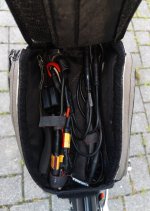
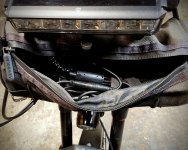
On an ebike I've used a small frame bag to tuck away all the connections. Makes adds, changes and troubleshooting very easy in the future.
Screenshot_20260418_204041_Photos.jpg Screenshot_20260418_214509_Photos~2.jpg Screenshot_20260418_214529_Photos~2.jpg
With still plenty of room for a pair of gloves and/or glasses.
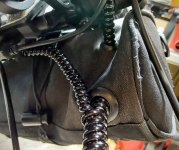
I'm a big fan of spiral wrap...
Screenshot_20260418_211134_Photos.jpg Screenshot_20260418_211217_Photos~2.jpg
Probably too big 🙃
 
Last edited:
I use a little of everything... and do what I find appropriate or easier for the occasion.
Just tried some of the solder heat gun butt splices and didn't like them at all. Not enough solder in them imo.
To bullet proof a wire nut.. a little heat shrink does the trick
View attachment 208840
That said I've never had a wire nut come loose regardless.

On an ebike I've used a small frame bag to tuck away all the connections. Makes adds, changes and troubleshooting very easy in the future.
View attachment 208842 View attachment 208846 View attachment 208847
With still plenty of room for a pair of gloves and/or glasses.
I'm a big fan of spiral wrap...
View attachment 208844 View attachment 208845
Probably too big 🙃
I have that same horn
 
I use a little of everything... and do what I find appropriate or easier for the occasion.
Just tried some of the solder heat gun butt splices and didn't like them at all. Not enough solder in them imo.
To bullet proof a wire nut.. a little heat shrink does the trick
View attachment 208840
That said I've never had a wire nut come loose regardless.

On an ebike I've used a small frame bag to tuck away all the connections. Makes adds, changes and troubleshooting very easy in the future.
View attachment 208842 View attachment 208846 View attachment 208847
With still plenty of room for a pair of gloves and/or glasses.
I'm a big fan of spiral wrap...
View attachment 208844 View attachment 208845
Probably too big 🙃
That is what I did on this BBS02. All the connectors are hidden in the phone bag. I just made a little slit and stuffed them in. Gone.
 

Attachments

  • BBS02Trek5.JPG
    BBS02Trek5.JPG
    281.8 KB · Views: 4
  • BBS02Trek6.JPG
    BBS02Trek6.JPG
    256.6 KB · Views: 4
Back