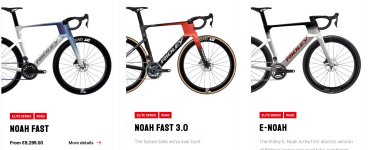
Another new TQ motor: hpr40

Stop being a troll Stefan, it's unpleasant.

Why going personal? Do you know that going personal in a discussion is the "Ultimate Argument" (dishonest) as described by one Artur Schopenhauer in his "The Art of Being Right" (1831)? Going personal means you have no valid arguments.

A mid size company that has tried with a plethora of e-bike systems either leaves their older customers unsupported or gets into the trouble because of maintaining so many e-bike systems. Fazua turned out to be a lemon and companies such as TREK escaped from it, leaving their customers alone.

Now, TQ 40 and an Enduro e-MTB. Well, if I'm not wrong, Specialized ended the production of Kenevo SL 2 back in 2024, leaving the 2023 model of that lightweight low power (50 Nm) e-bike as the last one. Perhaps the brand realized it was a dead end. Now, Orbea gets into the same trap.

Discuss if you have arguments.
 
For the past year I have been following this thread and intrigued by the latest generation of lightweight e-road bikes like the Canyon Endurace Onfly and Scott Fastlane with the TQ40 drive.

The Fastlane is now available in the US (and I hear the Onfly will be available by summer) and very temped but worry that an e road bike might not push me as hard as my analog bike. I’m a 70-year-old cyclist trying to maintain or improve fitness. Typical rides are 40–60 miles with ~3,000 ft of climbing but I must admit the longer or harder rides are starting to leave me pretty wiped out for the rest of the day especially on warmer days.

For those of you who were strong riders before switching:

How did you decide it was the right time to get an e-bike?
Did you wish you had done it earlier, or were you glad you waited?
Did switching make you ride longer, harder and make you fitter (or just gave the feeling that you were?)

Seriously I am on the fence and looking for input. None of my friends have switched yet.
 
I started quite early (August 2019)
How did you decide it was the right time to get an e-bike?
Nobody of my friends had a clue about e-bikes at that time, neither had I. As I suffer from a leg illness and can hardly walk, I took my interest in e-bikes. (I found an e-scooter would do nothing to improve my health). The ignorance made me buy a classic hub-drive motor e-bike (no throttle of course); I could live with that but wanted something better. Then I started exploring e-bikes with full gas :) which led me to a purchase of a Vado already on Nov 1st, 2019. At the peak of my interest I owned as many as 4 e-bikes, now down to the two I need the most. And... I know the e-MTB is not my thing :)
Did you wish you had done it earlier, or were you glad you waited?
Your question can be easily explained with the purchase of my Vado SL in June 2021. When I was ready for the purchase, I could have waited for the delivery for over half a year to get a newer model in a better colour. No, I bought my Vado SL on the spot which gave me over 6 months riding more and in the best year's season. (As long as there are new exciting models from respected brands, waiting makes these e-bikes just become older) :)
Did switching make you ride longer, harder and make you fitter (or just gave the feeling that you were?)
  • I can now ride for distances as long as I wouldn't ever dream I could on a traditional bike (extra batteries do help).
  • Yes, I can ride harder with e-bikes and more frequently.
  • Riding an e-bike is just a pleasure. If it is a lightweight e-bike, it feels like riding a traditional bike only easier. Riding making me fitter? Guess what, I still have my own leg, which might be amputated otherwise? For 9 years now!
FYI, I was on a 100 km trip just last Saturday :)
 
For the past year I have been following this thread and intrigued by the latest generation of lightweight e-road bikes like the Canyon Endurace Onfly and Scott Fastlane with the TQ40 drive.

The Fastlane is now available in the US (and I hear the Onfly will be available by summer) and very temped but worry that an e road bike might not push me as hard as my analog bike. I’m a 70-year-old cyclist trying to maintain or improve fitness. Typical rides are 40–60 miles with ~3,000 ft of climbing but I must admit the longer or harder rides are starting to leave me pretty wiped out for the rest of the day especially on warmer days.

For those of you who were strong riders before switching:

How did you decide it was the right time to get an e-bike?
Did you wish you had done it earlier, or were you glad you waited?
Did switching make you ride longer, harder and make you fitter (or just gave the feeling that you were?)

Seriously I am on the fence and looking for input. None of my friends have switched yet.
It's not an easy answer(s). And I don't fulfil your criteria as my e bike helped get me back to cycling, my strong riding was years earlier.

So my take - Particularily these new sub 10Kg bikes should allow you to ride unassisted with a good ride feel. V. important. The motor will be be very handy in 3 areas; hills, particularly long or steep, headwinds and those last weary miles home. Beyond that it gives you the ability to try out assist levels to see what helps with recovery - how much help/how little help. Ridden like an analogue bike with a back up of assist when you need it, should enable you to ride further than present. I think that's why it's hard to be black and white about this, as you can use an ebike in different ways; I adjust assist levels frequently to help on different length rides, different levels of climbing and just how I feel that day, weak or strong. It's up to you how you use it, or not.

If you are worried the temptation of having power on tap will ruin fitness, I think you're ok. The 40nm from the motor means you still have to work.

Finally I'm just assuming these new TQ40 bikes feel good to ride unassisted, as I haven't had the luxury of riding one, but that feeling is going to be personal, so test ride as much as you will be able.
 
So my take - Particularily these new sub 10Kg bikes should allow you to ride unassisted with a good ride feel. V. important. The motor will be be very handy in 3 areas; hills, particularly long or steep, headwinds and those last weary miles home. Beyond that it gives you the ability to try out assist levels to see what helps with recovery - how much help/how little help. Ridden like an analogue bike with a back up of assist when you need it, should enable you to ride further than present. I think that's why it's hard to be black and white about this, as you can use an ebike in different ways; I adjust assist levels frequently to help on different length rides, different levels of climbing and just how I feel that day, weak or strong. It's up to you how you use it, or not.

Great input, thank you. I wish a test ride was an option but no dealers in my area are stocking these so it will be a sight unseen online purchase.
 
How did you decide it was the right time to get an e-bike?
Did you wish you had done it earlier, or were you glad you waited?
Did switching make you ride longer, harder and make you fitter (or just gave the feeling that you were?)
Like the others, the change was forced on me through illness, but it didn’t take long for me to regain fitness, and soon surpass the amount of riding I was doing before. My annual kms went from 6k to 10k, but more importantly, I was enjoying it more. No climb was beyond me - opening up descents that I hadn’t done before, and absolutely love. The number of available routes multiplied, making riding more interesting, which meant I rode more. Riding more, even with assist on the toughest bits has increased my fitness - and I’ve shed quite a few unwanted pounds too - over 50, in fact, since buying my first e-road bike, so I’m def not taking it easy. And finally, these latest e-road bikes aren’t much heavier than my analogue road bike from before the cancer, so riding them on the flat feels completely normal.
I‘d absolutely recommend switching soon. Today/tomorrow if possible!
 
I was a fairly strong rider when I drifted away from cycling in my 50s and a fairly weak rider when ebikes and a move to SoCal lured me back at age 74. Over 3 years and 6,500 mi later, exclusively on ebikes, I'm a MUCH stronger rider than when I restarted.

Though I'm still not as strong as the OP, this shows that an ebike doesn't have to soften you up. On the contrary, by luring you into more frequent, longer, faster, and hillier rides, an ebike in the hands of an avid rider like the OP would in all likelihood have the opposite effect.

20250809_151948.jpg

My last 3,400 mi and 144,000 ft of climbing have been on a 240W, 35 Nm Specialized Vado SL 1 weighing 38 lb as ridden. This bike's a pleasure to ride with the motor OFF, and I rarely need the highest assist in my hilly terrain. The ebikes the OP's contemplating would of course be much lighter still.

Regarding the OP's core question, I generally second @Rás Cnoic . I'll only add the following:

o How much wattage you put into an ebike like the ones under consideration here is entirely under your control. You can always turn the motor off.

o Adding motor power at constant rider power just adds speed. Handy when you've stayed out on the bike longer than you should have.

o The less often you let rides kill you, the more you're likely to ride.

o As a corollary, knowing that they won't kill you puts hard rides that you've been avoiding back on the table.

o Paradoxically, I get my best workouts at higher assist through an odd phenomenon I call the "carrot effect": For some reason, adding more motor power tends to pull MORE power out of me.

This isn't an illusion. It's clear as day on my rider power meter, and others here have noticed it, too.

So, to @apctjb I say, take the plunge now. All you'll do is add many valuable options to the ones you already have.
 
Last edited:
And finally, these latest e-road bikes aren’t much heavier than my analogue road bike from before the cancer, so riding them on the flat feels completely normal.
I‘d absolutely recommend switching soon. Today/tomorrow if possible!

Great advise!
If I want a lightweight TQ40 bike, today/tomorrow limits my choice to the Scott Fastlane . If I am willing to wait Canyon supposedly available this summer and Obrea in the fall .

Yako you have ridden a lot these bikes. Is there one that you would recommend above the others for a 70 yr/ 75kg rider doing recreational rides in hilly/mountainous areas, mostly on pavement with occasional short sections of gravel (that I do no problem on 28tires).

I now prefer a more upright position (shorter reach, higher stack) which I have achieved on my Emonda via 40mm of spacers, shorter stem with 17degree rise. Unfortunately the Canyon, Fastlane, others come with one piece stem/bars and internal routing which makes adjusting fit more of a challenge and to get more stack means more reach, so a tradeoff.
 
Great advise!
If I want a lightweight TQ40 bike, today/tomorrow limits my choice to the Scott Fastlane . If I am willing to wait Canyon supposedly available this summer and Obrea in the fall .

Yako you have ridden a lot these bikes. Is there one that you would recommend above the others for a 70 yr/ 75kg rider doing recreational rides in hilly/mountainous areas, mostly on pavement with occasional short sections of gravel (that I do no problem on 28tires).

I now prefer a more upright position (shorter reach, higher stack) which I have achieved on my Emonda via 40mm of spacers, shorter stem with 17degree rise. Unfortunately the Canyon, Fastlane, others come with one piece stem/bars and internal routing which makes adjusting fit more of a challenge and to get more stack means more reach, so a tradeoff.

I have very bad osteoarthritis in my metacarpal joints, so I was very nervous about riding position when I bought my Grizl CF ON: 7. This was based on my experience riding my old acoustic Raleigh in New York City a few times a year in the early 2020s-- I just can't do more than 20-40 minutes on that bike comfortably (though I've done a few 80-minute round trips, they were hell.) Just too hard on my hands, mainly, but also my back. I just assumed I needed a more upright position.

What I told myself was, "I'm going to buy this bike knowing that I'll have to swap out the bars and find some way to get the bars higher at some point, it's going to cost me money and be difficult to do, but I'm willing to wait and spend the money-- and this purchase is a little stupid."

What I found was that riding with my hands on the hoods of a gravel bike solved a lot of problems; for me, this was actually EASIER on my hands and probably even for my back than riding my eMTB. And I don't really know why. I've never had much back pain, it's true, but I have WAY serious medical / musculoskeletal problems, and I actually died in mid July 2025. I made a full recovery, and the GRIZL was a huge part of it.

One thing about having a relatively light bike (36 pounds in Large) is that even with suspension, I have to be much more careful going fast-- and I do like to break 35 MPH going downhill sometimes. I've hit about 38 MPH on the Grizl, but... I don't know how I'd feel about that on a bike that was even lighter and had no suspension, even on pavement. I think the Grizl will be fine at 40 MPH or a little faster on descents, but it's much more critical to have sharp eyes and be alert for every crack in the road. If I just lighten up on the bars for some of the little bumps, I have no problems, but if I don't see them? MUCH more frightening on the Grizl than on the eMTB.

Around here-- and it's very hilly, like your neighborhood-- I do see a few riders hauling ass on road bikes. But they are much younger. You don't often see guys my age or older on road bikes (late 60s) and when you do, they're not going as fast. So if your pavement is good and/or you're not often going over 30 MPH, the ultralight road bikes with the TQ40 may be a great choice for you, and depending on the shape of the bars and the hoods, you may have less trouble adapting than you'd expect.

When I was younger, I broke 40 MPH a couple of times on my Raleigh, but... the pavement was good. And I was younger.
 
Great advise!
If I want a lightweight TQ40 bike, today/tomorrow limits my choice to the Scott Fastlane . If I am willing to wait Canyon supposedly available this summer and Obrea in the fall .

Yako you have ridden a lot these bikes. Is there one that you would recommend above the others for a 70 yr/ 75kg rider doing recreational rides in hilly/mountainous areas, mostly on pavement with occasional short sections of gravel (that I do no problem on 28tires).

I now prefer a more upright position (shorter reach, higher stack) which I have achieved on my Emonda via 40mm of spacers, shorter stem with 17degree rise. Unfortunately the Canyon, Fastlane, others come with one piece stem/bars and internal routing which makes adjusting fit more of a challenge and to get more stack means more reach, so a tradeoff.
As far as still getting a good workout on a TQ equipped bike, you definitely will if that’s your goal. On my BMC with a TQ 50 I set the assist% to 35 and max power to 60W in eco mode and I get the same workout as I did on my analog bike. The difference is I ride farther, a bit faster and more often. I do use short periods of higher settings as well as periods of no assist. At the low settings I really don’t feel the assist unless I toggle between this eco level and no assist, then I just notice I’m riding about 1 -2 mpg faster. Occasionally bumping it up to medium keeps me from getting too tired which is why I end up riding farther and for longer periods.

I’ve looked at the canyon and Scott (just on paper) and see that because of the one piece cockpit and proprietary steerer tube it would be unlikely one could raise the bars beyond the few spacers they provide. As I remember one of the Scott models uses a separate stem and bars and I thought that would open the possibility of using riser bars like the redshift top shelf to get a higher stack height. Then I realized Scott uses internally routed hoses through the bars and stem to go into the steerer. So it would mean drilling access holes in the riser bars and maybe some tedious work to re do the hydraulic hoses. And no guarantee it would all fit or that drilling the bars would be safe.

My BMC 01 Amp X 2 geometry has a tall stack height and short reach so it fits me as is. I’m 6’3”, bike is a 61cm and the bars are at saddle level. I do hope more options with the TQ 40 open up in the future!
 
My BMC 01 Amp X 2 geometry has a tall stack height and short reach so it fits me as is. I’m 6’3”, bike is a 61cm and the bars are at saddle level. I do hope more options with the TQ 40 open up in the future!

Yea the IC cockpit looks cool but a pain for fitting. I can get the stack I need with the Fastlane but it comes with 50mm greater reach. I will look at the BMC Amp, I assume that is a heavier bike than Fastlane or Canyon?
 
Yes it’s around 28lbs. It’s a lot like the trek domane+ SLR but I liked the fit better, and it was on sale for about half off. It looked like BMC was downsizing their road ebike offerings last time I looked. You can check Erik’s bikes and Contender bikes (US) for more left over new ones at great discounts. I got mine shipped to me from Erik’s and everything worked out well.
 
Yes it’s around 28lbs. It’s a lot like the trek domane+ SLR but I liked the fit better, and it was on sale for about half off. It looked like BMC was downsizing their road ebike offerings last time I looked. You can check Erik’s bikes and Contender bikes (US) for more left over new ones at great discounts. I got mine shipped to me from Erik’s and everything worked out well.
Nice looking bike at a great price. Are you happy with the 1x12- 10-44T drive train? That sounds good for mountain bike but seems like it would force using assist when climbing?

28 lbs is +4.5lbs/2kg heavier than the Fastlane. To an analog rider/weight weenie like myself that seems like a lot, but maybe I need to recalibrate...
 
Nice looking bike at a great price. Are you happy with the 1x12- 10-44T drive train? That sounds good for mountain bike but seems like it would force using assist when climbing?

28 lbs is +4.5lbs/2kg heavier than the Fastlane. To an analog rider/weight weenie like myself that seems like a lot, but maybe I need to recalibrate...
A rider like you won't need assist on every climb, but embrace it when you do. Put out as much power as you want at that point in the ride and let the motor do the rest.

A couple of things to recalibrate in going electric...

1. On a mid-drive, the optimal gearing is the one that strikes the best compromise between (a) the motor's optimal cadence range, and (b) your own. Luckily, my motor and legs all work best at 80-100 rpm. So I lowered my gearing (via chainring) to make 80-100 rpm sustainable on all but our steepest hills.

Optimizing gearing on a hub-drive is less straightforward, as the motor in that case wants you to keep up wheel speed. Target cadence is then mainly just to please your legs.

2. To me, the main reason to keep weight down on an ebike is to keep responsiveness, handling, and agility up. You've got a motor to cover the extra power needed to lift each added kg at a given vertical rate. On flat smooth pavement with good tires, the extra power per kg of added weight is generally negligible.

All of that gives you permission to worry a little less about weight.
 
Last edited:
I think it rides very well. I have an old specialized roubaix (carbon) that weighs around 21 lbs. I’d much rather ride the BMC even with no assist. The roubaix only feels lighter and more agile when I lift it up, get on or off, and very low speed maneuvers. Everything else, I like the BMC better. I did add some carbon wheels - Ican 40mm deep with 23mm inner width, 1300 grams. I noticed the difference the first couple of rides and then it became the new normal. An experiment I’m glad I did but not really worth the trouble for the tiny performance gain, even though they are real nice wheels.

My only hesitation was that the nearest BMC dealer is 4 hours from me but I decided the $$ savings was worth the risk of needing warranty work. It’s been flawless for 3500 miles now.

Erik’s was very good to deal with. Since I knew it was a year or more old (but new) when I bought it I told them I wanted them to update the firmware before shipping to me. They had to go to their retail store to borrow or buy another dongle to do that, and did so without complaint.

So, yes lighter is ‘better’ but I think it’s a marginal gain in enjoyment, at least for someone not racing or doing hill climb events. Of course if my 21 lb roubaix was a 15 lb race machine I’d notice the extra weight of the BMC more!

It gives me 1:1 gearing for climbing and that’s when I do use a bit of assist anyway so it’s not a problem. I do like the 1X and have learned that I prefer the simplicity over a 2X. I’m not bothered by the slightly bigger gaps in gearing. If I was racing or riding with a serious group in close quarters the 2X might be a little better but that’s not how I ride.

I’m always watching the market and if a sub-20 lb TQ 40 bike ever shows up with geometry that fits me I’ll be tempted, otherwise after over a year this one is still my favorite of all time.
 
Yea the IC cockpit looks cool but a pain for fitting. I can get the stack I need with the Fastlane but it comes with 50mm greater reach. I will look at the BMC Amp, I assume that is a heavier bike than Fastlane or Canyon?
Oh, I see it’s the reach you’re concerned with not the stack. The fastlane has cockpit options with 80-110mm reach. And the lower end model uses a stem with options even shorter.
 
Oh, I see it’s the reach you’re concerned with not the stack. The fastlane has cockpit options with 80-110mm reach. And the lower end model uses a stem with options even shorter.
Yes, the Fastlane 56 comes with the Syncros 100m stem, 6 degree. So that adds considerable reach to what I am currently riding. You right I can purchase a Syncros 80mm, but they are not cheap ontop of spending 8k for the bike.
 
Yes it’s around 28lbs.
The TQ50 with 360WH is only a couple lbs heavier than the TQ40 with 290, so I guess in theory could get the weight down to about 24.5-25lbs with lighter wheels, seat, and stem/bars
 
Back