American Customary (a.k.a Freedom) Units vs Imperial vs Metric

Stefan Mikes

Gravel e-biker
Region
Europe
City
Mazovia, PL
I am a process engineer, so the unit conversion is a daily bread for me. (The engineering software I sell has a perfect automatic unit conversion system as well as an excellent Units Calculator) but I am also interested in the subject itself and the definitions.

Some U.S. freedom units are not stupid at all; these are practical. For example the valve constant Cv is "A valve of the Cv = 1 is one that drops 1 psi when the flow rate is 1 U.S. gallon per minute". The metric definition of Kv is: "A valve of the Kv = 1 is one that drops 1 bar when the flowrate is 1 m3/h". Both definitions are neat and comprehensive; a single conversion factor does.

Temperature? Well, I have learned a lot here at the Forums. While I think in degrees C, I also have got a feeling how the Americans perceive the ambient temperature. I do not feel it in the processes though. For me 474 F means nothing but 245 C gives me the right feeling.

Riding distance? I love thinking in miles! Did you know a ride of 25.4 km was worth a million inches? :)

Those pints! The imperial pint being bigger than the U.S. one!

I have never been interested in the definition of BTU for energy. Now I know 1 BTU is defined as the amount of heat energy required to raise the temperature of one pound of water by one degree Fahrenheit. Oh well, we had the calorie (raise the temperature of 1 gram of water by 1 deg C) but the kcal has only remained to express the human body energy expense (I burned 1,000 "calories" on my ride: it is a thousand kilocalories indeed). Now, it is J, kJ, MJ... (Not everyone in the States is aware that the SI unit of mass is 1 kilogram, not a gram). I find many British people using words like "a kay" or "a kilo" while the unit following the "k" really matters ;) 1 kilogram or 1 kilometre but neither "1 kay" nor "1 kilo" :)

How come America is using a British Thermal Unit?! :D You know, Gulf of America or Lake America :D But I digress.

We have so many nations here. American, Canadian, British, European/Australian/New Zealanders. A specific question to the U.S. members here is: In cycling, what metric units have you really adopted? (Yes I know ammo is metric there, hehe) :) For instance: is it 29x2" or 700x50 or 50-622?

P.S. A fun fact. Any sane bicycle tyre manufacturer makes a 2" wide tyre as 50 mm. Only Specialized and only with one model of the tyre made a 2" tyre 51 mm wide (as it should be!)
 
Last edited:

American freedom units are just the British system renamed the Customary.

Its also basically metric with official conversions, the dollar is metric.

We had proper crackpot money before 1971, Im old enough to remember it.

Pound (£): Equal to 20 shillings or 240 pence.
Shilling (s): Equal to 12 pence. Written as or .
Penny (d): The smallest main unit before fractions. Written with a "d" (from denarius).
Common Pre-Decimal Coins
Farthing (¼d): Worth one-quarter of a penny; withdrawn in 1960.
Halfpenny (½d): Known as a "ha'penny".
Penny (1d): A large copper coin.
Threepence (3d): Known as a "threepenny bit" (silver or a later 12-sided brass version).
Sixpence (6d): Affectionately called a "tanner".
Shilling (1s): Worth 12 pence (later worth 5p in decimal money).
Florin (2s): Worth two shillings or 24 pence (worth 10p).
Half Crown (2s 6d): Worth two shillings and sixpence, or 30 pence.
Crown (5s): Worth five shillings, or 60 pence (rarely used in everyday cash transactions).

WTF, Ive used a 1/2 p to buy petrol/gas, but it was the tiny decimal half penny.
Screenshot_20260909-125044-159.png
 
I never heard of "American freedom units". What does it refer to? Is this another of 🍊 💩's hallucinations?

As for temperature units, I grew up with Fahrenheit, so it has meaning for me. Try as I might to get a sense of Celsius, if you tell me it's 78(F) out, I know exactly what that feels like. If you say it's 24(C)or whatever out, I just don't get it.
 
I never heard of "American freedom units". What does it refer to? Is this another of 🍊 💩's hallucinations?
The United States Customary System of measurement.

My Dad (whose life got very complicated by WW2) spent 1951-1957 in Australia, where he was working as a specialist carpenter and later as a tram conductor. After having spent most of his post-war life in Poland, he was invited by an old acquaintance from Oz to the United States. At age of 67, he successfully expanded the house of that Ukrainian American with an extra floor. He said the U.S. system of the construction material where any linear dimension was expressed in the power of two was the best for him!
 
Last edited:
Threads are just hilarious.
I expect a full summary first thing in the morning.

The angle of the thread is 47.5°[4]: 2  and the depth of thread is 0.6 times the pitch with rounded tops and bottoms. Thus, the shortening at the crest and root is given by 0.26817p with a radius of 0.18083p at both crest and root.[4]: 2  The 1884 report specifies a radius of ⁠
2/11p ≈ 0.181818p but this was an approximation to the correct value.

 
There is an interesting thing related to the sizing of bicycle parts. Many inventions were done in the UK and the US while other were Italian, French or Japanese. Modern handlebars have the diameter at the stem of 31.8 mm, which is just 1 1/4". I haven't heard anyone expressing that diameter in inches though. Now, the flat handlebar grip area is 22.2 mm (7/8"). On the other hand, the diameter of the grip area of the drop handlebars is 23.8 mm (15/16"). Again, does anybody refer to these dimension in inch sizes?

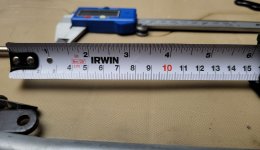
Fellow Americans: Do the rulers or calipers you use have the scale both in inch and millimetre (or centimetre)?

As for temperature units, I grew up with Fahrenheit, so it has meaning for me. Try as I might to get a sense of Celsius, if you tell me it's 78(F) out, I know exactly what that feels like. If you say it's 24(C)or whatever out, I just don't get it.
It must be because of the weird conversion formula. My understanding of Fahrenheit is the following:
  • 0 F: Rum freezes :)
  • 10 F: Not riding!
  • 20 F: A short shopping ride doable, Full Winter Armor :)
  • 32 F: Water freezes
  • 40s F: Mild winter temperature
  • 50s F: Not that cold on the ride unless it is windy!
  • 60 F: Eyes stop watering in the winter, a pleasant evening in the summer
  • 65 F: The beginning of the comfort zone
  • 68 F: The room temperature
  • 70 F: I'm in Heaven!
  • 70s F: A tad too warm for riding, still can do
  • 80s F: Think of possible dehydration on the ride
  • 90s F: Not riding!
:)

24 C (75 F) is the very end of the comfort zone for me.

Worth mentioning, Daniel Gabriel Fahrenheit was a German burgher of Danzig/Gdańsk, then (and now) a part of Poland :) There are several Fahrenheit references in Gdańsk nowadays.

1789031348693.png

Fahrenheit's Meteorological Column in Gdańsk, Poland.

Back to cycling again. Road cyclists think in km and km/h. Gravel cyclists... well, it depends. The sport was invented in the U.S., therefore many popular racing/rally distances are milers (even if the rider has their Wahoo set to kilometres). I love riding 50 milers! Then there comes the Metric Century (62 mi), easy. While the Imperial Century is the gravel cycling Classic distance!
 
Last edited:
It's actually 22.2mm, but who's counting? 😁

When I'm working on bikes, I use stainless rulers and tape measures that are dual marked. I have separate SAE and metric calipers, combination wrenches, drill bits, etc. It's a royal PITA. Just go metric for crying out loud.
 
It's actually 22.2mm, but who's counting? 😁
A typo, my bad!

One concept is really good: the ETRTO sizes for the tyre and rim: you never guess. Although, it is still easier for me to comprehend the MTB tyre sizes in inch. Would you believe many gravel cyclists here inflate the tyre to a psi value? This is what I do not understand! Bar are so convenient.
 
When the company I worked for started playing with the metric system, they started by converting still relevant drawings (yes, pre CAD). If you pulled a dwg that had decimal mm, it was old.

For me, seperate rulers, digital caliper that is dual with the push of a button.

I do very little that requires metric measurement.
 
Fellow Americans:


I'm not American, but I have windsurfed on Lake America.😁


Do the rulers or calipers you use have the scale both in inch and millimetre (or centimetre)?

Canadian rulers and such have both,..


20260912_001646.jpg


I bought my digital caliper at Canadian Tire.
Mastercraft is their brand name.


20260912_003741.jpg


I just bought a 500 mm X 7mm stainless steel rod that I can measure in three scales.
Metric,..

20260912_000425.jpg


Inches as a decimal,..

20260912_000449.jpg


And it even shows Fricken Fractions !!!


20260912_000523.jpg


35 over 128 is useless to me, but I can use the caliper like a slide rule to find a familiar fraction by opening the jaws slowly,..

The next "more whole" looking fraction still doesn't work for me,..

20260912_000611.jpg


There we go !!
I can relate to that,..

20260912_000741.jpg


And going the other way, closing the jaws. This was the next tangible fraction,..

20260912_000822.jpg


So the rod is between 1/4" and 5/16" (standard bolt sizes) but it's closer to 1/4" than 5/16"
 
I'm not American,
I didn't want to mention Canada because the nation is Metric but many units of measure of the neighbour are accepted. When I was in Canada (once), I was really surprised with the road distances in kilometres and the speedometers in kph (we call it km/h in Europe, by the way).
The British are a special case:
  • Temperature is Celsius
  • Short distance is metres or centimetres. Long distance is miles.
  • Beer and milk are by Imperial Pints, the rest in litres.
  • Body weight is stones
  • Shopping weight is either kilogram or pound
  • Pipe diameter is inches, pipe length is metres...
Ireland is similar to Britain only the road distances are in kilometres.

Now, what is the time format in Canada? 12-hour I believe? The date format? Do you Canadians use the A4 or Letter paper size?
 
I didn't want to mention Canada because the nation is Metric but many units of measure of the neighbour are accepted.

We're kinda stuck in the middle between metric and SAE.
Domestic cars are still all SAE but import cars are metric, so auto mechanics need to know both, and have two sets of tools.

Building supplies are all still "two by fours" and "four by eight" sheets of plywood.


If they get to downsize a product for the conversion to metric, then they will convert it. 😁


I just bought a dozen 2' square patio stones.
They are still labeled 24" but they've been downsized to 60 cm


When I was in Canada (once), I was really surprised with the road distances in kilometres and the speedometers in kph (we call it km/h in Europe, by the way).

We switched to metric when I was in grade 7 just as math was starting to get more difficult, especially with trying to remember all the conversions.

Metric made math and science Way Easier because all you need to do is move the decimal point to convert mm to cm to m to km.


One thing that I think is pretty cool about the Metric System is that all weights and measures can be created using an accurate 1 cm length.

A 1 cm cube filled with potable water at room temperature, will be exactly 1 cubic centimeter and weight exactly 1 gram.
(using earth's grabity at ~sea level)

A 10 cm cube of potable water is exactly 1 liter and weighs exactly 1 Kg.


In the other conversion thread, it was mentioned that the 1cc unit of measure is kinda small to be useful and tangible, but I think metric was first used to measure gold and silver, so the 1 gram 1 cc unit would be appropriate.

We all know the story of the King's Crown, so gold can be measured for both mass and volume using a calibrated beaker of water.


For liquid, the 10 cm cube (1000 cubic centiliters, or 1 liter) is a lot more practical.

I figure that's where the 1000 cc, 1 liter, 1 Kg came from, leading to the kilocalorie being called a calorie.

I remember a calorie being the amount of energy required to heat 1 liter of water 1 Celsius degree.

But 1 actual calorie can only heat 1 cc of water 1 degree, so you need a kilocalorie to heat 1000 of them,
So yeah 1 calorie per liter ??


Now, what is the time format in Canada? 12-hour I believe?

Yeah, am and pm for me.
Army time isn't tangible to me. I keep having to subtract 12 after noon to know what time it is.

The date format?

That's kinda all over the place with date, month; and year.

I usually hope to find one of the digits is a number larger than 12 and smaller than 31 to know for sure it's the day of the month.


Do you Canadians use the A4 or Letter paper size?

I'm not sure?
I think letter paper size is the standard, but in grade school we used "fullscap" paper sometimes.
It was a couple inches longer, but I think the same width?

I remember typing class in 1979, and whatever size "normal" paper fits in an old-school typewriter is the standard size paper that I'm used to.
 
Back