You are using an out of date browser. It may not display this or other websites correctly.
You should upgrade or use an alternative browser.
You should upgrade or use an alternative browser.
Clean Custom Conversions
- Thread starter PedalUma
- Start date



PedalUma
Well-Known Member
- Region
- USA
- City
- Petaluma, CA
The wheel magnet sensor will need to be at the rear with a three wire larger gauge wire extension and a physical extender of the pickup to get it close enough to the spokes. These things are a pain. I am putting the UL cert. battery on the boom with the discharge facing the motor at the crank. The motor will be upside down against the vertical post at the front.
Last edited:
PedalUma
Well-Known Member
- Region
- USA
- City
- Petaluma, CA
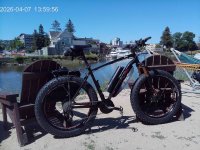
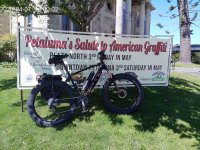
Here is how the Fat Boy turned out. Speed is limited to 45 kph and cadence at 100. The upper limit is 20 Amps so I set it a 18 for a safe margie. 18 x 48V nominal = 864W. If the internal temp gets to 100C it goes to 30% limp mode until it cools. You can set all those high and low limits.
Attachments
How did I miss this thread originally?
I especially enjoyed the discussion about the Ti Spectrum. I raced on a few different Ti Litespeeds (Catalyst and Ultimate). I still have a jack of all trades Appalachian (originally designed as a cyclecross frame) with Campy Chorus shifting (shifts smooth like budda). It's a fantastic ride and we've been over a few of Colorado's high mountain passes (including the ridiculous Independence pass at something like 12.500') It has 132mm rear drop out width and I keep toying with the idea of adding one of my Shengyi hub motors (but lots of work to change the gearing and I'd have to give up the lovely Mavic Open 4 rim). The 3.25 Ti frame seems to have enough flex to be pulled open to accept the 137mm motor width.
Pedal is now jumping up and down yelling at the PC saying "put a mid drive on it" .... lol.
I especially enjoyed the discussion about the Ti Spectrum. I raced on a few different Ti Litespeeds (Catalyst and Ultimate). I still have a jack of all trades Appalachian (originally designed as a cyclecross frame) with Campy Chorus shifting (shifts smooth like budda). It's a fantastic ride and we've been over a few of Colorado's high mountain passes (including the ridiculous Independence pass at something like 12.500') It has 132mm rear drop out width and I keep toying with the idea of adding one of my Shengyi hub motors (but lots of work to change the gearing and I'd have to give up the lovely Mavic Open 4 rim). The 3.25 Ti frame seems to have enough flex to be pulled open to accept the 137mm motor width.
Pedal is now jumping up and down yelling at the PC saying "put a mid drive on it" .... lol.


PedalUma
Well-Known Member
- Region
- USA
- City
- Petaluma, CA
I love it. Eat a fresh lobster for me. Dipping it in a some melted salted budda, with a little lemon, and some parsley. Sipping some crisp white wine cuts the fat. Maybe a Carneros malolactic creamy chardonae with high acid. Yes, a torque sensor mid is the way to go. Add a little summer squash and corn on the cob on the side. I put a converter on that bike to retain the Campy shifter and use a wider range Shimano cluster. It is getting White Industries hubs. Jewelry. They are made two blocks away.How did I miss this thread originally?
I especially enjoyed the discussion about the Ti Spectrum. I raced on a few different Ti Litespeeds (Catalyst and Ultimate). I still have a jack of all trades Appalachian (originally designed as a cyclecross frame) with Campy Chorus shifting (shifts smooth like budda). It's a fantastic ride and we've been over a few of Colorado's high mountain passes (including the ridiculous Independence pass at something like 12.500') It has 132mm rear drop out width and I keep toying with the idea of adding one of my Shengyi hub motors (but lots of work to change the gearing and I'd have to give up the lovely Mavic Open 4 rim). The 3.25 Ti frame seems to have enough flex to be pulled open to accept the 137mm motor width.
Pedal is now jumping up and down yelling at the PC saying "put a mid drive on it" .... lol.
Last edited:
Going waaay back that orange Raleigh also brought back memories. In the very early 80s I bought an orange Centurion LeMans that looked very similar. No it didn't have that lovely lug work or the polished drilled out components but overall it was a very similar vibe. Even the sizing looked similar - the Centurion was a 25" with about the same amount of seat tube showing (I was almost 6-3 with a 34" inseam).
PedalUma
Well-Known Member
- Region
- USA
- City
- Petaluma, CA
Our lobstas don't have any claw meat. You are lucky. I did catch one moments before the season opened on a pole and poached it to perfection.Going waaay back that orange Raleigh also brought back memories. In the very early 80s I bought an orange Centurion LeMans that looked very similar. No it didn't have that lovely lug work or the polished drilled out components but overall it was a very similar vibe. Even the sizing looked similar - the Centurion was a 25" with about the same amount of seat tube showing (I was almost 6-3 with a 34" inseam).
PedalUma
Well-Known Member
- Region
- USA
- City
- Petaluma, CA
On that fat bike I rolled a section of old tube wrapping it with electrical tape to make a bushing. When installing the motor I levered it up and forward as hard as I could against that bushing and the downtube with my foot as I tightened the lock ring, using thread lock and a hammer on the tool to torque it to maybe 85Nm. As the chainring goes down and forward, the motor goes up against the down tube. This will prevent rock strikes. The motor is higher than the chainring.
Last edited:
PedalUma
Well-Known Member
- Region
- USA
- City
- Petaluma, CA
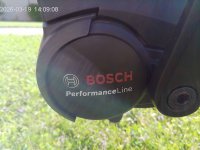
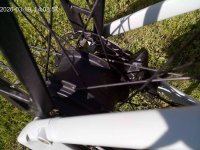
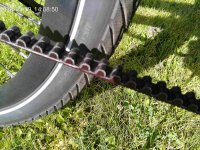
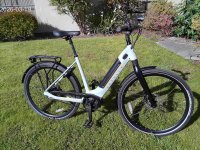
They are not custom builds but they are nice bikes. A couple purchased new Gazelles in So. Cal. while on vacation. They rode them 12 miles and had the bike shop ship them here. I reassembled them and gave them safety checks and tunes. That is an Envolio hub. They are heavy but smooth. I will finish hers tomorrow morning. This is his. It had loose parts and the brakes were warped. Working on quality stuff makes up for McFoxes with no brakes.

 www.gazellebikes.com
Gazelle Arroyo C380 Elite | Gazelle
Experience the Gazelle Arroyo C380 Elite, the premium e-bike with a powerful Bosch motor, stepless shifting, and a comfortable upright design. Perfect for city commuting and leisurely tours.
www.gazellebikes.com
Attachments
Last edited:

gromike
Well-Known Member
- Region
- USA
- City
- City of Dreams
I do believe a case can be made on a road bike for a torque sensing direct-drive hubmotor with regen braking.Yes, a torque sensor mid is the way to go.
I put an Grin All-Axle on this bike:
The bi-directional throttle is amazing. One hand go and stop.
PedalUma
Well-Known Member
- Region
- USA
- City
- Petaluma, CA
Tease, show a little more.I do believe a case can be made on a road bike for a torque sensing direct-drive hubmotor with regen braking.
I put an Grin All-Axle on this bike:
View attachment 210309
The bi-directional throttle is amazing. One hand go and stop.
That's almost exactly what I was thinking of as an upgrade to my urban all season ebike (currently a Shengyi SX motor, CycleAnalyst, 52v/750w battery with a Baserunner controller). The only thing holding me back was/is money.
I'm with Pedal ... I'd like to hear more about your experiences setting up and running that nice Superharness based conversion.
One initial question - why didn't you opt for a controller in the battery holder setup to hide the Baserunner?
I'm with Pedal ... I'd like to hear more about your experiences setting up and running that nice Superharness based conversion.
One initial question - why didn't you opt for a controller in the battery holder setup to hide the Baserunner?

RunForTheHills
Well-Known Member
- Region
- USA
That looks like a Phaserunner and not a Baserunner under the downtube. It won't fit in the battery shell. I converted to the Superharness. It was pretty easy once I got the cable extensions I needed. The Superharness mounts on the stem and you have to run all cables except the torque sensor up to there. The torque sensor connects directly to the controller. I had and am still having problems getting my older Sempu torque sensor to work the way I want. I get a surge of power when I first start pedaling. I haven't spent much time troubleshooting it yet though and I do have a spare torque sensor if I want to go to the trouble of replacing the bottom bracket. You need an ebrake switch to program the Superharness, but you can probably rig any switch to do that with if you don't have one. I used a v6 Phaserunner and a GMAC motor. The Autotune feature in the v6 Phaserunner doesn't work with the GMAC and you have to use the predefined settings for that motor in the software.
PedalUma
Well-Known Member
- Region
- USA
- City
- Petaluma, CA
I am so out of my league in the conversations about hub-motors. I do love it that you are innovating. I need to solder two display wires together with an added foot long section to get that recumbent trike wired through the boom. I need 8.5 feet. It goes from the motor which holds the internal controller, down the boom, out the rear, and up to the left steering bar. I have been putting that project off in favor of quick turn around low hanging fruit that keeps coming at me. I need to get serious about it today.
Upon closer inspection (my zooming in was confined to the handlebar area) that is indeed a Phaserunner (it initially appeared to me to be a bit flatter and more like the Baserunner) ... sorry about that, and to gromike ... Never mind the question.
Pedal - don't mind us. All of this little discussion is about Grin specific hub motor kits and the controllers. None of the specifics really apply to any other hub motor setup.
Now my questions to gromike will be about the performance of what appears to be the narrower width All-Axle motor and it's performance climbing when powered by the Phaserunner controller (with a suitable battery it's able to pull more amps than the Baserunner).
The really interesting setup is to build up a frame that has the wider (fat bike like in the 175mm range) rear dropout spacing and use a suitable battery with the Phaserunner controller using the wider version of the All-Axle motor. That configuration is supposed to climb just about anything - which is very impressive for a smaller direct drive motor. Then for a high performance bike you've checked all the boxes - high reliability (no internal gears) and lower maintenance, ability to climb, regen, torque sensor PAS, with reasonable weight and diameter (vs. those huge multi kW DD motors)
Pedal - don't mind us. All of this little discussion is about Grin specific hub motor kits and the controllers. None of the specifics really apply to any other hub motor setup.
Now my questions to gromike will be about the performance of what appears to be the narrower width All-Axle motor and it's performance climbing when powered by the Phaserunner controller (with a suitable battery it's able to pull more amps than the Baserunner).
The really interesting setup is to build up a frame that has the wider (fat bike like in the 175mm range) rear dropout spacing and use a suitable battery with the Phaserunner controller using the wider version of the All-Axle motor. That configuration is supposed to climb just about anything - which is very impressive for a smaller direct drive motor. Then for a high performance bike you've checked all the boxes - high reliability (no internal gears) and lower maintenance, ability to climb, regen, torque sensor PAS, with reasonable weight and diameter (vs. those huge multi kW DD motors)
gromike
Well-Known Member
- Region
- USA
- City
- City of Dreams
The standard width All-Axle motor provides more than enough power for me. It will push me up the steepest hills I encounter with no pedaling, though I usually do some pedal work. What I do have a problem with is battery capacity. The bidirectional throttle is just way too much fun, and with it the bike behaves as if it's a emoto. The bikes range suffers.
LandoftheGiants
Active Member
- Region
- Australia
I miss the old color schemes. All the bikes now are solid colors, monochrome, dark shades, like out of some Noir murder movie.
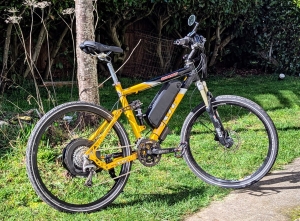
It's cheaper to turn out bikes in just a few solid colours ... and you know how everyone is looking to save a few dollars. I too miss a choice of colours and combinations (stripes etc.), or even just more chrome.
This from a guy who built up his ebikes from solid black frames (both Surlys) ... but that was because of wanting to hide the wiring as much as practical and black was also the only local choice at the time. So I ride around on something that the bad guys in a Noir movie might drive - shiny black bike, black fenders, black bars, black seat, black rack, black panniers, black battery, black tires, black rims, black spokes, oh and the black wires.
Interestingly even though my choices were both black Surly is known for both a wide selection of unusual colors and some great names for them. 20+ years ago I almost bought my CrossCheck in S'not green, and my BridgeClub was also offered in a deep red called Grandma's lipstick (I really wanted that one for my 2nd build but there were no size large bikes available in anything but black at the time).
This from a guy who built up his ebikes from solid black frames (both Surlys) ... but that was because of wanting to hide the wiring as much as practical and black was also the only local choice at the time. So I ride around on something that the bad guys in a Noir movie might drive - shiny black bike, black fenders, black bars, black seat, black rack, black panniers, black battery, black tires, black rims, black spokes, oh and the black wires.
Interestingly even though my choices were both black Surly is known for both a wide selection of unusual colors and some great names for them. 20+ years ago I almost bought my CrossCheck in S'not green, and my BridgeClub was also offered in a deep red called Grandma's lipstick (I really wanted that one for my 2nd build but there were no size large bikes available in anything but black at the time).
RunForTheHills
Well-Known Member
- Region
- USA
20+ years ago I almost bought my CrossCheck in S'not green

Darth_Vado
I Find Your Lack Of Faith Disturbing
- Region
- USA
- City
- Huntington Beach, CA
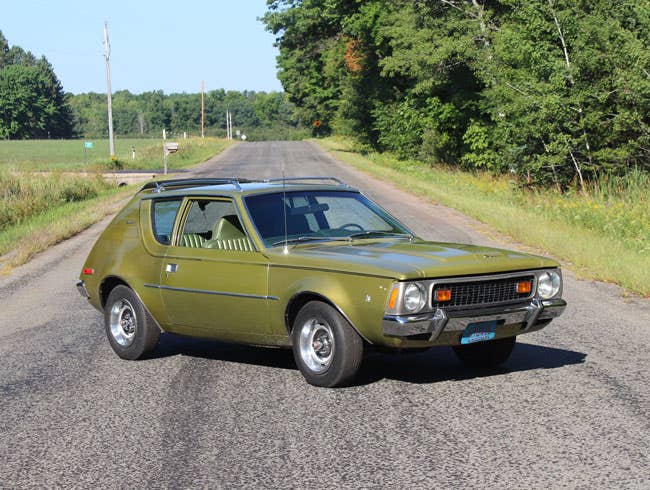
AMC had some odd looking cars in the day! Between the Gremlin and Pacer, not sure which was more odd
Similar threads


- Replies
- 56
- Views
- 19K

- Replies
- 18
- Views
- 3K

