
stompandgo
Well-Known Member
- Region
- USA
And I am the exact opposite. Pound it on the flats.



The flats do have their charms— even in fitness riding. Gobbling up the road in front of you with no wind or slope to help or hurt your effort can be very satisfying. Adding motor assist just ups the ground speed, which generally only adds to the fun.And I am the exact opposite. Pound it on the flats.

I live at the top of the highest hill in town and coming home I get the wind and the climb at the same time when I am already tired. Big battery suck if I can even keep it climbing...
 “
“
Not clickbait to call road e-bikes pointless, in the UK. When you can do 22+ mph on flats, a heavier costlier ebike that maxes out at 15 mph under assist is of limited appeal.Three more interesting takes on the Canyon Endurace ONFLY and its hpr40 motor. Don't be put off by the click-bait title.



I would almost agree with you but in all the honesty, you would not ride very far on a smallish battery with the Class 3 limitationa heavier costlier ebike that maxes out at 15 mph under assist is of limited appeal.

The flats do have their charms— even in fitness riding. Gobbling up the road in front of you with no wind or slope to help or hurt your effort can be very satisfying. Adding motor assist just ups the ground speed, which generally only adds to the fun.And I am the exact opposite. Pound it on the flats.

Funny this came up. I've been saying over and over that there are no relatively flat routes near my house, the mythical low-zone-3 or mid-zone-2 ride (that @stompandgo suggested I try to work into my fitness routine) is impossible where I live, and it's mostly true. But just today, I had to run to the ATM and stop at the aquarium store to pick up turtle chow, and I thought, "Driving and parking in Hollywood is getting too annoying. And they're not going to throw me out of the aquarium store for bringing my bike in, the turtle food is right behind the counter."The flats do have their charms— even in fitness riding. Gobbling up the road in front of you with no wind or slope to help or hurt your effort can be very satisfying. Adding motor assist just ups the ground speed, which generally only adds to the fun.
So you were saving yourself on the way to the top to pace them on the way home? Good a way as any to feed your stated need for speed.Saturday rides were about getting into the Berkshire mountains and climbing. We would do about 60-80 miles and 5-6K feet of climbing. On the longer, steeper stuff, I'd be at the back or off the back of the group, and they would usually have to wait at the summit for me and a few others, usually for less than a minute. On the way home, though, I'd be on the front with another strong rider or two, and we would pull the group home at 22-24mph so they could just sit in.
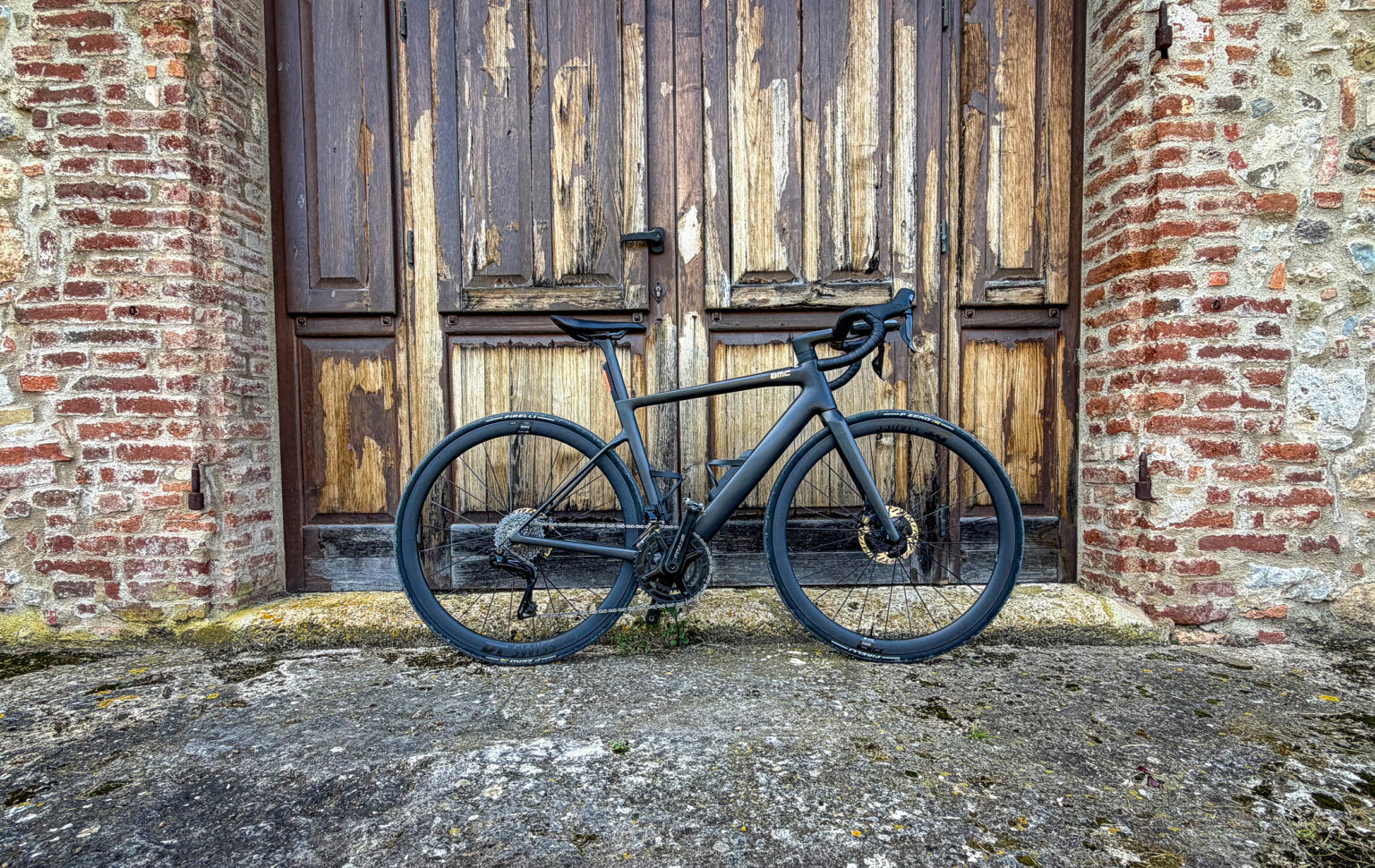
 bikerumor.com
With the motor on, it’s a slightly different story. In the low setting, the motor is acting on the drivetrain, but it’s also introducing noticeable friction as you also push against the motor.
In short, in this mode the power delivery was capped at such a low level that when I pushed hard to accelerate, I found the system felt draggier than it would have done with the system switched off.
It’s also noticeable (to a lesser extent) in the medium setting, meaning only the more powerful two settings are really powerful enough to feel like true assistance when you're working hard.

Trying to get my head around this - so if the motor is on a low 'eco' setting, power is so low your own pedalling is exceeding the assist and that creates drag? For comparison I'm not feeling that on my SL motor (35nm max) for a couple of factors I'm guessing, because of the steep hills here Eco is always set over 35% so there is always a good level of assist, and my motor has a clutch(?) which does not create friction/drag when I exceed low levels? Damn I want to try one of these on my roads to experience this and see what it feels like as I've difficulty in visualising it. If as the reviewer says, it is noticeable, that would be, excuse the pun, a real drag.from a review of the new BMC
this is what i have been worried about with these designs, which lacks the “clutch” behavior of other mid drive motors. it makes sense that once it’s engaged, with no clutch and at very low power levels, you could overrun the motor and essentially be acting as a generator. of course it should catch up quickly … but instantly?
Additional: just read that Bike Rumours review above. It's the approx 20lbs that gets me every time. That and of course the price. Clearly Less really is More!Trying to get my head around this - so if the motor is on a low 'eco' setting, power is so low your own pedalling is exceeding the assist and that creates drag? For comparison I'm not feeling that on my SL motor (35nm max) for a couple of factors I'm guessing, because of the steep hills here Eco is always set over 35% so there is always a good level of assist, and my motor has a clutch(?) which does not create friction/drag when I exceed low levels? Damn I want to try one of these on my roads to experience this and see what it feels like as I've difficulty in visualising it. If as the reviewer says, it is noticeable, that would be, excuse the pun, a real drag.
Yeah that is a chronic problem with the bike media - bikes are reviewed in isolation when everyone wants to know how they compare against others in the field. It's why review Roundup sites like the Wirecutter are so successful.Above 25kph, the motor disengages entirely, and all rider-generated power is transferred directly to the rear wheel without drag. The assist cuts cleanly, leaving the bike to behave like an unassisted machine at the speeds where road cycling most often operates. BMC worked very closely with TQ in this area, ensuring a very smooth switch of power, an area that other motors struggle with. On a mountain bike or hybrid bike the 15mph cut-off isn't such a big deal as in general the speeds are lower, but on road, where it's easy to go over that speed, the transition needs to be very subtle or else it feels like more of a problem than a help and can be very frustrating when riding with others on flatter terrain.
Rouleur
I've noticed a couple of reviewers saying this now- It must really piss Specialized off. When did the first Creo & SL motor come out? 2019? So for about 7 years they've had this imperceptible motor cut off already. But I find it's a common thread for road bike magazine reviewers to spend half the review delicately weaving the line of 'of course some say e bikes are cheating' and the other half showing that the last ebike they rode had a car battery hooked up to a washing machine electric motor.
He never mentions either that Canyon Scott and Ridley already have models with the TQ40 motor. Guess BMC are paying for the review.
Be interesting to see if more riders comment on this low power v drag issue. Personally I hope it's not a big deal as this low power, low weight mid drive fits my hilly rides and I'd love to own a bike that feels breezy when riding with assist off. Right now my 16 year old Salsa Vaya, no weight weeny at 27lbs, still is fun to ride, so a 21lbs machine with 40nm must feel extraordinary. An on the road weight of nearly half of my Vado SL yet with similar power. But also, and a big deal for me, is the silence of the TQ.
My forlorn hope is of course that a Decathlon or X Lab etc will come out with a reasonably priced TQ40 motor model and I can start to do the sneaky maths to figure out how to justify getting one.
Also, and I mentioned this in a thread yesterday re the Avinox launch, what are Shimano thinking about all these new motor developments? Are they going to quietly withdraw from motor R&D, it's been 6 years since any new motors. Or are they just waiting for market conditions to improve? I've thought for a long time they have the most knowledge of the cutting edge of bicycle development, the most contacts in all bike sports, right to the top, and so are in the prime spot to come out with brilliant e bike tech and a ready market to sell it to.
Anyway a topic for another day.
Trying to get my head around this - so if the motor is on a low 'eco' setting, power is so low your own pedalling is exceeding the assist and that creates drag? For comparison I'm not feeling that on my SL motor (35nm max) for a couple of factors I'm guessing, because of the steep hills here Eco is always set over 35% so there is always a good level of assist, and my motor has a clutch(?) which does not create friction/drag when I exceed low levels? Damn I want to try one of these on my roads to experience this and see what it feels like as I've difficulty in visualising it. If as the reviewer says, it is noticeable, that would be, excuse the pun, a real drag.
Very interesting. Not an engineer but I do get nervous when it's software not mechanical, not when the motor is new, but how the longevity of the system pans out. I guess we'll hear more reports as people buy the bikes.the SL motors have a clutch (or something like one) - you physically can’t turn the motor with the pedals, and the motor can’t actually turn the pedals either. if you put the bike on a stand and give the pedals a quick spin without any load on the wheel in turbo what you’ll see is actually the chainring spinning fast for a second (and the rear wheel of course) but the crank arms are basically disconnected by the clutch. it’s strange, but makes sense. you don’t want to ever feel like the motor is turning the pedals, and when the motor is off or you’re out pedaling it briefly you don’t want to be a generator!
TQ does it differently, the whole deal is fully concentric to the motor and the harmonic pin ring assembly replaces all the kludgy splined gears, and in the 40 they’ve made it so tiny and light by removing one of the physical clutches and using software to emulate it by spinning the motor “just right.”
something doesn’t seem right about this - so we/i may be misunderstanding part of it. the motor obviously disconnects above the cutoff, there’s no way the rider is spinning the motor at all times, but it seems like the behavior when the motor is “ON” but at low power level is highly dependent on the software.

something doesn’t seem right about this - so we/i may be misunderstanding part of it. the motor obviously disconnects above the cutoff


