Litespeed launched their titanium take on e-bikes

Base

Bike nerd
Region
Europe
City
in the exact center of the Netherlands
Just ran in to the new e-bikes from the Ti specialists from Litespeed.
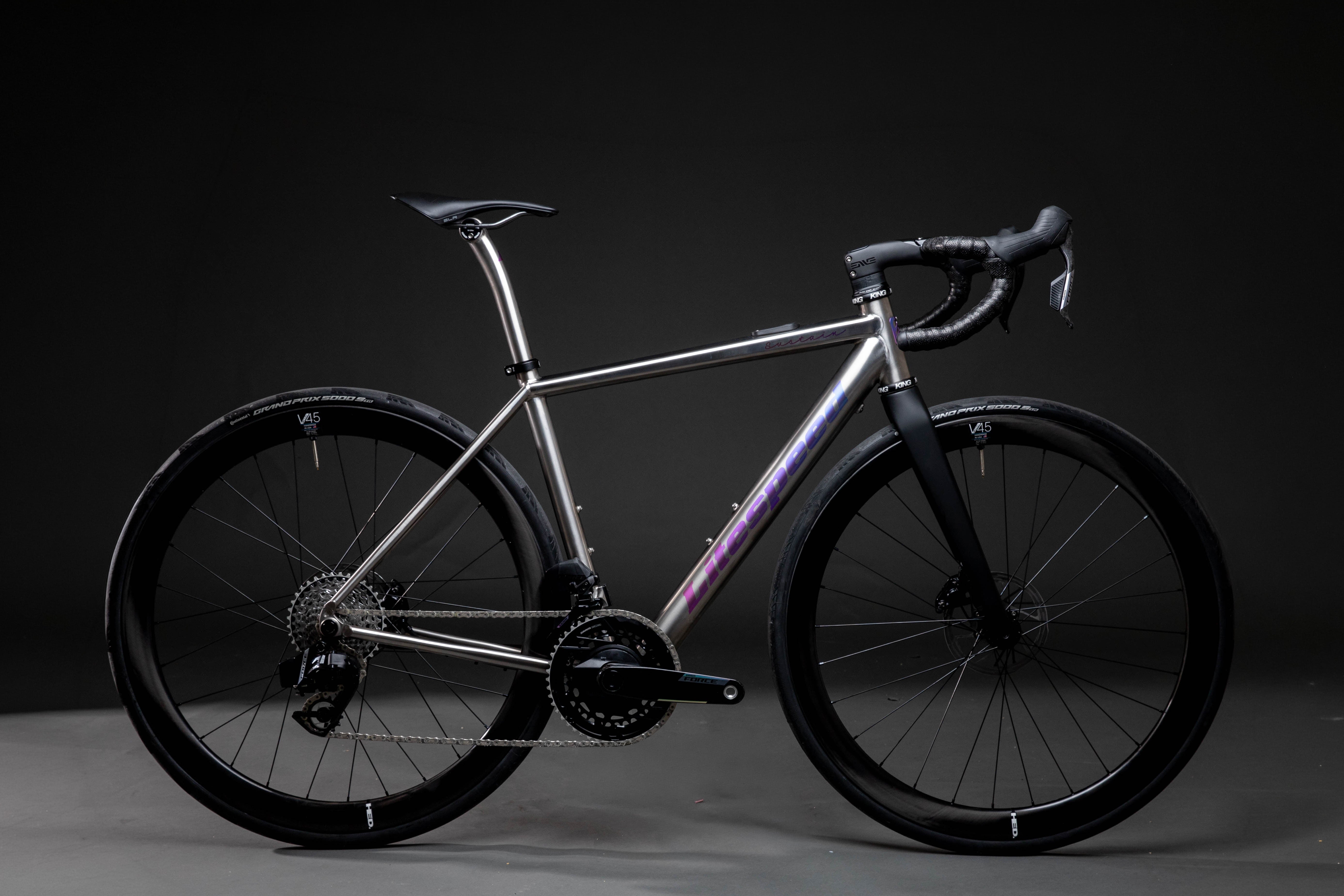
IMG_6470_1579e4e7-e164-4543-8912-9d3f1f33ec67.jpg


Mmmmm .... that's really nice (but I can't afford one). I like that tag line "True classics don' t need reinventing. They just need a boost."

I have a classic late 90's Litespeed Appalachian (cross bike) hanging in the garage, and I keep thinking I'd like to add a kit to it. There are however a few issues ... I think the rear dropout spacing is 130mm (and not 135 so a rear hub motor might be difficult), the front forks are carbon fibre (an upgrade done in the early 2000s) and I wouldn't consider a front hub safe in those forks even with torque arms. So that likely would mean a mid drive setup, and that means being unable to move/reuse many of the ebike components from my existing steel frame road bike (so higher costs).

Still though like most/all of Litespeed's products it's a sweet ride (we've been over many of Colorado's mountain passes when I was younger and fitter), and it needs to get out more.
 
I hear those Mahle motors are really locked down.
Off topic, I see you responded to Neptronix thread on Keyde P110 at Endless Sphere. I'm not registered so not able to post there but I am following. I have a Keyde S110 that I've put some miles on, with their small 250w battery (I have their 400w battery) weighs in at 3.5kg, just a couple hundred grams heavier than Mahle x20. Although not torque sensing I think it performs well in the hilly areas that I ride. I was impressed enough that I bought a P110 which supposedly is torque sensing which I laced into a 700c rim and installing on a '70's road bike. Still working on brakes and shifter cables but should be ready to ride soon. I'm sort of surprised that there isn't much in the way of user reviews considering the clean installation, UL certified battery and potential for building a light ebike.

edit:
Apparently the LG cells are what are UL certified rather than the entire battery apparatus
per the ebay listing: UL 2849 Standard Reference : UL Product iQ - BBCV2.MH19896
 
Last edited:
Off topic, I see you responded to Neptronix thread on Keyde P110 at Endless Sphere. I'm not registered so not able to post there but I am following. I have a Keyde S110 that I've put some miles on, with their small 250w battery (I have their 400w battery) weighs in at 3.5kg, just a couple hundred grams heavier than Mahle x20. Although not torque sensing I think it performs well in the hilly areas that I ride. I was impressed enough that I bought a P110 which supposedly is torque sensing which I laced into a 700c rim and installing on a '70's road bike. Still working on brakes and shifter cables but should be ready to ride soon. I'm sort of surprised that there isn't much in the way of user reviews considering the clean installation, UL certified battery and potential for building a light ebike.
Maybe it's kind of in a similar boat as the Mahle re DIYers. Keyde used to offer motors without a controller, but nowadays require their own integrated one. Similarly they no longer offer throttle options, I suppose due to the motor using rollers instead of gears and slipping if you apply full throttle abruptly.

A lot of DIYers want to bring their own controller. Some slap in generic KT ones that are very cheap, others fancy customized VESC ones, etc.. Many want to use custom batteries, but the Keyde caps max out at 50V, which is too low for even standard 48V packs at full charge. Most want throttle capability as well. I pedal my e-bike all the time for exercise, personally, so only having PAS wouldn't kill me, but I still prefer throttle to start from stopped at a traffic light, for example.

Meanwhile I never really cared about weight for an ebike myself. It's got a motor anyway, so weight only matters to me once a year or two when it breaks down and I fold it up and toss it in the back of my SUV to bring home for repairs. I have a nice light carbon road bike without a motor as well, so do understand wanting a light non-ebike.
 
Keyde motors might best be left to be used as they were designed for. Under the advanced settings I increased the max watts on my S110 to 750 resulting in roller slipping at highest power so back it went to 500W max. Supposedly the P110 has the exact same transmission but max power is 750w, I'll reduce the max if I get any slipping. I can see that it might slip with a throttle or after market controllers. Personally I do appreciate lower weight bikes and the Keyde can deliver in that respect similar to what Mahle weight allows with Lightspeed bikes that are the subject of this thread within a couple hundred grams. The wireless app control is excellent in my opinion. No idea if the system will prove durable but I haven't read anything suggesting that it isn't.
 
I have two Litespeeds, road and gravel, as well as a Trek Checkpoint Plus SL 5. I'm not interested in any bike with a hub motor. And definitely not interested in anything below class 3.
 
Litespeed doesn't seem to be offering class 3, unfortunately. Even the page for the $12,000 overdrive model on their site says it is just class 1:
Motor
MAHLE X20 rear hub
Power
250 W (275 W Peak)
Torque
65 Nm
Battery
250 Wh
Extender
Optional eX1 available
Class
Class 1, assists up to 20 mph
System Weight
3.2 kg (7.05 lbs) complete, including battery

If the motor was more generic you could just slap a third party controller on there. Maybe they are just targeting the European market or something.
 
I have two Litespeeds, road and gravel, as well as a Trek Checkpoint Plus SL 5. I'm not interested in any bike with a hub motor. And definitely not interested in anything below class 3.

This made me wonder, what kind of rider power would it take to get a top-end Litespeed Sustain x20 ebike to the Class 3 assist limit of 28 mph (45 km/h)?

Screenshot_20261104_100527_Chrome.jpg

Put the very reasonable parameters above into the speed vs. power calculator at www.gribble.org.

Result: Total estimated resistance at the Class 3 limit is 448W, including aerodynamic, rolling, and drivetrain losses. So, if the motor puts in its peak mechanical power of 275W, the balance for the rider to cover is 173W.

Seems pretty doable for the kind of rider likely to be attracted to this bike, so a Class 3 version might well have some appeal.
 
Last edited:
275 W with a 250 Wh battery at 80% motor efficiency and 0.95 usable battery charge (190 Wh) would mean 190 / 275 = 0.69 h = 41 minutes ride. Range of 19 mi.

Yes, not far at 28 mph. At 24 mph,
— still well above the Class 1 limit — total resistance drops to 294W. You could then roughly double that range to 38 mi with 138W (50% peak power) from the motor and 156W from the rider.

Not bad, and you could always trade off speed for range as desired.
 
I was invited for friendly RC coffee rides thrice; it was 42, 43, and 49 miles. The average speed on the longest on them was 20.3 mph (so we had to cruise a way faster than that). I put the notes for that ride. It was approximately 620 Wh battery used at the average user power of 111 W. The elevation gain was about 600 ft. The max speed was 28.9 mph and the peak rider power was 427 W. The motor peak mechanical power was 520 W. As I only noted the battery % but not Wh, you Jeremy could verify the actual battery consumption at 79% motor efficiency. My big Vado is equivalent to Class 3.

1793856008551.png

1793855511297.png

A photo from the 42 mile ride.

Our three recent gravel rallies were for 63 or 68 miles. New people riding gravel e-bikes appeared. Their technique is to ride on the leg power only over the 25 km/h speed restrictor and only (automatically) get the assistance on the climbs. A close friend riding a TREK e-Caliber (250 Wh battery) has been applying that technique for the last two seasons. When the races were 50-milers, he was typically using just 35% of the battery charge. Of course, he used more battery on the 68-miler. Still, all the Top 3 e-bikers were mostly riding on their own leg power on every rally.

1793856691729.png

The winner of Sudovia Gravel 2026 eRide100. A KTM Macina Gravelator SX 20, 400 Wh battery. It was 63.7 miles with 5,050 ft elevation gain. That man came in 3 h 54 min.

My point is Class 3 seems to defeat the purpose of a lightweight e-bike on fast rides.
 
Last edited:
Back