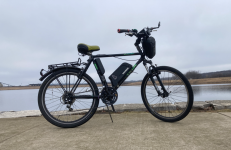
What do you check first before choosing an e-bike conversion kit?

JL0256

Member
Region
USA
I've been looking at different e-bike conversion setups lately, and the more I read, the more it seems like choosing a kit based mainly on motor wattage is probably the wrong way to go about it.

At first it's easy to look at 500W, 750W, 1000W, etc. and assume that's the main decision. But after reading through some builds here, there seem to be quite a few things that can cause problems even when the motor itself looks right.

A few things I'm wondering about:

  • Hub motor vs mid-drive — For a fairly normal bike, what usually makes you choose one over the other? Is it mostly terrain and climbing, or are reliability and maintenance just as important?
  • Fitment — With mid-drives there's bottom bracket width and clearance, while hub kits bring up dropout width, wheel size and axle fit. Which measurements do you always check before ordering?
  • Battery and controller matching — Besides making sure the voltage is compatible, how much attention do you pay to controller current and what the battery can actually supply?
  • Brakes and drivetrain — At what power level do you start thinking seriously about upgrading brakes, chain, cassette, torque arms, etc.?
  • Parts availability — This one seems easy to overlook. If a display, controller, cable or sensor fails a couple of years later, being able to buy individual replacement parts seems pretty important.
  • Installation difficulty — Are there certain types of kits you would recommend avoiding for a first conversion simply because they tend to create more compatibility headaches?
I'm not trying to build the fastest bike possible. I'm more interested in what makes a conversion reliable and relatively easy to live with after the initial installation.

For those of you who have done several conversions, what are the first 3–5 things you check before buying a kit?

And what's something you learned the hard way on an earlier build that you now always check beforehand?

 
I've done geared hubmotors front/rear plus mid drives. I've also purchased a few inexpensive but decent ebikes. Been ebiking for 11 years. It was originally cheaper to build/convert but today, if you watch for closeouts, you can often buy a better featured ebike for less than the price of converting something,

What's the purpose for converting a bike? Is it for sentimental reasons on a beloved bike, or to build something not readily available? I've converted clunkers/junkers and spent time/money upgrading them. Maybe don't be doing that. After we get past the why of conversion, then we can go thru the details of how to convert. I'll give my answers to your specific questions next,
 
Hub motor vs mid-drive — For a fairly normal bike, what usually makes you choose one over the other? Is it mostly terrain and climbing, or are reliability and maintenance just as important?

Originally, it was price. A Bafang BBS02B was over $500. The CYC's twice as expensive. Hubmotor kits with wheels were selling for $250 ten years ago. More recently, pricing is closer. I personally think a mid drive is easier to install, as there is no controller to locate and wire up. I also think a torque sense mid drive kit is hard to beat in the class II realm. More fun to pedal and it has a throttle.

Fitment — With mid-drives there's bottom bracket width and clearance, while hub kits bring up dropout width, wheel size and axle fit. Which measurements do you always check before ordering?


You might have a newer model bike with different style BB, but the majority of older bikes are 68mm with square taper BB. Most newer bikes have 135mm rear and 100mm front drop outs. Fat tire bikes are 175mm rear, 135mm front. . Older steel 10 speeds are 120mm, but only a few diehards like me convert them.

Battery and controller matching — Besides making sure the voltage is compatible, how much attention do you pay to controller current and what the battery can actually supply?

It matters for higher power builds, but most of my hubmotor bikes are 20A or 25A controllers. It's pretty easy to get a battery rated to supply 25A. My BBS02B middrive pulls 25A peak, while my various mid drive bikes are 12-13A peak. A 25A battery would be fine there. If you;re building a +30 mph bike, you'e spending a lot of money on a battery. I never need to power up past 20 mph, unless it's a bragging rights test. Once I know the top speed, no need to check again. Most of my my riding average 12 mph, I only have two bikes that an exceed 25 mph on throttle.

Brakes and drivetrain — At what power level do you start thinking seriously about upgrading brakes, chain, cassette, torque arms, etc.?


I have always installed torque arms on every hubmotor build. I have noted that my commercial ebikes with hubmotors didn't have torque arms. When I can, I use a torque wrench on the axle nuts - 25 foot-pounds. I mark the nuts too, and have never seen any move,

Have never broken a chain. I use KMC standard 7 speed chains. Think their ebike rated chains are likely the same chain. The Bafang BBS02B will cause stretched chains and old freewheels to pop and skip. so those get replaced on a comversion. I'm still using a 40 year old chain on my DM02 mid drive since it's not making any noises and doesn't miss a shift,

You want good brakes, regardless of power, but for a Class 2 that rarely goes over 20 mph, caliper brakes work. If the hardware/fittings are there. I'll change a wheel to disks. Gets expensive to replace w caliper wheel hub with a disk brake wheel though. Its just for looks.

You forgot wheels. Nothing makes a bike more sluggish than steel rims. Don't get a donor bike with them. It will cost $150 to swap, and you really had to love your old beater bike to do that.

Parts availabilityThis one seems easy to overlook. If a display, controller, cable or sensor fails a couple of years later, being able to buy individual replacement parts seems pretty important.

In the DIY world, if you stay with popular kits, the parts are available. For example. Bafang no longer sells the uart based BBS02, BBSHD middrives, but you can still buy the controller boards. Same with displays. That won't be forever though, but I don't plan to buy any spares. On the other hand, I liked the way the Tong Sheng TSDZ2B middrive ran with aftermarket firmware on our bikes that I bought a spare motor kit when they were on sale for $240, even though you can buy almost all of the intern parts ala carte,.

Installation difficulty — Are there certain types of kits you would recommend avoiding for a first conversion simply because they tend to create more compatibility headaches?

Newbies often do front drive hubmotors because they fear the unknowns of adjusting a derailleur for a rear hubmotor. First, this task is something any DIY bike enthusiast should know. Next, newbie errors are more likely to let the front motor spin out of the fork and faceplant the rider. I'd rather see the newbie do a rear motor.

Mid motors have the same issue. You need more tools, like a chain breaker to remove the chain, tools to take out the BB, and the dreaded readjustment of the derailleur. But there is no controller to locate on the frame, and no need to put it in a box where it can get wet. I'll spend several hours planning how I will fit a box to a bike and putting a controller inside it.
Mid drives make better use of the motor/gearing and you can run them on smaller batteries.

I think that if you take on the job of converting a bike to electric, you need to be able to handle all aspects pf bike maintenance, You should be able to adjust your handlebars and grease the head set. Even a hubmotor should have the BB looked at and regreased.
 
Back