Brake Wear Question -- Is it possible...

Catalyzt

Well-Known Member
Region
USA
...that I could have burned through the pads on my Canyon Grizl:ON 7 in only 250 miles?!

I live in an area with a lot of steep hills, yes. But this seems like an absurdly short service life. My eMTB's brake pads were good for at least 500 miles in this terrain, and it's 47 pounds as compared to 36 for the Grizl.

The reason I ask: I'm just hearing a funny "shhh" kind of sound from the (Front) brakes sometimes, sometimes a little from the rear. And the discs look kind of chewed up-- not like they were sorta sandblasted, which I know can happen if the rakes get bad enough, but radial scratches. (I'll post a picture later if it's important to answering the question, I'm just exhausted at this moment.)

This is one thing I just don't have an eye for. Normal riders can see or feel brake wear. For whatever reason, I can't. What am I looking for? Maybe I should just clean the discs with alcohol, ride it for another hundred miles or so, see if there's any change, and then take it in.

Links to photos/videos of good vs. bad brake pads and trashed vs. serviceable discs greatly appreciated! Thanks!@

 
we might need to see some photo's of the actual pads.
Wear is always something that is not going linear, I can ride with a set off pads for 8 months on my daily ride (sees also some "offroad" paths) and with my mtb I can wear out a set in muddy winter conditions in one ride, for example happened a few times in the Ardennes with really foul weather.

so if you look at the pads, do they look like this:
1766135654170.png


plenty pad material left but glazed? or are they worn in an angle? you might see that the return spring could be bent out so it could run into your rotor.

glazed pads can be sanded down and the rotor should also be lightly sanded down.
 
Is it easy to remove a pad and measure the thickness? That is in my experience the best way to determine if the pads need replacing, well besides being clearly down to the metal.
 
Yeah whip out the pads & check for wear. Check for uneven wear as well to see if alignment is off and if close to metal just replace them. Can't remember that credit card trick for measuring how much pad is left. Whether it was one card or more. Park tools do an excellent video on you tube showing all the different caliper designs & how to remove pads and check wear.

Steep hills do a surprising amount of pad damage in a short time, though 250 does sound very short. If they are worn already could have been cheap pads.
 
If you're hearing brake noise, chances are, you have some brake drag which will wear out pads prematurely. Re align the calipers so there is no more noise. loosen the caliper mounting screws, firmly apply the brake and re tighten the mounting screws without releasing the brake lever. If that doesn't work, check for a warped or worn brake disk and perhaps a stuck caliper piston.

You can also try a different type brake pad that has a better wear rating.
 
Yeah whip out the pads & check for wear. Check for uneven wear as well to see if alignment is off and if close to metal just replace them. Can't remember that credit card trick for measuring how much pad is left. Whether it was one card or more. Park tools do an excellent video on you tube showing all the different caliper designs & how to remove pads and check wear.

Steep hills do a surprising amount of pad damage in a short time, though 250 does sound very short. If they are worn already could have been cheap pads.
Also could have a stock piston or stuck pad if wear is uneven. The last time I changed my pads I had to deal with both situations.
 
This is very helpful. I need to do a deeper dive into YT diy videos for checking the pads.

The disc is not warped, at least that I can see. There is no wobble at all. Brake drag is possible. Better brake pads sounds like a really good idea. Super helpful!
 
No, it's not normal unless you ride 100% of the time in wet, sloppy off-road conditions and don't wash your bike. Diagnosis is a multi step process.
 
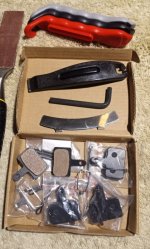
You need a cheek spreader. Spread the pads before you remove them. This allows for the added thickness of the new pads, pushing the pistons in. Clean the area well before touching. This saves messy hands but also contaminants from following the pistons in and messing with the seals. A four pack of pairs of generic sintered pads can be less expensive than one pair of brand name pads at a bike shop. No one is checking for logos. It's the same stuff from the same factory in a different package. Most pads, except for eMotos, are 3mm thick to start. Having a velcro strap on the lever is a good way to center the caliper before retightening the mounting screws. Since you do this infrequently a generic pad spreader will work fine.
 
Since you do this infrequently a generic pad spreader will work fine.

I used my geriatric tools for the job.
Putty knife, bread knife, filet knife, large flat head screwdriver, small flat head screwdriver, empty beer can, and a hammer.

EDIT: I forgot chisel, which was the only thing that would open up a gap big enough to start using the other tools.
I ended taking a few chunks out of my pads, but nobody needs to know, because they can't see it, and you don't have to them about it.

Screenshot_20250118-131610_Gallery.jpg


It worked flawlessly.
(At least I think it did? I barely remember the event? I ended up needing A Lot Of empty beer cans)
 

Attachments

  • Screenshot_20251221_054056_Gallery.jpg
    Screenshot_20251221_054056_Gallery.jpg
    319.7 KB · Views: 10
  • Screenshot_20250118-035542_Gallery.jpg
    Screenshot_20250118-035542_Gallery.jpg
    262 KB · Views: 11
Last edited:
It sounded fine the last two rides. I wonder if there was some grit on the pads that just burned itself off.

It has only been ridden in drizzle once, and I did wash/wipe it off, but there's plenty of sand and debris on the road. It sounds like none of this involves any brake bleeding, so I'll find some time to examine the pads more closely after I deal with some other busywork and check out YT videos for this flavor of GRX brakes.
 
It sounded fine the last two rides. I wonder if there was some grit on the pads that just burned itself off.

It has only been ridden in drizzle once, and I did wash/wipe it off, but there's plenty of sand and debris on the road. It sounds like none of this involves any brake bleeding, so I'll find some time to examine the pads more closely after I deal with some other busywork and check out YT videos for this flavor of GRX brakes.
In the winter I often flush out the caliper with some water after a gritty ride.
You can use a garden hose or even a spray bottle or garden sprayer. If you have a compressor you can blow them clear/dry afterwards as well.
 
Back